Le 2 mai 2026, Vichy Enchères présentera une guitare Selmer d’un intérêt tout particulier : un modèle Jazz “petite bouche” à quatorze cases, portant le numéro de série 624, fabriqué en 1946 à Paris et livré en 1947 à Jean Billault, marchand d’instruments de musique à Bordeaux. Par sa datation, sa provenance documentée et son état de conservation remarquable, cet instrument est un remarquable témoignage de la relance de la production Selmer au lendemain de la Seconde Guerre mondiale.
La guitare Selmer n°624, proposée à la vente, s’inscrit dans une histoire amorcée en 1932, lorsque la Maison Henri Selmer, jusque-là spécialisée dans les instruments à vent, entreprend la fabrication de guitares en collaboration avec le luthier italien Mario Maccaferri. Celui-ci met au point un instrument innovant, destiné à répondre aux exigences du jazz naissant, notamment en matière de puissance sonore, grâce à une caisse élargie, un résonateur interne et une ouverture en forme de D, dite “grande bouche”[1].
[1] François Charle, L’histoire des guitares Selmer Maccaferri, 2008
Très rapidement adoptées par les musiciens, et en particulier par Django Reinhardt, ces guitares s’imposent comme une référence. Après le départ de Maccaferri en 1933, la production se poursuit et évolue progressivement au cours des années suivantes, avant de se stabiliser à la veille de la Seconde Guerre mondiale dans une forme qui restera associée au jazz manouche. Interrompue durant le conflit, la fabrication ne reprend véritablement qu’en 1946, année de réalisation de la guitare n°624, qui s’inscrit ainsi dans cette phase de relance de la production Selmer.
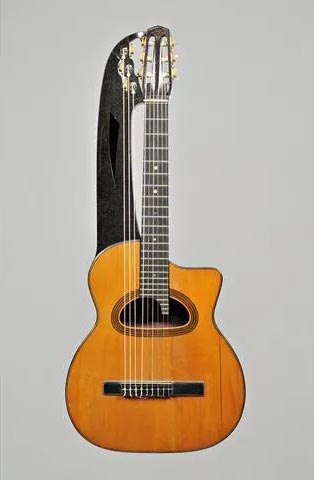
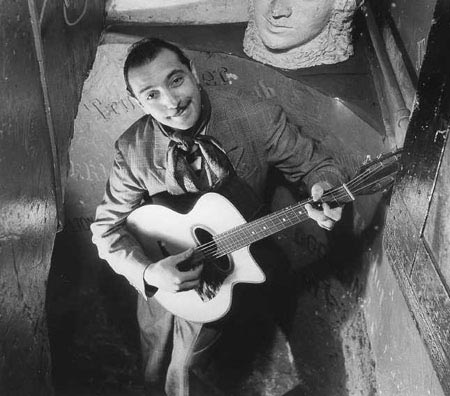
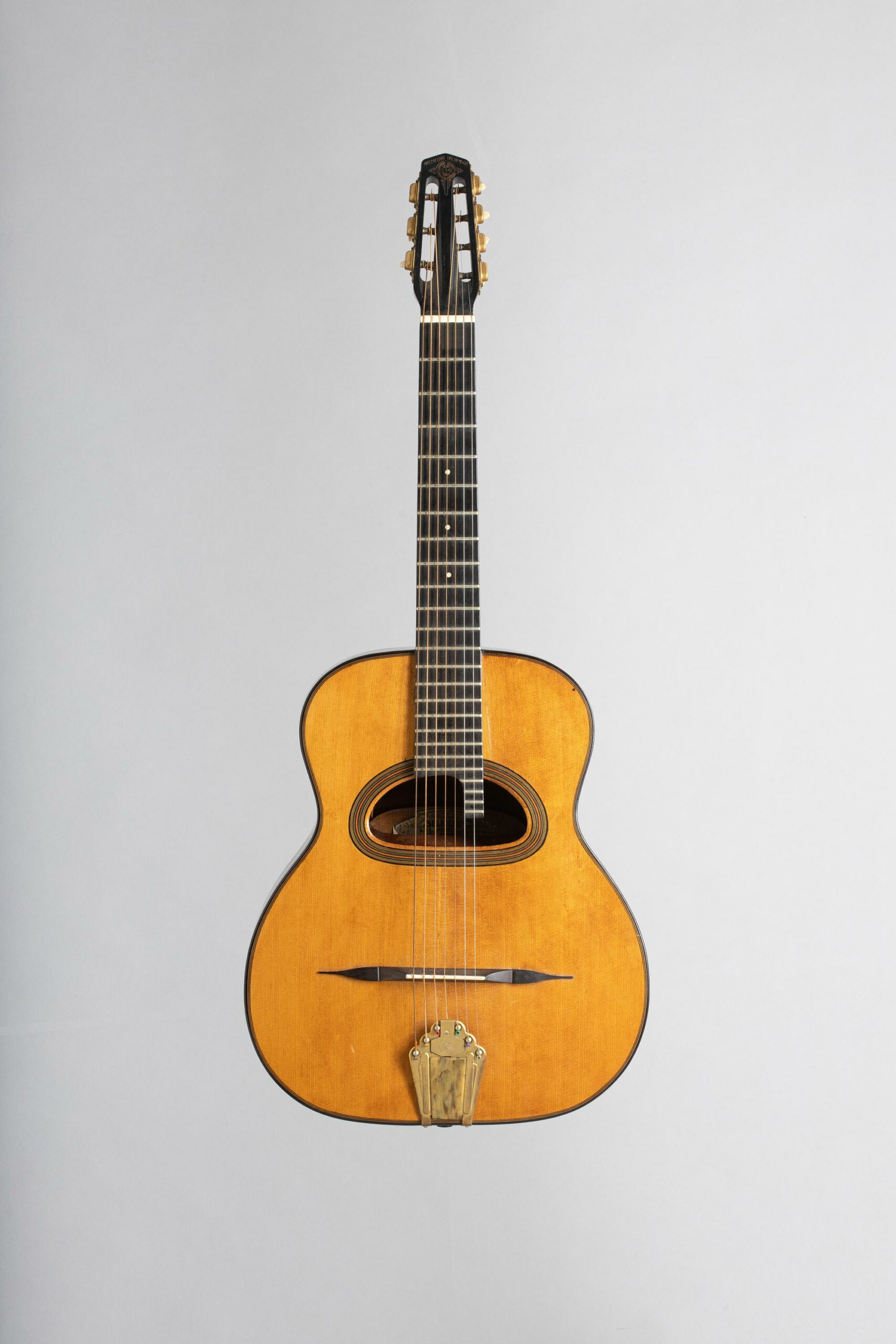

La guitare n°624 appartient à une phase très spécifique de l’histoire des guitares Selmer. Après l’essor spectaculaire des années 1930, largement porté par la figure de Django Reinhardt, la production avait été profondément affectée par la guerre. Les difficultés d’approvisionnement, la désorganisation industrielle et la mobilisation des ouvriers avaient entraîné un ralentissement considérable, jusqu’à une quasi-interruption au début des années 1940.
Comme le souligne François Charle dans son ouvrage dédié à la Selmer Maccaferri, la fabrication ne reprend véritablement qu’en 1946, à partir du numéro de série 590[1]. Cette reprise s’effectue sous la direction de Lucien Guérinet, figure centrale de l’atelier depuis ses débuts aux côtés de Mario Maccaferri. Resté seul pendant la guerre pour assurer quelques réparations et préparer des éléments de caisse, Guérinet se voit confier la tâche de relancer la production avec une équipe réduite. Dans ce contexte, chaque instrument fabriqué au sortir de la guerre revêt une importance particulière.
[1] François Charle, L’histoire des guitares Selmer Maccaferri, 2008
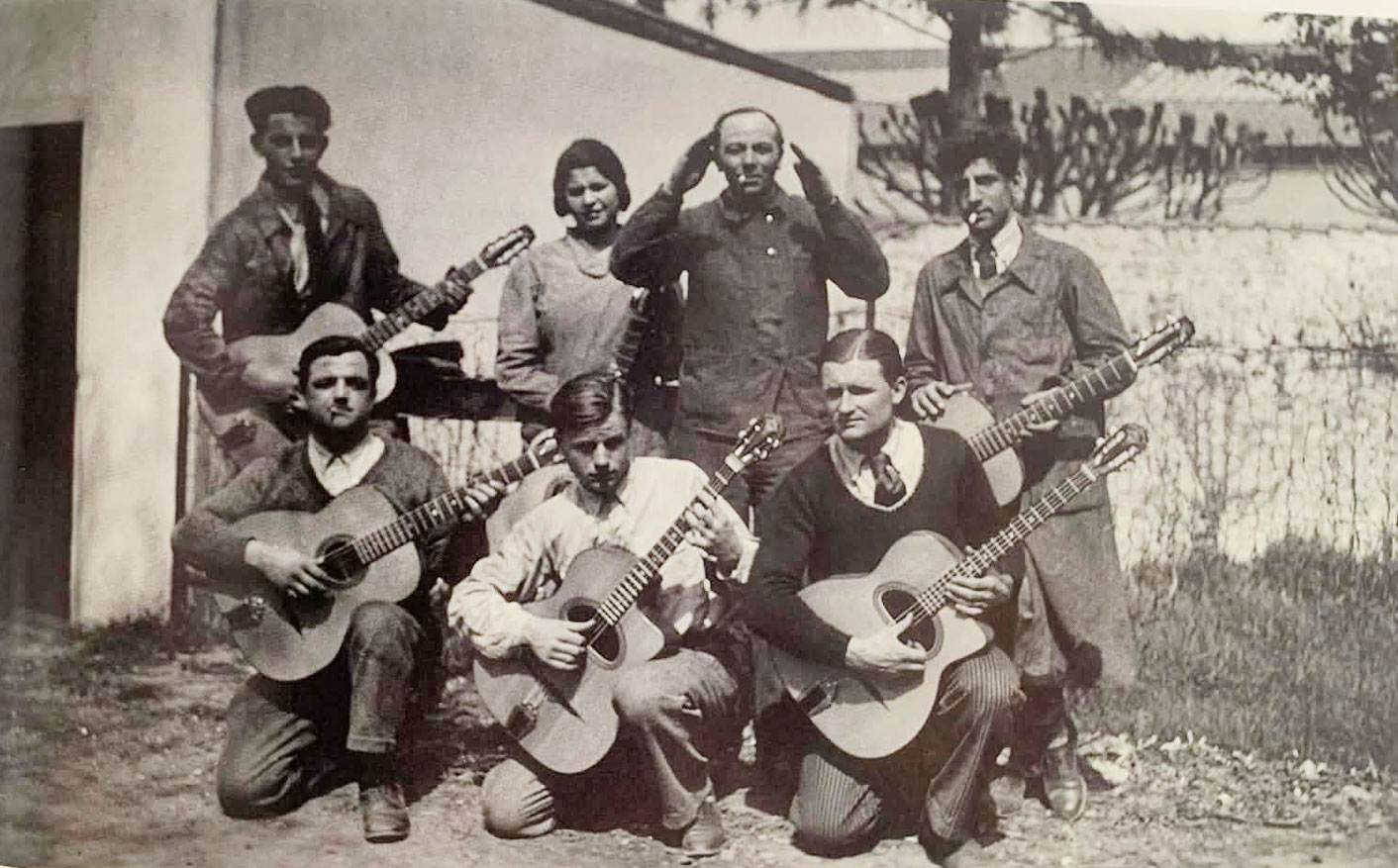
La guitare n°624, réalisée dès cette première année de reprise, appartient donc à un corpus restreint d’instruments qui témoignent de la continuité d’un savoir-faire malgré les ruptures historiques. Elle incarne à la fois une forme de fidélité aux modèles d’avant-guerre et une adaptation aux contraintes nouvelles de production, qui en font un véritable document historique.



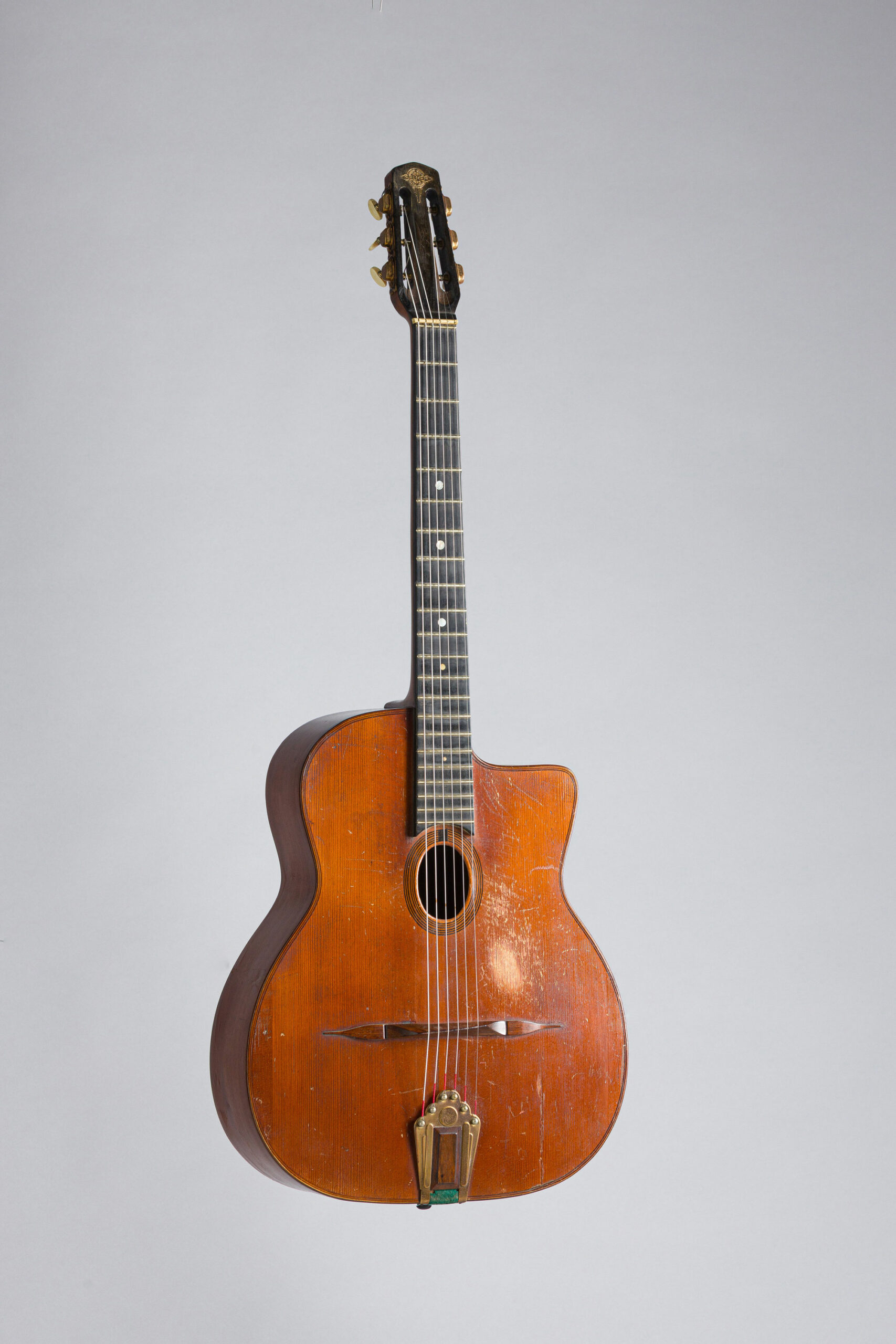
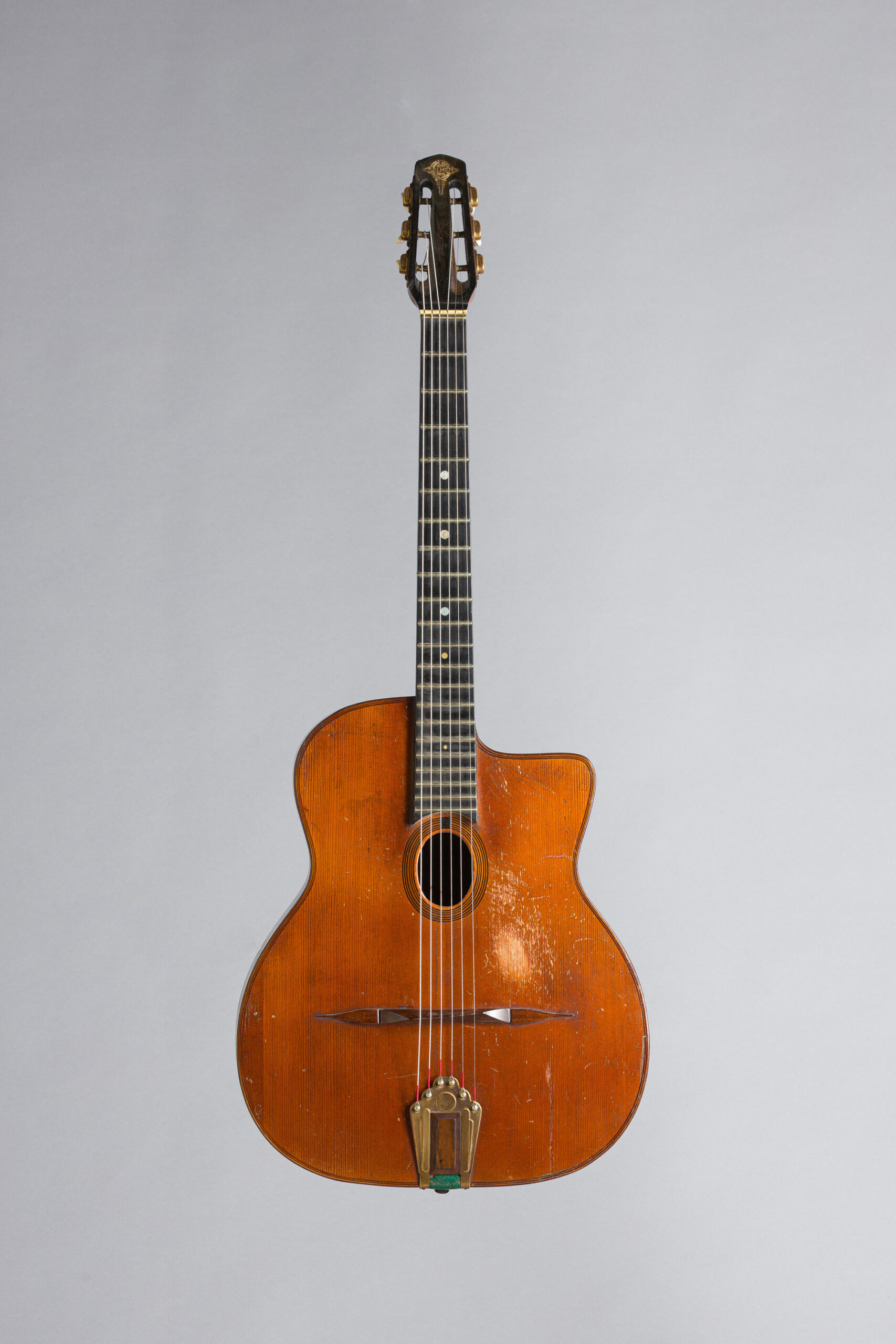
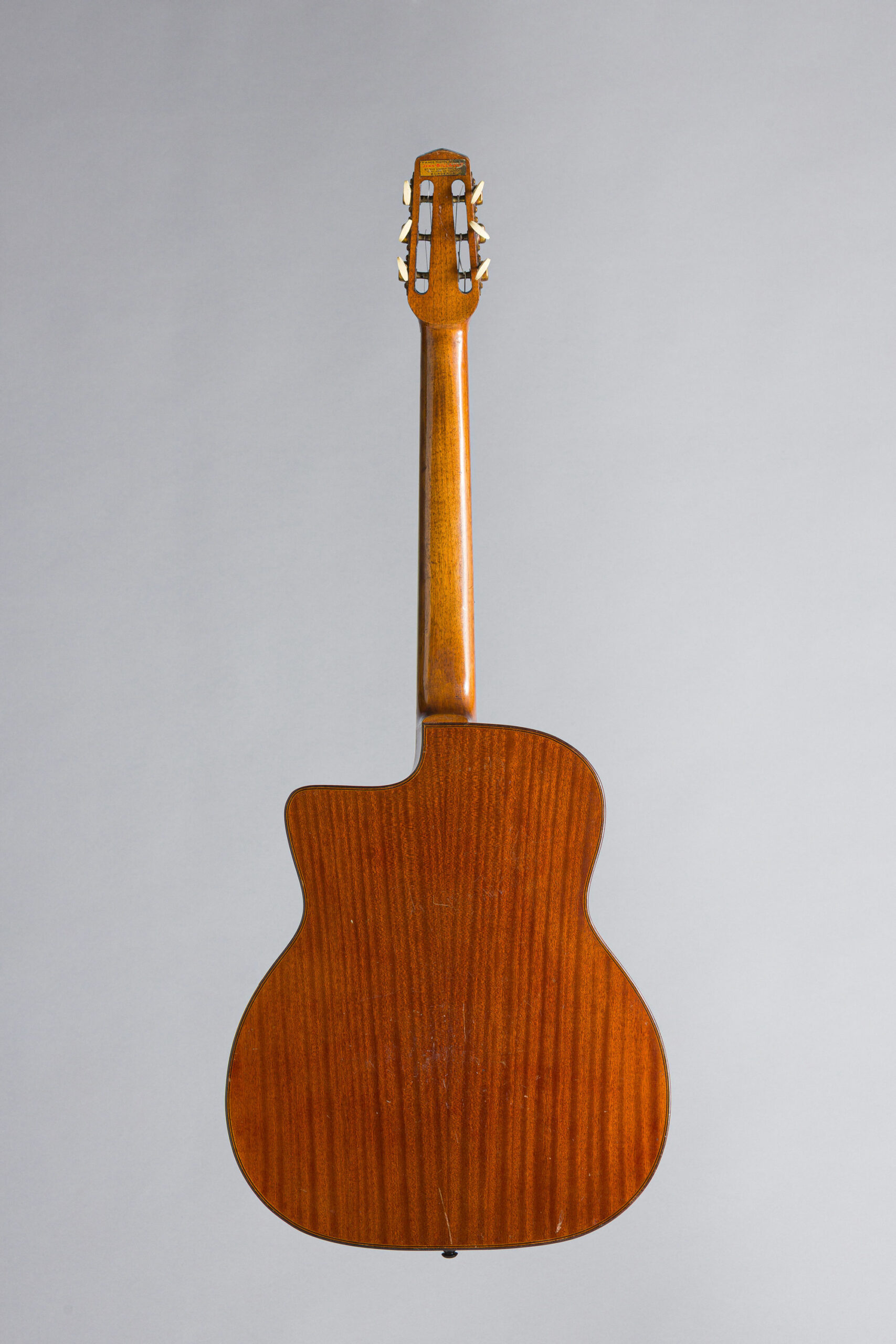
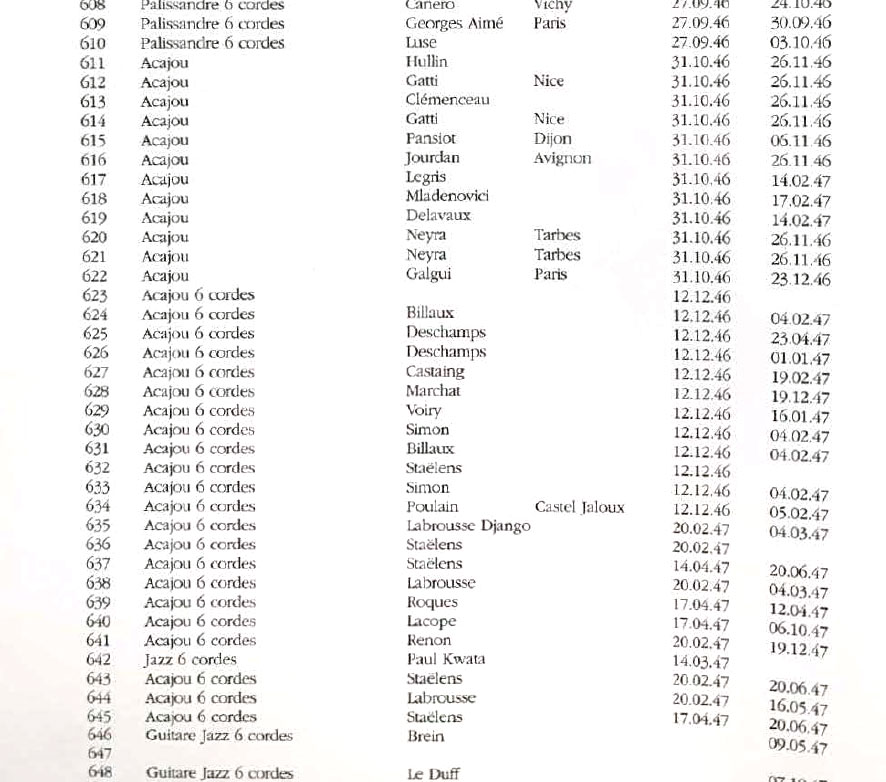
L’intérêt de ce modèle se trouve renforcé par son appartenance à une série précisément identifiée dans les travaux de François Charle. Entre les numéros 611 et 645 – soit un ensemble de seulement trente-quatre guitares – Selmer utilise un placage extérieur en acajou pour le fond et les éclisses.
Cette particularité s’explique directement par les conditions matérielles de l’époque. Les stocks de bois étant limités et irréguliers, les ateliers Selmer s’adaptent aux arrivages disponibles, produisant ainsi des séries relativement homogènes sur le plan des matériaux. Ces variations, initialement liées aux contraintes d’approvisionnement, constituent aujourd’hui des repères précieux pour comprendre la production Selmer. La guitare n°624, réalisée en plein cœur de cette série, bénéficie donc d’une double singularité : celle d’un instrument de la reprise d’après-guerre et d’un modèle appartenant à un groupe restreint, identifiable et documenté. Le choix de l’acajou, en lieu et place du palissandre plus couramment utilisé, confère en outre à l’instrument une esthétique particulière et participe à sa personnalité sonore.
Sur le plan organologique, la guitare n°624 correspond pleinement au modèle Selmer dit “Jazz”, dont les caractéristiques se fixent à partir du milieu des années 1930, après la période de transition qui suit le départ de Maccaferri.
Elle adopte ainsi la petite bouche ovale, devenue emblématique des modèles sans résonateur, ainsi qu’un manche à quatorze cases hors caisse – une évolution déterminante qui permet un accès élargi aux registres aigus et répond aux exigences des guitaristes solistes.
La structure interne de l’instrument repose sur un barrage à quatre barres d’harmonie, caractéristique des modèles de la seconde époque.
La table d’harmonie, constituée ici de quatre parties dont deux chanteaux, témoigne d’une adaptation aux contraintes d’approvisionnement tout en conservant les propriétés acoustiques recherchées.
Le manche, entièrement réalisé dans une seule pièce de noyer incluant la tête, la poignée et le talon, est particulièrement remarquable.
L’ensemble de ces caractéristiques place la n°624 dans la pleine maturité du modèle Selmer, tel qu’il fut adopté par Django Reinhardt et par de nombreux guitaristes de jazz, de swing et de musette.
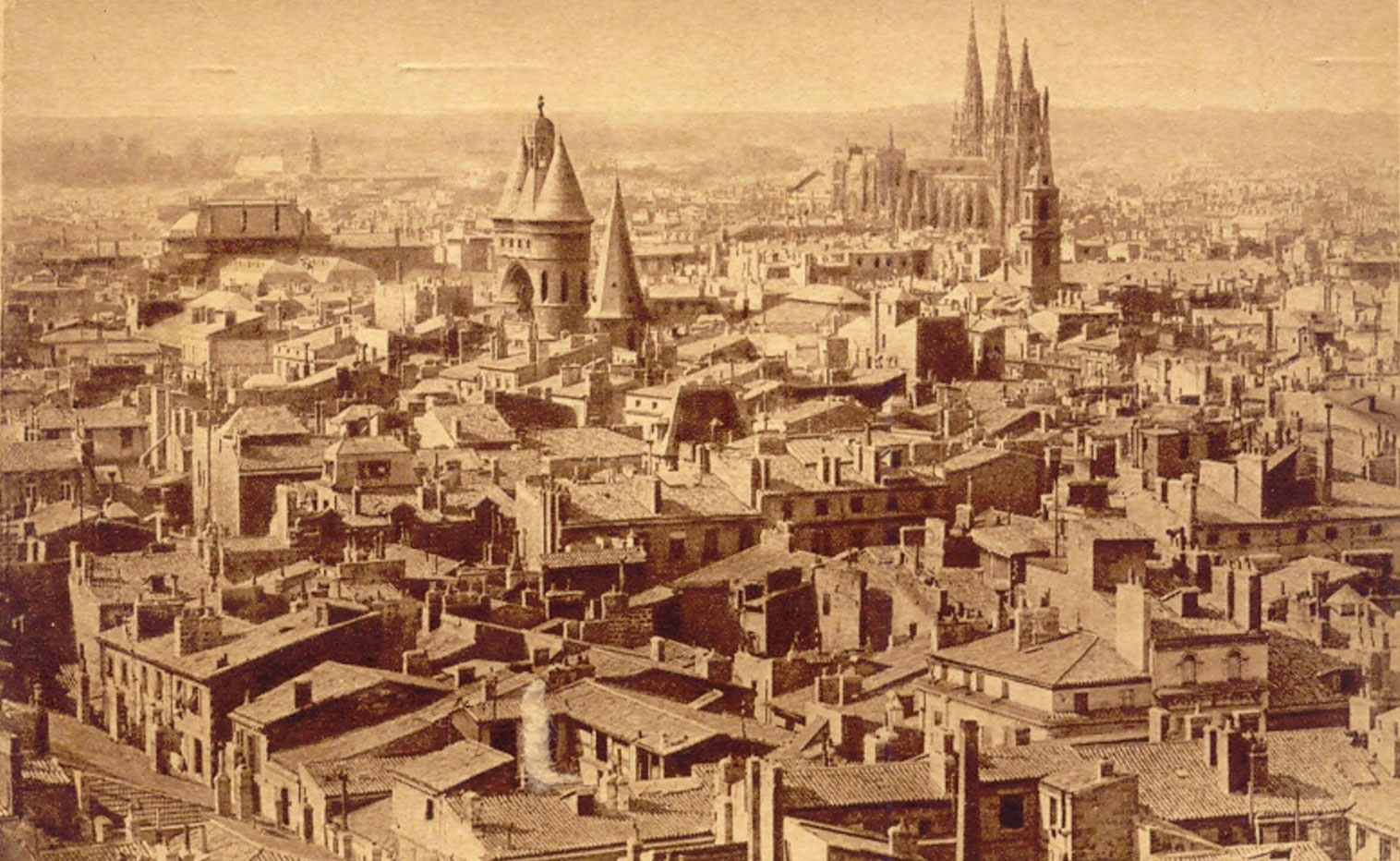
Au-delà de ses qualités intrinsèques, la guitare n°624 se distingue par une provenance précisément documentée. Tout d’abord, elle comprend son étiquette d’origine à l’intérieur et sur le fond. Ensuite, elle est mentionnée et numérotée dans les registres de la maison Selmer, registres qui nous apprennent également que la guitare a été commandée par Jean Billault, marchand d’instruments à Bordeaux, et livrée en 1947. Cette information est confirmée par l’étiquette du marchand, apposée à l’arrière de la tête.
Elle permet de retracer l’histoire de l’instrument, illustrant le rôle des marchands régionaux dans la diffusion des guitares Selmer.
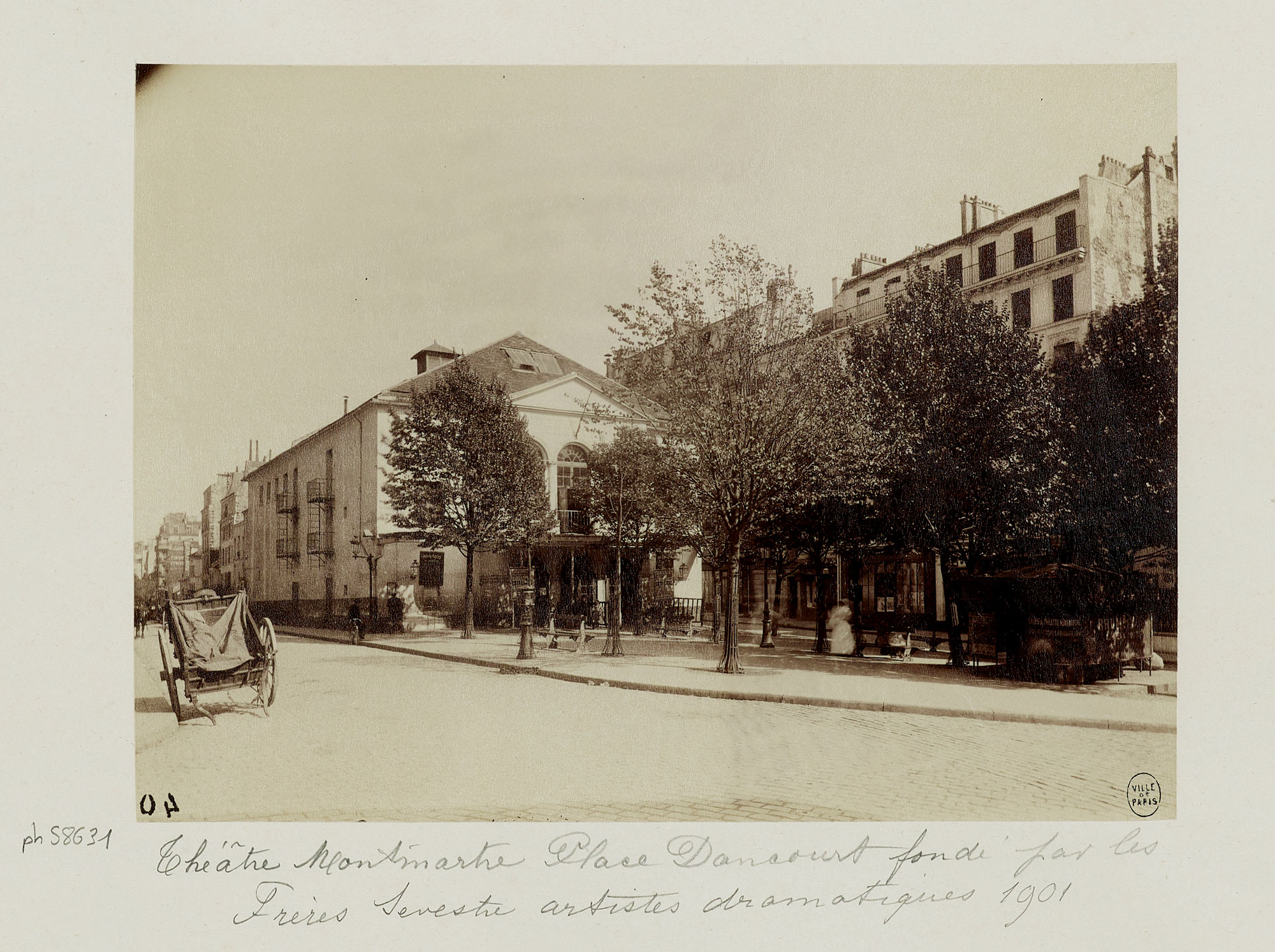
Ainsi, si la boutique parisienne de la place Dancourt demeurait le principal point de vente, une part non négligeable de la production était aussi écoulée en province. La n°624 témoigne de cette circulation des instruments à l’échelle du territoire français, participant à la diffusion du modèle Selmer dans toute la France.
Cette guitare a également la particularité d’être dans un bon état de conservation. Elle a conservé l’essentiel de ses éléments d’origine, parmi lesquels les mécaniques, le cordier et son feutre, le chevalet, le bouton d’attache courroie, les frettes, le sillet en galalithe, ainsi que le vernis.
Une telle intégrité est rare pour des instruments de cette époque, souvent soumis à un usage intensif et à des interventions parfois lourdes. La n°624 présente au contraire une usure mesurée, cohérente avec son âge, qui n’altère ni sa lisibilité historique ni sa fonctionnalité (pour plus d’informations sur l’état, consultez la notice de l’expert, Jérôme Casanova).
À la croisée de l’histoire de la guitare et du marché des instruments, cette guitare Selmer n°624 apparaît ainsi comme un témoin particulièrement intéressant de la production d’après-guerre. Plus qu’un simple objet de collection, elle est le reflet de la capacité de la maison Selmer à développer un modèle devenu emblématique, tout en s’adaptant aux contraintes de son temps. Sa présence dans la vente du 2 mai 2026 offre ainsi l’opportunité d’acquérir un modèle recherché et historique.
On 2 May 2026, Vichy Enchères will offer at auction a Selmer guitar of particular interest: a 14-fret “small mouth” Jazz model, serial number 624, made in 1946 in Paris and delivered in 1947 to Jean Billault, a musical instrument dealer in Bordeaux. Its year of manufacture, documented provenance and remarkable condition make this instrument a remarkable testament to the revival of Selmer’s production in the aftermath of World War II.
The Selmer guitar no. 624, offered at auction, is part of a story that began in 1932, when the Henri Selmer company, which until then specialized in wind instruments, began manufacturing guitars in collaboration with the Italian maker Mario Maccaferri. He developed an innovative instrument designed to meet the demands of the nascent jazz scene, particularly in terms of sound projection, thanks to an enlarged body, an internal resonator and a D-shaped soundhole, known as a “big mouth”[1].
[1] François Charle, L’histoire des guitares Selmer Maccaferri, 2008
These guitars were quickly adopted by musicians, notably Django Reinhardt, and became a benchmark. After Maccaferri’s departure in 1933, production continued and gradually evolved over the following years, before settling, on the eve of World War II, to a form that would become associated with Gypsy jazz. Production was interrupted during the war and did not truly resume until 1946, the year guitar no. 624 was made, which places it within this revival phase in Selmer’s production.
Guitar no. 624 belongs to a very particular phase in the history of Selmer guitars. After its spectacular rise in the 1930s, largely driven by Django Reinhardt, Selmer’s production was profoundly affected by the war. Issues with the supply chain, industrial disruption and worker mobilization led to a considerable slowdown, until an almost complete halt in production in the early 1940s.
As François Charle points out in his book dedicated to the Selmer Maccaferri guitar, production did not truly resume until 1946, starting with serial number 590[1]. This restart took place under the direction of Lucien Guérinet, who, alongside Mario Maccaferri, had been a central figure in the workshop since its outset. Guérinet, who continued working on his own in the workshop during the war, carrying out repairs and preparing body parts, was tasked with restarting production with a small team. In this context, each instrument manufactured after the war took on particular significance.
[1] François Charle, L’histoire des guitares Selmer Maccaferri, 2008
Guitar no. 624, made in the very first year the company resumed production, belongs to a small group of instruments that demonstrate the continuity of the company’s craftsmanship despite the disruptions of the war. It embodies both a desire to stay true to pre-war models and the need to adapt to new production constraints, making it an object of true historical significance.
This example is all the more interesting for being part of a production batch specifically referenced in the work of François Charle. For its guitars bearing serial numbers between 611 and 645 – i.e., a series of only 34 guitars – Selmer used mahogany veneer for the back and sides.
This unique feature is directly attributable to the availability of materials at the time. Due to wood supplies being limited and unpredictable, the Selmer workshops had to adapt to what could be sourced, and therefore produced batches of instruments that were relatively consistent in terms of materials used. These variations in materials, which were the result of shortages, now constitute valuable clues in understanding Selmer’s production. Guitar no. 624, which is part of this batch, is therefore interesting for both being one of the instruments produced during the post-war revival period, as well as being part of a small, identifiable and documented group. The choice of mahogany, instead of the more commonly used rosewood, also gives the instrument a distinctive appearance and contributes to its unique sound.
From a technical standpoint, guitar no. 624 corresponds in all aspects to the Selmer “Jazz” model, whose characteristics were established from the mid-1930s onward, after the transitional period following Maccaferri’s departure.
It therefore adopts the small oval soundhole, which is typical of models without a resonator, as well as a 14-fret neck – a significant evolution that extended access to the higher registers and met the demands of solo guitarists.
The instrument’s internal structure is based on a four-bar bracing system, typical of second-era models.
The soundboard, made of four pieces, including two to extend its width, is evidence of the need to adapt to supply shortages while maintaining the desired acoustic properties.
The neck, made entirely from a single piece of walnut for the headstock, grip and heel, is particularly noteworthy.
All these features place guitar no. 624 at the heart of the mature period of the Selmer model, as adopted by Django Reinhardt and many jazz, swing and musette guitarists.
Beyond its inherent qualities, guitar no. 624 is remarkable for its meticulously documented provenance. Firstly, it retains its original label inside and on the back. Furthermore, it is listed and numbered in the Selmer company records, which also indicate that the guitar was ordered by Jean Billault, a musical instrument dealer in Bordeaux, and delivered to him in 1947. This information is confirmed by the dealer’s label affixed to the back of the headstock.
This label allows us to trace the instrument’s history, illustrating the role regional dealers played in the distribution of Selmer guitars. Therefore, while the Parisian shop on Place Dancourt remained the main point of sale, a significant portion of the production was also sold in the provinces. Guitar no. 624 illustrates the flow of instruments across France, which contributed to the spread of the Selmer model throughout the country.
This guitar is also notable for being in excellent condition. It has retained most of its original components, including the tuning machines, tailpiece and felt, bridge, strap button, frets, galalith nut, and finish.
Such original condition is rare for instruments of this era, as they were often victim of heavy use and sometimes extensive repairs. Instead, guitar no. 624 shows only moderate signs of wear, consistent with its age and which do not detract from its originality or functionality (for more information on its condition, please refer to the report by expert Jérôme Casanova).
This Selmer guitar no. 624, produced at a turning point in the history of the guitar and the instrument market, stands out as a particularly interesting example of post-war production. More than just a collector’s item, it reflects Selmer’s ability to develop a model that became iconic, while adapting to the constraints of the time. Its inclusion in the sale on 2 May 2026 is therefore an opportunity to acquire a sought-after and historic model.