La dispersion d’une collection offre souvent l’occasion de redécouvrir la personnalité de celui qui l’avait réunie. C’est particulièrement le cas de celle de Maurice Guyot (1884-1974), secrétaire général de la Fondation Victor Hugo et figure engagée dans la transmission de l’œuvre de l’écrivain tout au long du XXème siècle. Constituée au fil d’une vie consacrée à l’Université de Paris et aux études hugoliennes, sa collection réunit des œuvres qui témoignent autant de ses centres d’intérêt que des relations artistiques et intellectuelles qu’il entretint. L’ensemble conserve notamment un remarquable dessin de Victor Hugo, Souvenir d’une démolition réalisée en 1864, dont la provenance le rattache directement au premier cercle de l’écrivain. Cette feuille est naturellement le point d’orgue de la collection et permet d’en éclairer la cohérence.
Né à Coulommiers le 31 décembre 1884 et décédé à Paris le 28 avril 1974, Maurice Guyot effectue l’essentiel de sa carrière au sein de l’Université de Paris. Successivement secrétaire de l’Académie de Paris, puis secrétaire général de l’Université de Paris, il occupe des fonctions importantes dans l’administration universitaire française à une époque où les universités jouent un rôle essentiel dans le développement de la recherche, la diffusion du savoir et la préservation du patrimoine intellectuel.
Cet engagement le conduit naturellement à prendre part aux initiatives consacrées à la figure de Victor Hugo. Dès les années 1920, il participe au projet de création d’une Chaire Victor Hugo à la Sorbonne, dont il est le trésorier du comité de patronage. Cette entreprise vise à assurer une pérennité de l’étude de l’œuvre de Victor Hugo au sein de l’enseignement supérieur, à la faire connaître davantage et à encourager les recherches consacrées à l’écrivain. Installée au 5, rue de la Sorbonne, elle réunit universitaires, érudits, descendants de Victor Hugo et amateurs autour d’un objectif commun – celui de préserver et transmettre l’héritage de l’auteur des Misérables[1].
Il participe également à la relance de l’institution après la Seconde Guerre mondiale[2].
[1] Maurice Guyot, “La fondation Victor Hugo va renaître”, Le Monde, 5 décembre 1962.
[2] Bulletin de la Fondation Victor Hugo, 1930.
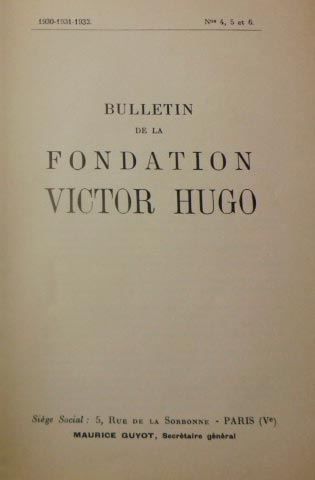
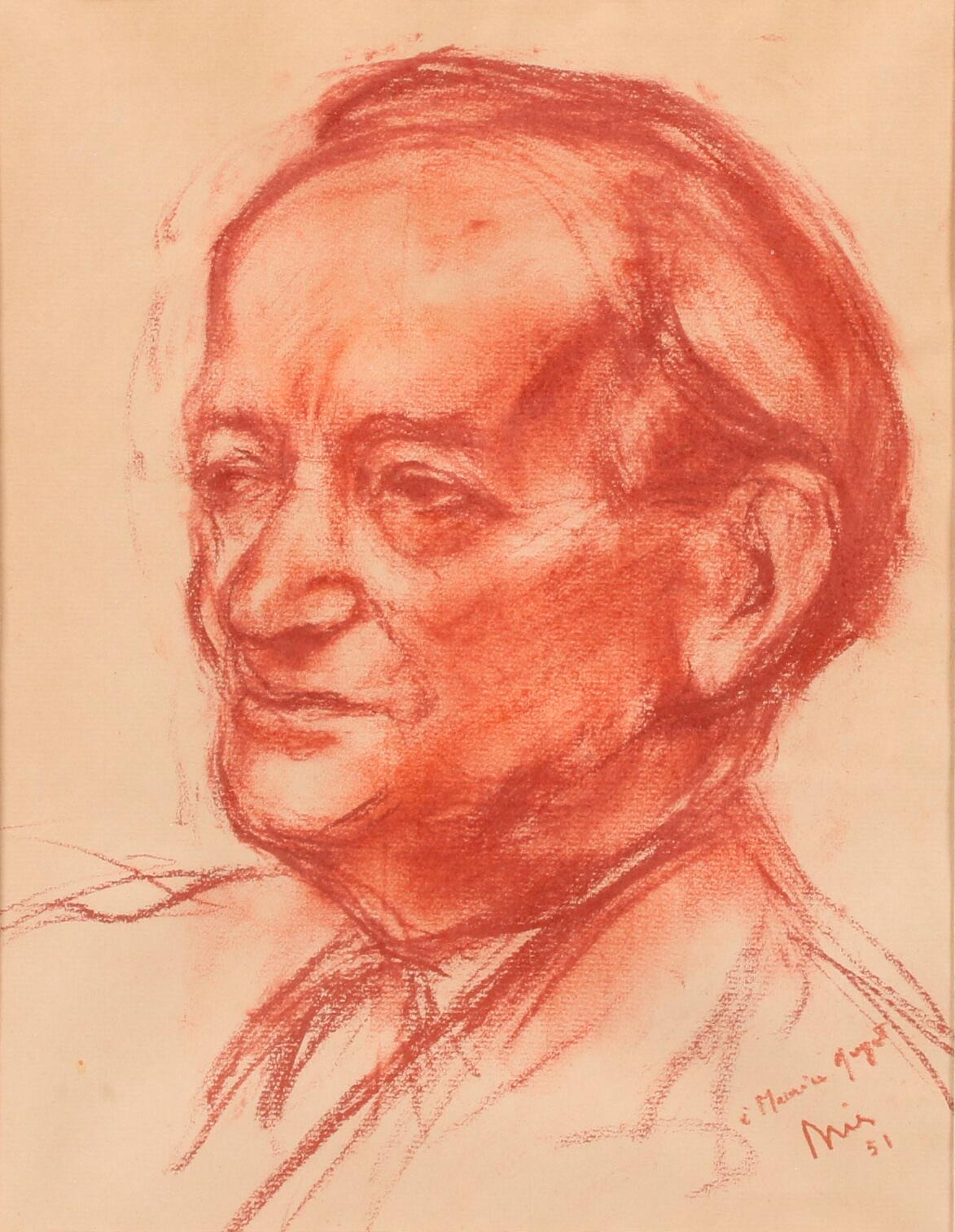
Cette position éclaire la présence, dans sa collection, d’œuvres et de souvenirs liés à Victor Hugo. Il est juste de voir dans sa collection le prolongement naturel de son engagement. Pour le secrétaire général de la Fondation Victor Hugo, conserver un dessin de l’écrivain, provenant de son cercle proche, ne relevait pas d’un simple goût privé, mais témoignait d’un attachement fort à l’œuvre hugolienne.
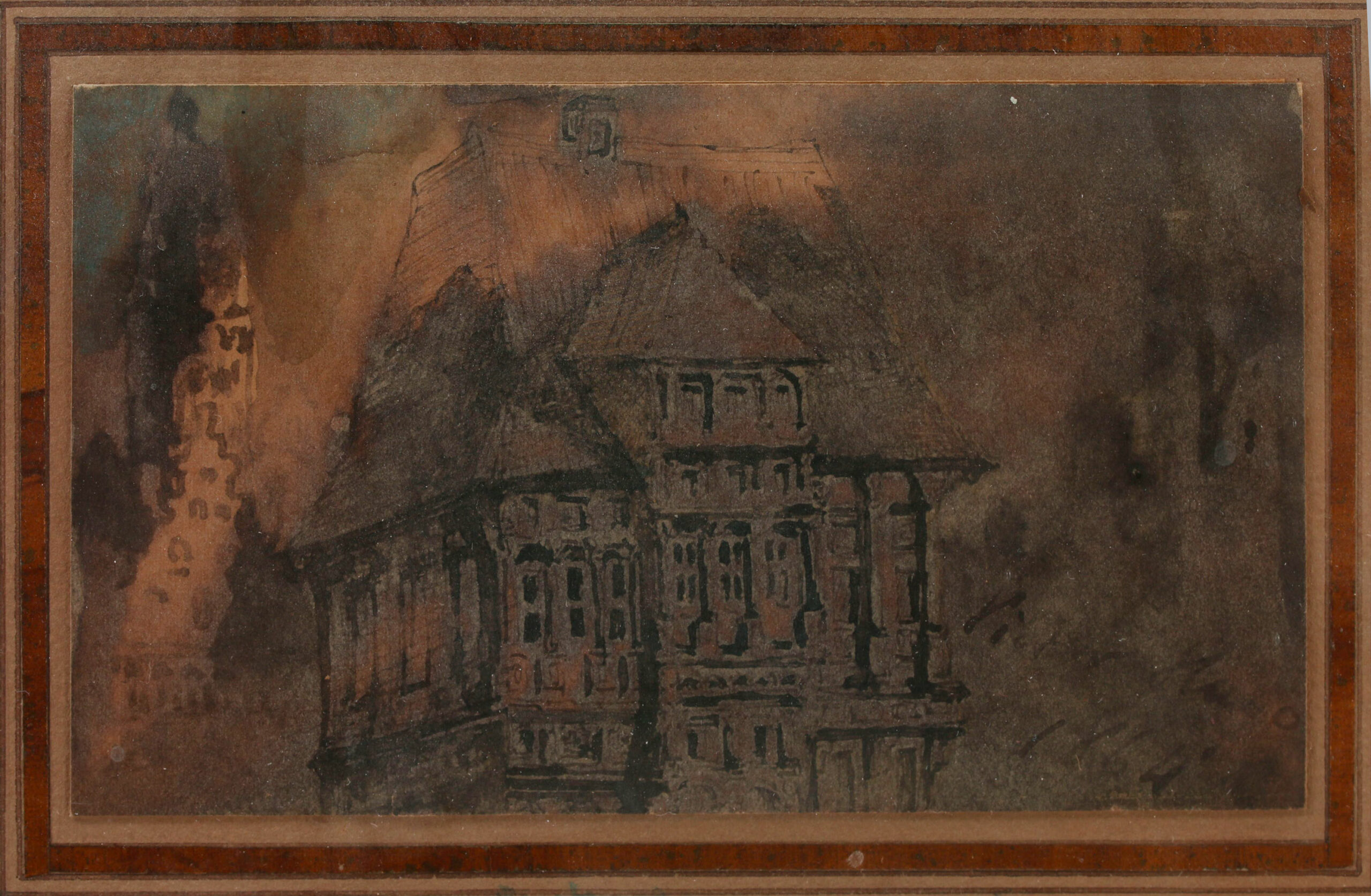
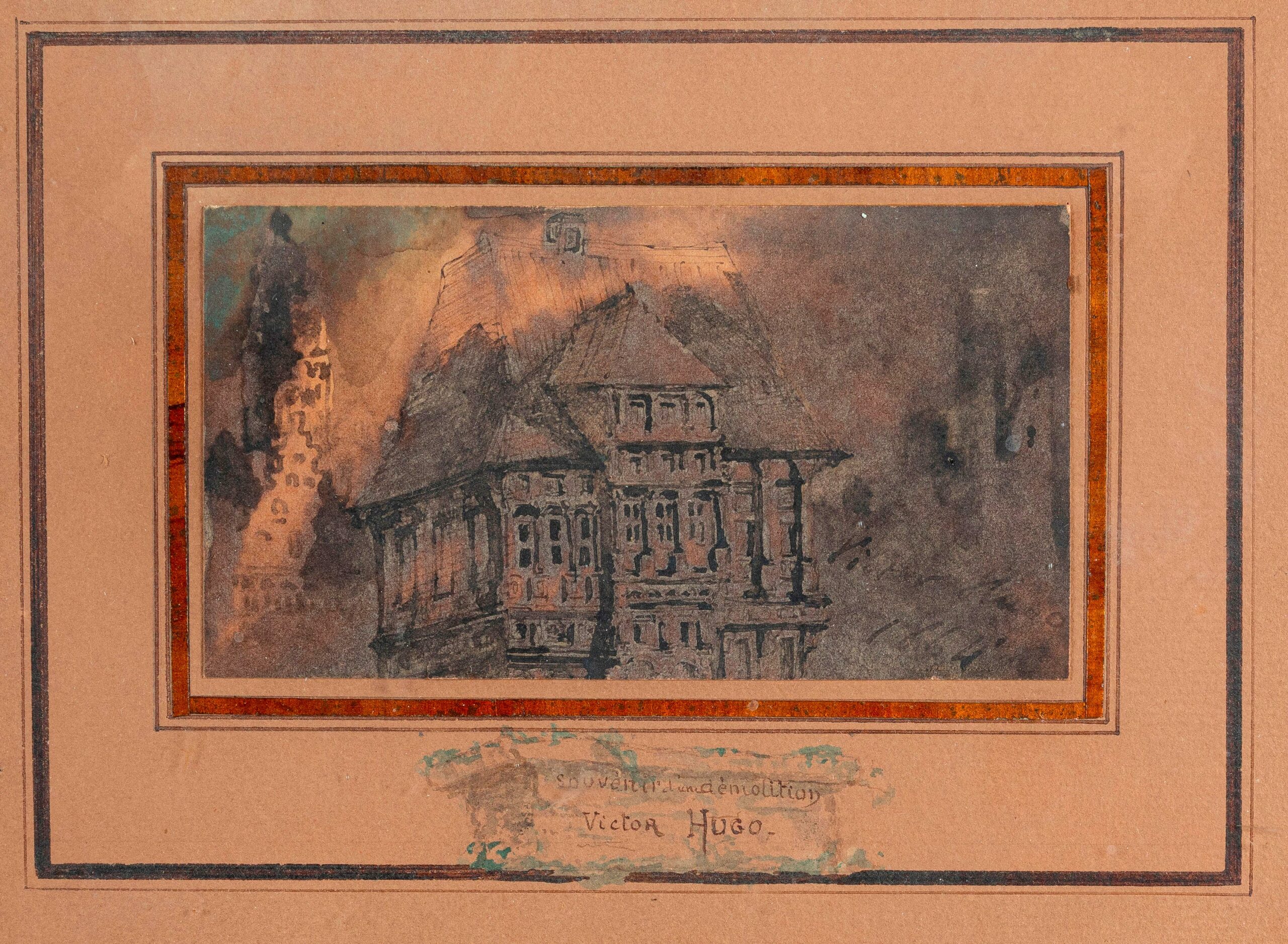
Parmi les œuvres réunies par Maurice Guyot, Souvenir d’une démolition occupe une place particulière. Ce dessin signé et daté “Victor Hugo 1864”, appartient à la période d’exil de l’écrivain à Guernesey.
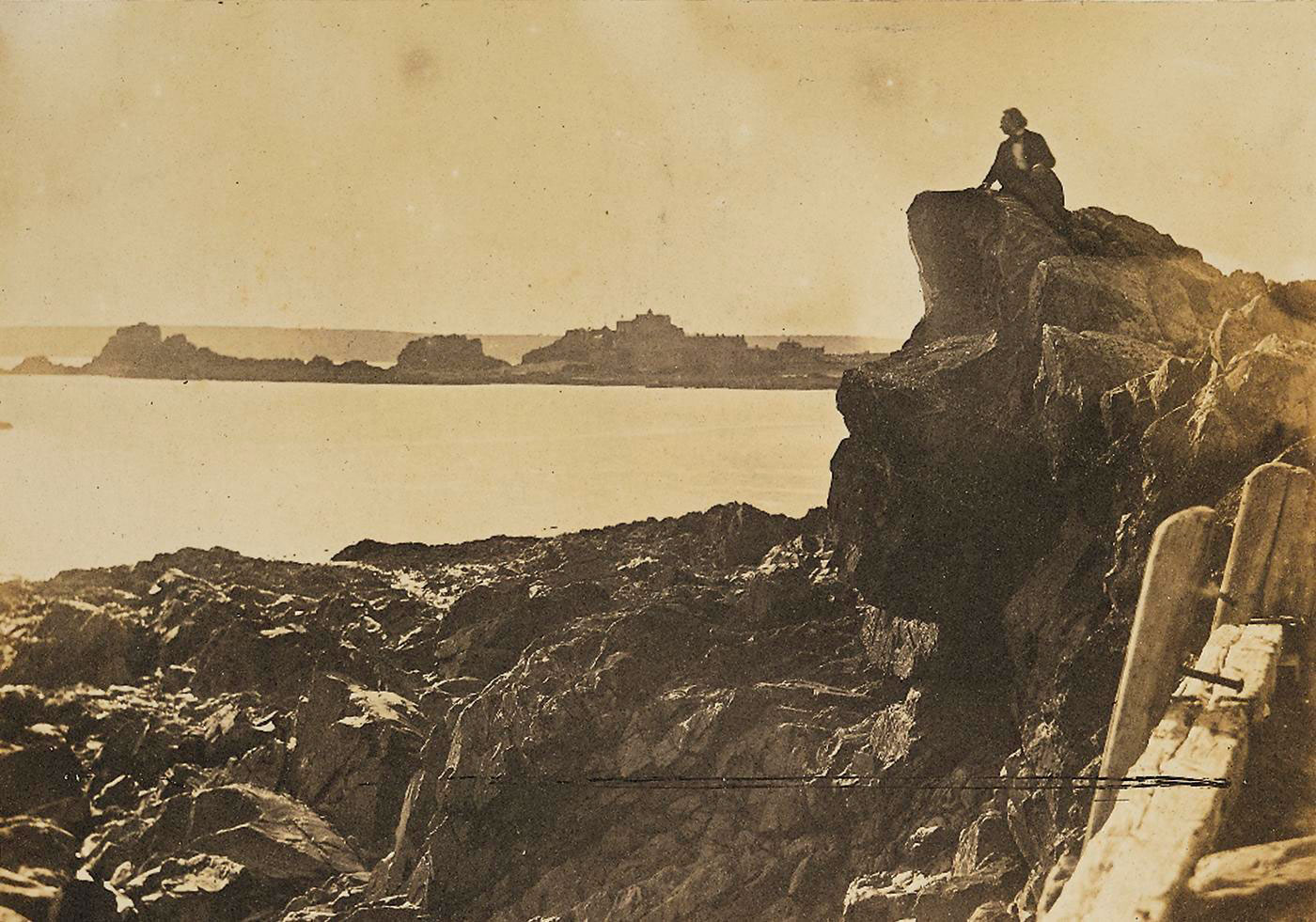
L’année 1864 correspond à une phase importante de son activité créatrice. Victor Hugo travaille alors à la rédaction des Travailleurs de la mer, roman publié deux ans plus tard, tandis que sa production graphique connaît un développement remarquable. Dessins, carnets et lavis accompagnent tout au long de sa vie son travail littéraire.
Le dessin ayant appartenu à Maurice Guyot représente un manoir dont l’esthétique s’inscrit dans celle du romantisme noir qui traverse une partie de l’œuvre graphique de Victor Hugo. Le titre, Souvenir d’une démolition, évoque la disparition d’un édifice autant qu’il invite à une réflexion mélancolique sur la mémoire des lieux et leurs ruines. Comme de nombreuses encres exécutées par Victor Hugo, les effets de lavis et de silhouettes architecturales fantomatiques composent un paysage à la frontière du rêve et de la réalité.
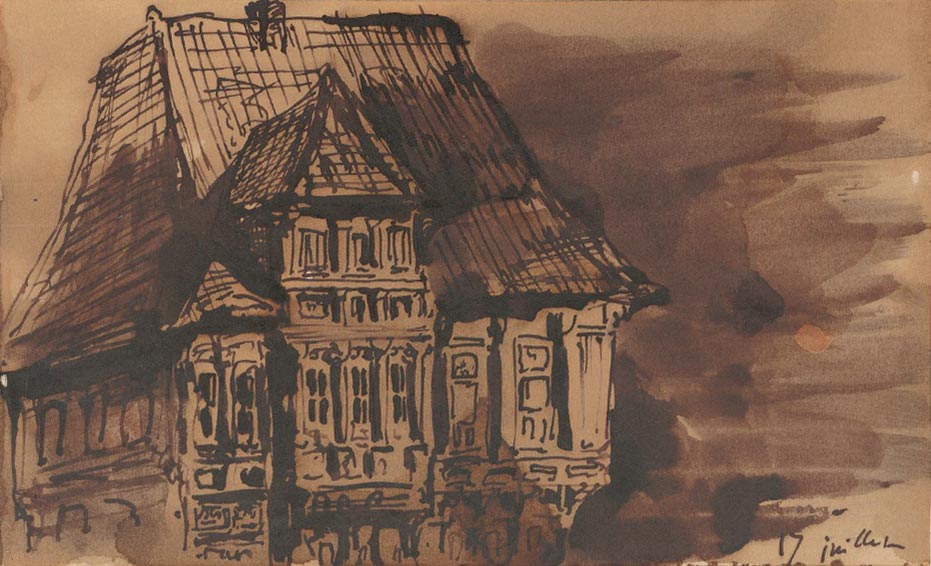
L’intérêt de ce dessin est renforcé par son rapprochement avec un carnet conservé à la Bibliothèque nationale de France sous la cote NAF 13459. Commencé le 24 mai 1864, ce carnet rassemble les premières notes préparatoires des Travailleurs de la mer, des cartes des récifs autour de Guernesey ainsi que plusieurs dessins. Le même manoir y figure au folio 81 verso. Les derniers feuillets du carnet ayant été complétés lors du voyage de Victor Hugo à Bruxelles en juillet 1865, certains détails architecturaux, notamment les pignons à gradins visibles sur l’édifice situé à gauche de la composition, nous conduisent à proposer aussi une origine bruxelloise pour ce manoir.
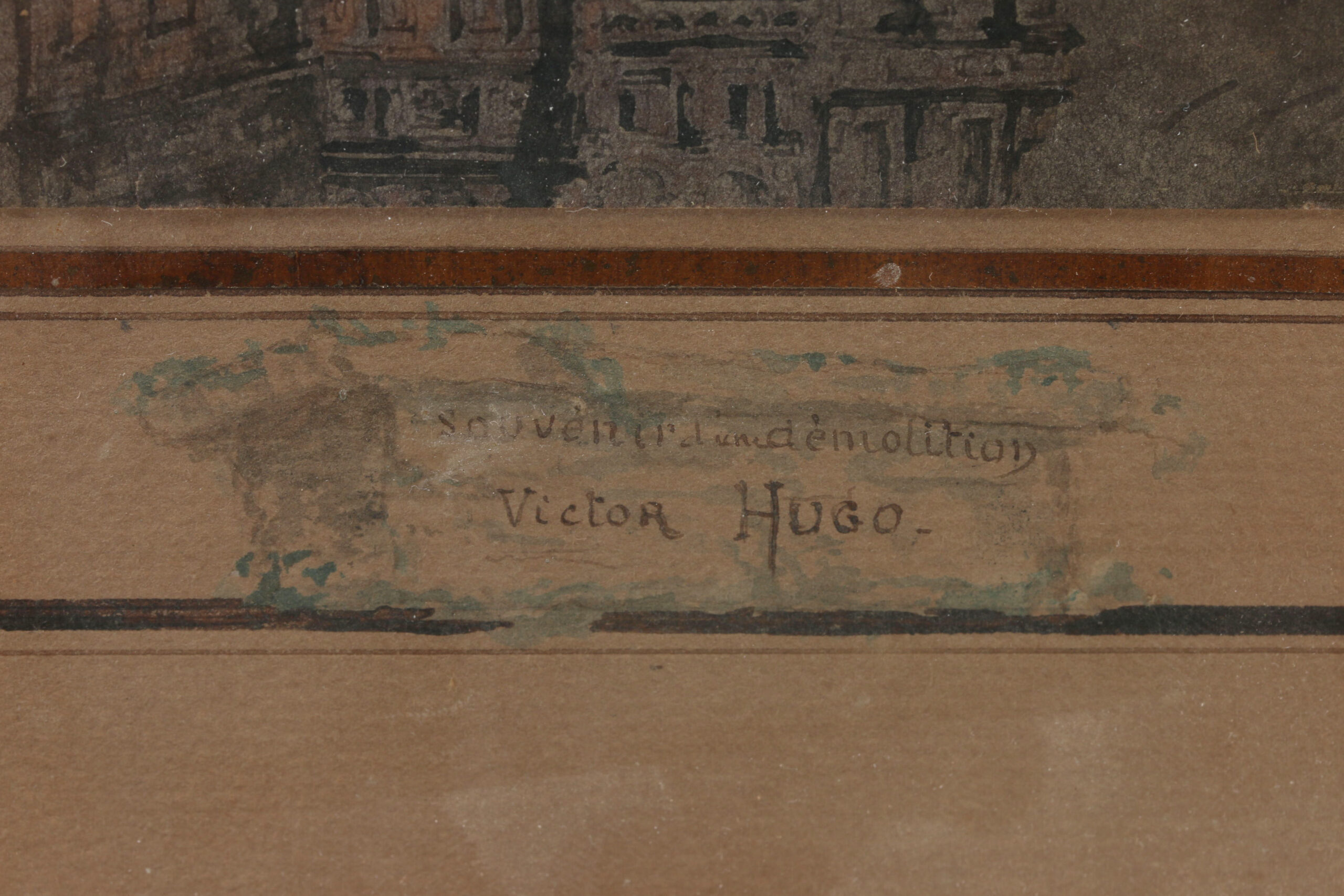
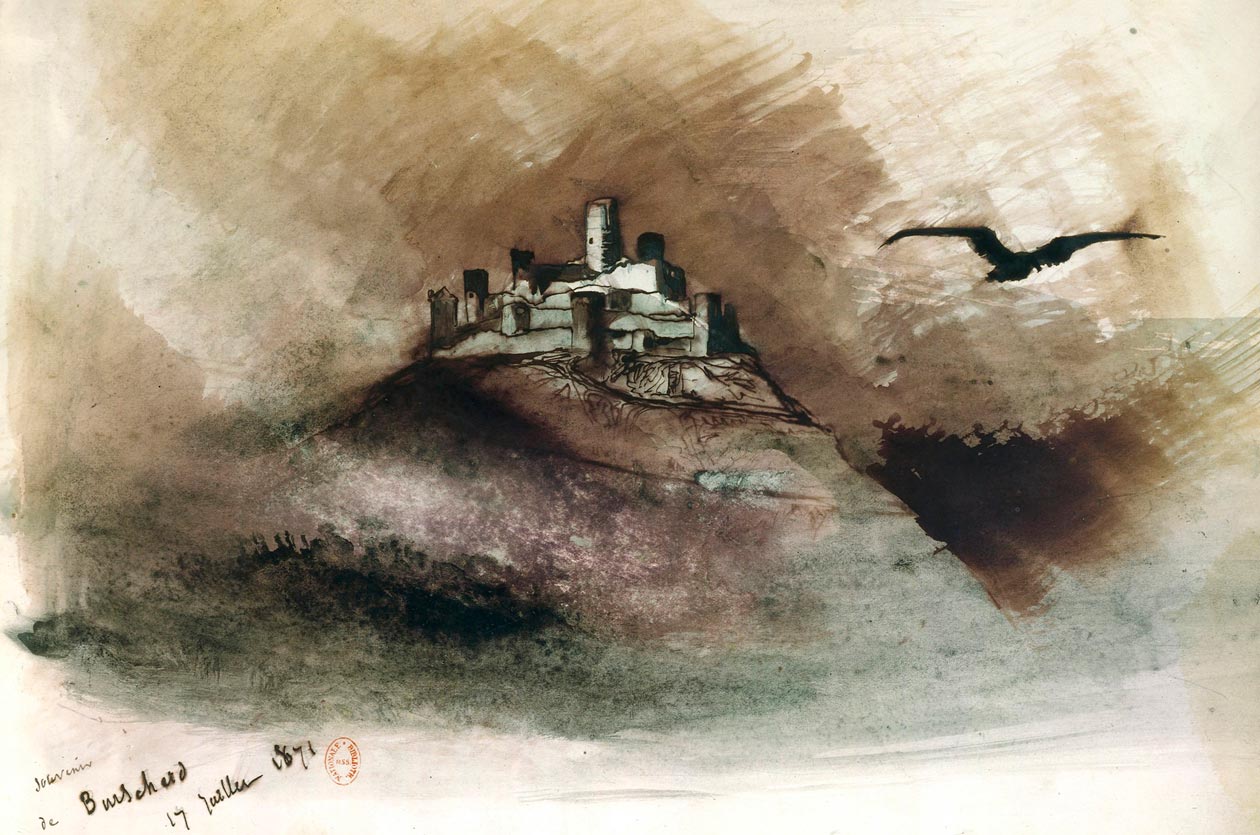
Au-delà de ses qualités artistiques, ce dessin présente un intérêt historique remarquable par la qualité de sa provenance, qui peut être retracée avec une rare précision grâce aux documents conservés.
Le dessin appartint d’abord à Pierre Lefèvre-Vacquerie, membre de la famille Vacquerie, intimement liée à Victor Hugo depuis le mariage de Léopoldine Hugo avec Charles Vacquerie. Il est ensuite conservé par Gustave Simon, proche de Victor Hugo, témoin de son mariage avec Sarah Sourdis en 1879, et éditeur de plusieurs œuvres posthumes et nouvel exécuteur testamentaire de l’écrivain. À la mort de Gustave Simon, le dessin est transmis à sa fille Marguerite Simon, avant de rejoindre la collection de Georges Van den Plas, puis celle de Maurice Guyot.
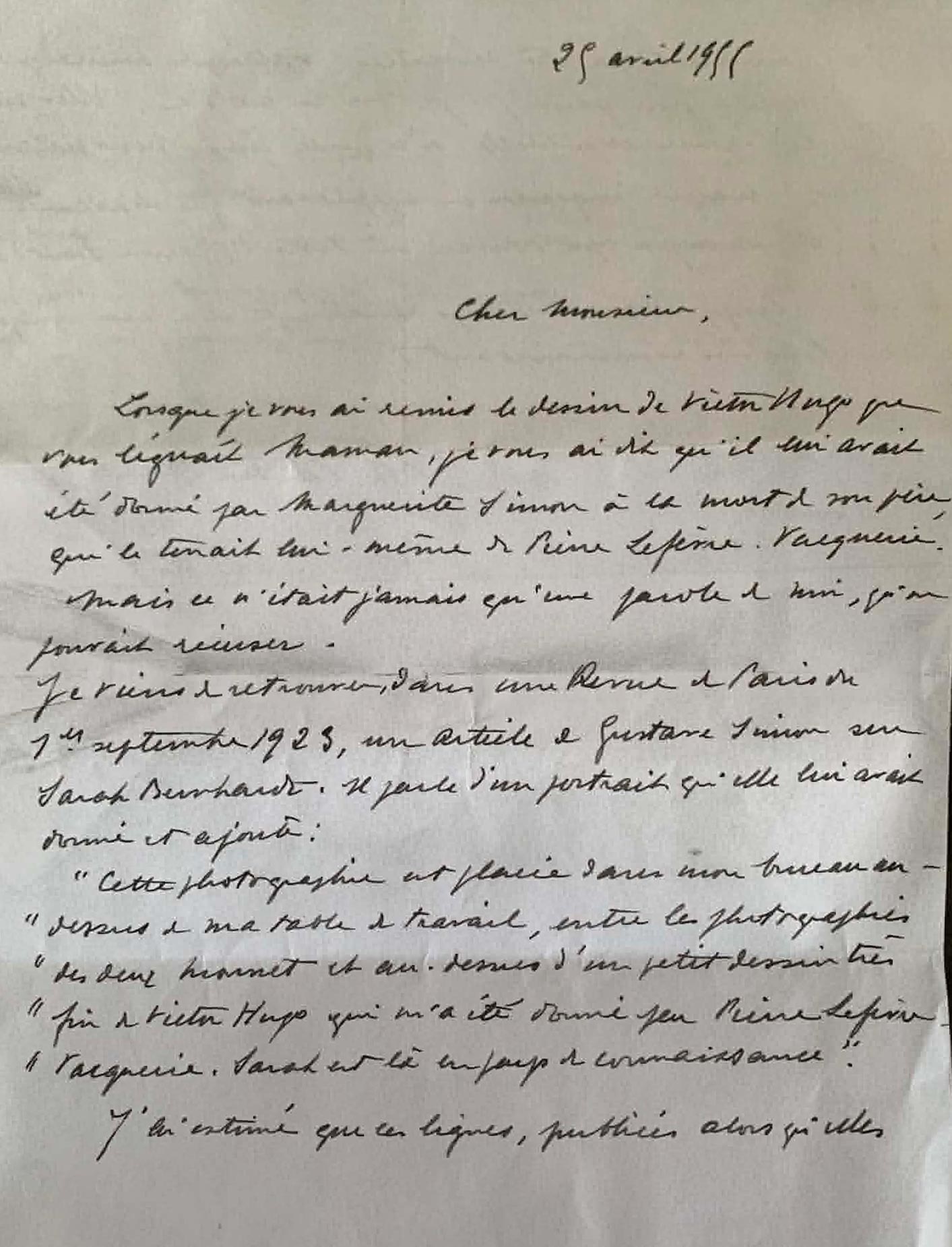
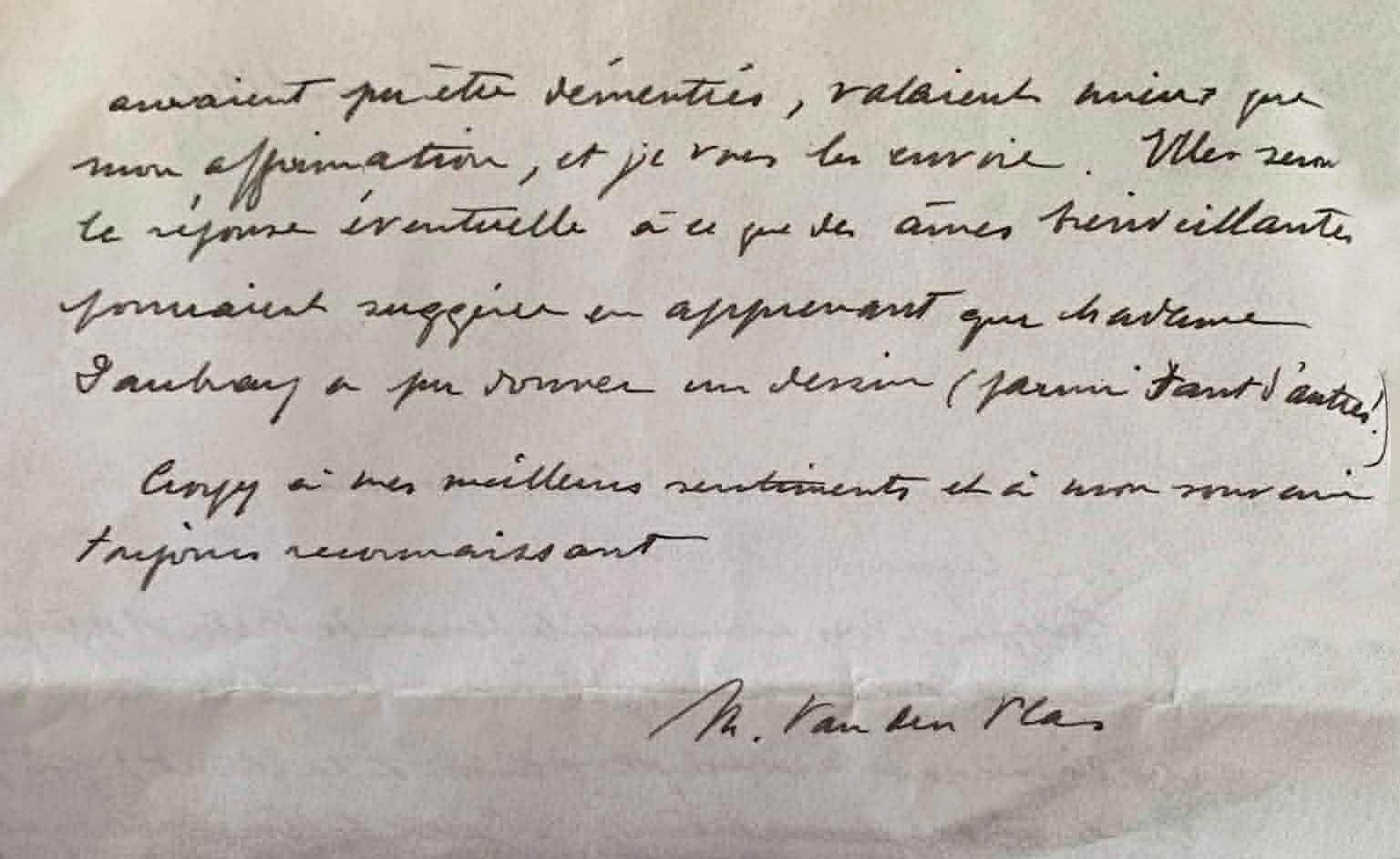
Une lettre adressée à Maurice Guyot par Georges Van den Plas le 29 avril 1956 revient sur ces éléments de provenance.
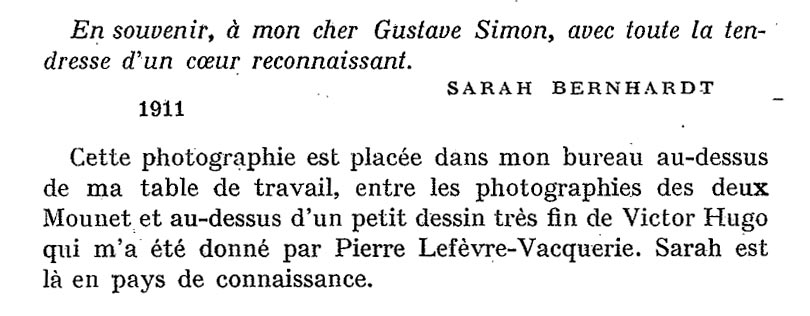
« Lorsque je vous ai remis le dessin de Victor Hugo que vous léguait Maman, je vous ai dit qu’il lui avait été donné par Marguerite Simon à la mort de son père, qui le tenait lui-même de Pierre Lefèvre-Vacquerie. Mais ce n’était jamais qu’une parole de moi, qu’on pouvait récuser. Je viens de retrouver, dans la Revue de Paris du 1ᵉʳ septembre 1923, un article de Gustave Simon sur Sarah Bernhardt. Il parle d’un portrait qu’elle lui avait donné et ajoute : “Cette photographie est placée dans mon bureau au-dessus de ma table de travail, entre les photographies des deux Mounet et au-dessus d’un petit dessin très fin de Victor Hugo qui m’a été donné par Pierre Lefèvre-Vacquerie. Sarah est là en pays de connaissance.” »
Lettre adressée à Maurice Guyot par Georges Van den Plas le 29 avril 1956
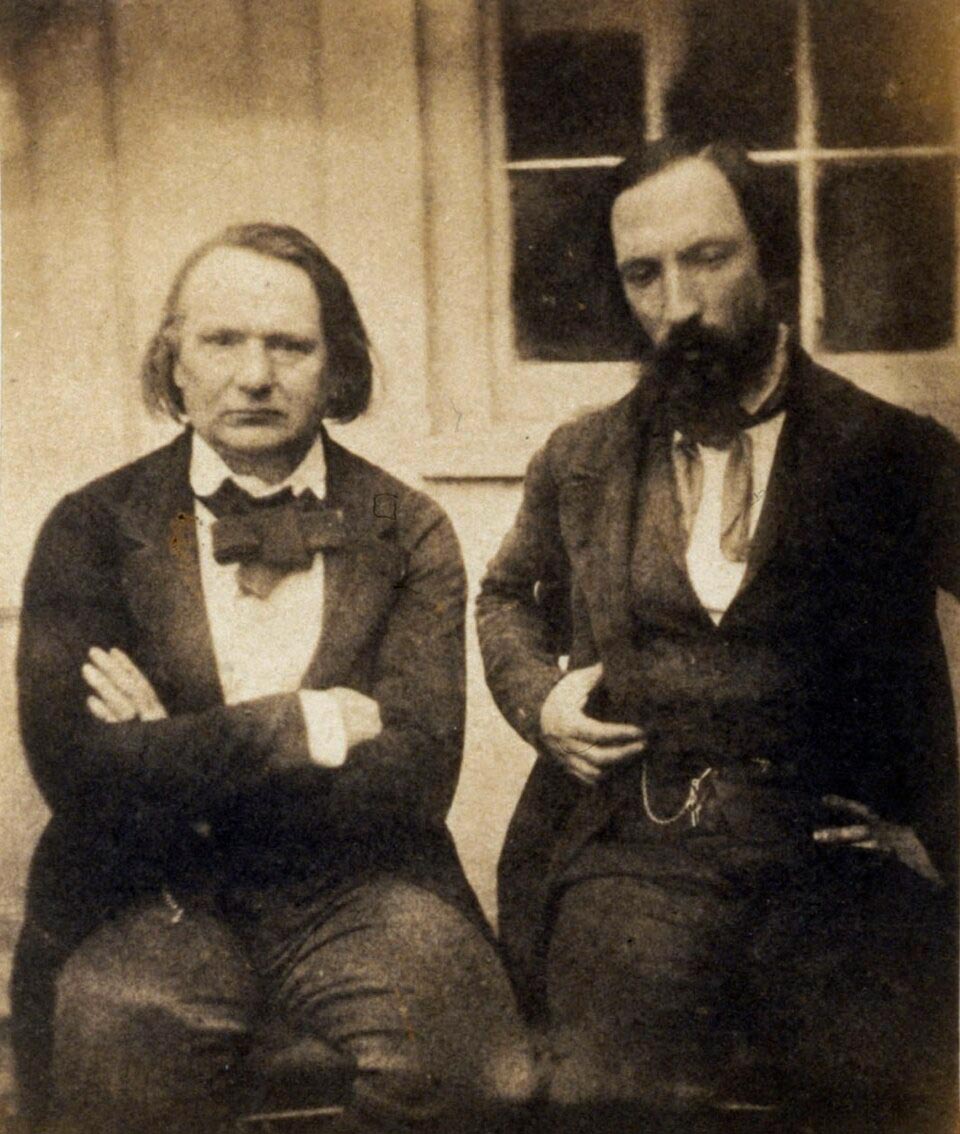
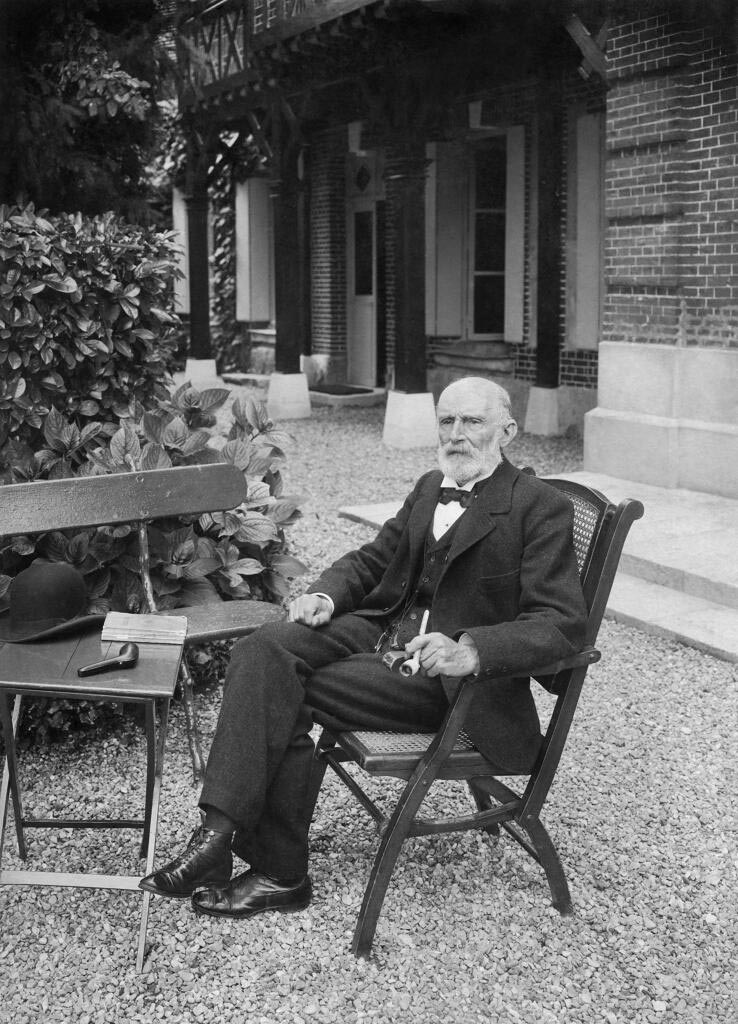
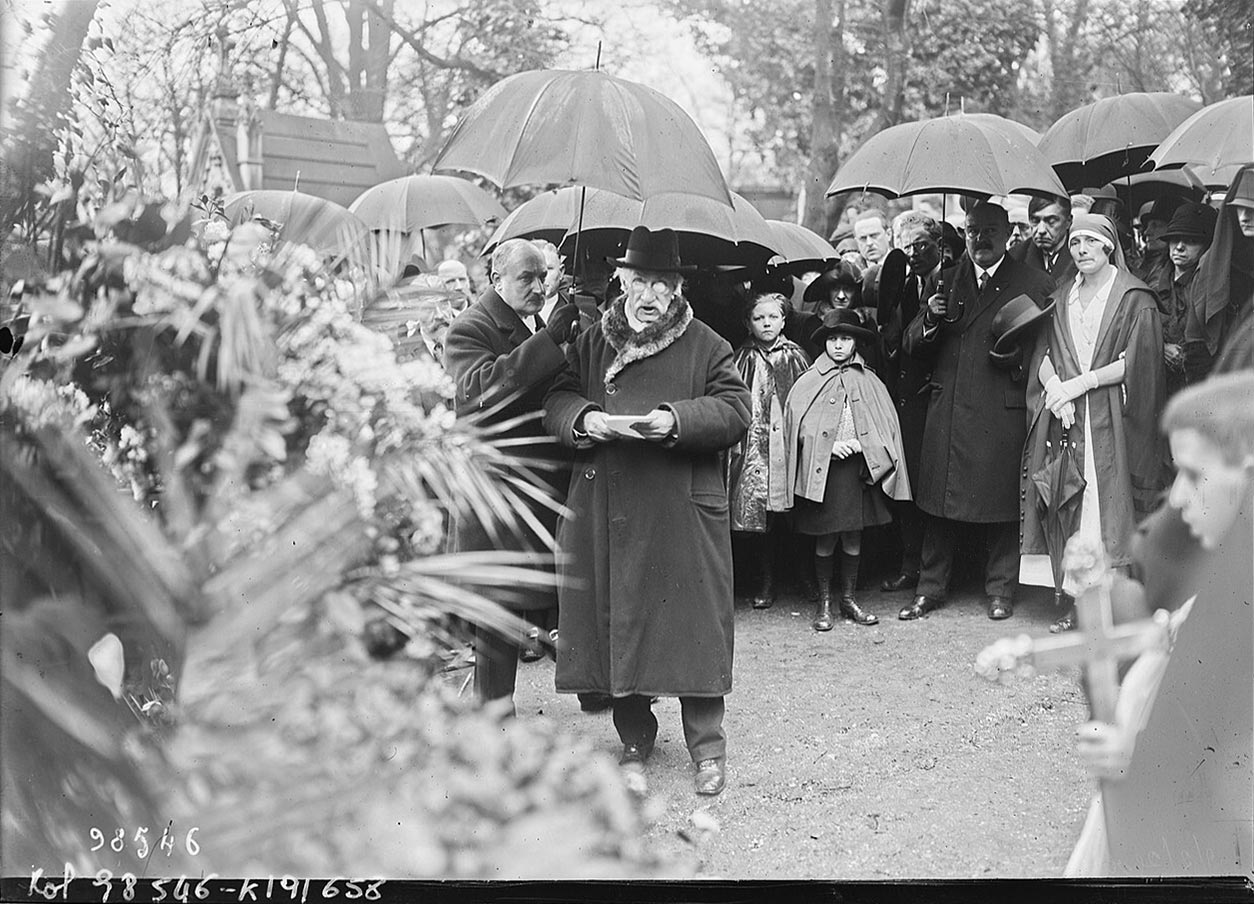
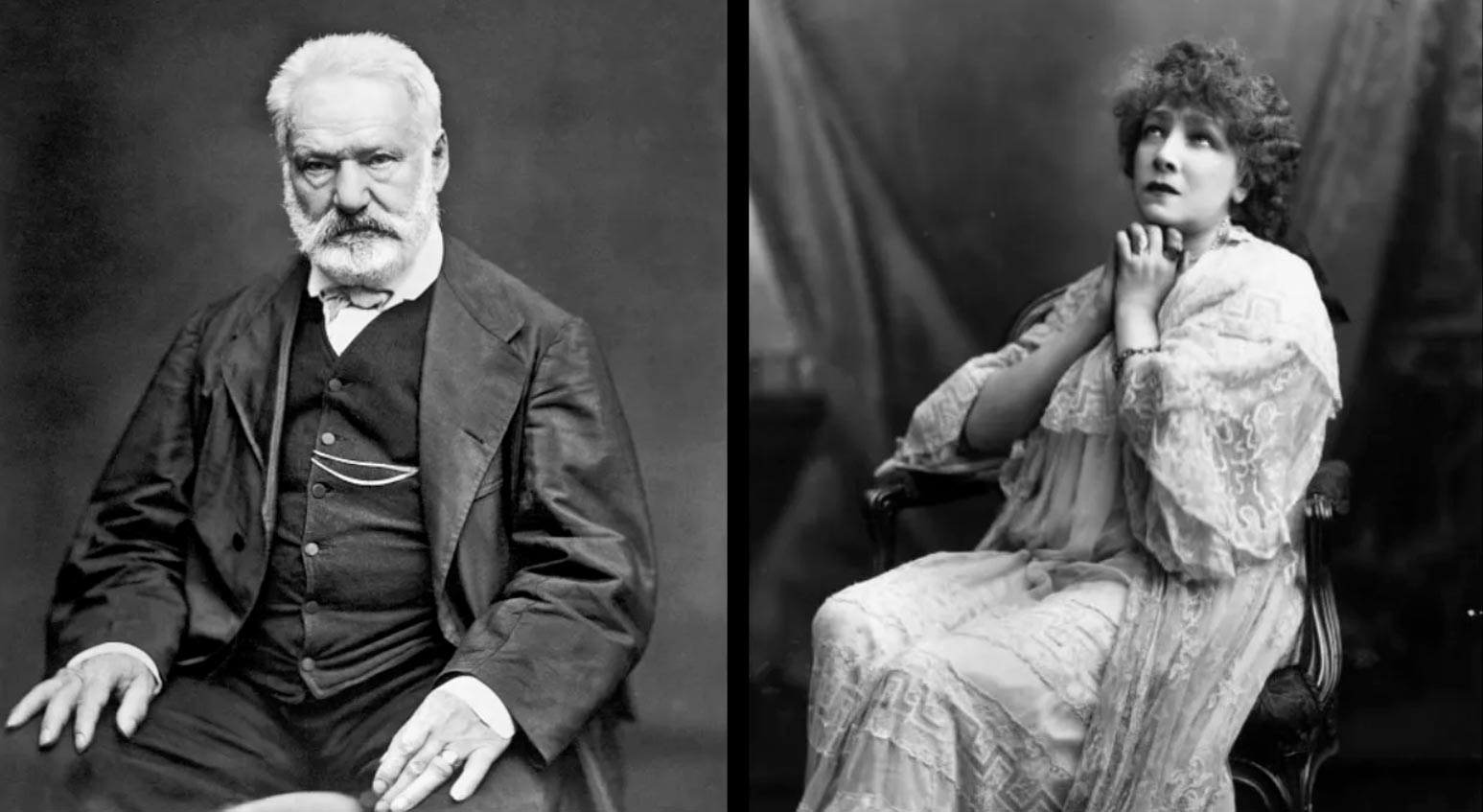
Le texte auquel fait référence Georges Van den Plas est un article publié par Gustave Simon dans La Revue de Paris du 1er septembre 1923, consacré à Sarah Bernhardt. Alors qu’il évoque une photographie dédicacée que la comédienne lui avait offerte en 1911, Simon décrit son bureau et la présence de ce dessin de Victor Hugo.
Cette mention présente un intérêt qui dépasse la seule question de la provenance. Elle atteste d’abord que le dessin est déjà conservé par Gustave Simon au début des années 1920. Mais elle permet également de restituer l’environnement dans lequel il prenait place, au-dessus de sa table de travail, près de la photographie dédicacée de Sarah Bernhardt et des portraits des frères Mounet – parmi les plus célèbres interprètes du théâtre de Victor Hugo.
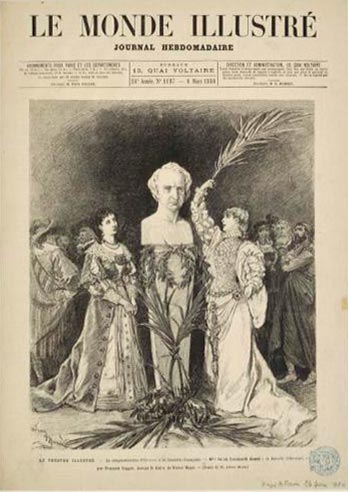
Le choix de Sarah Bernhardt n’est pas anodin. L’actrice entretint avec Victor Hugo une relation privilégiée depuis ses débuts à la Comédie-Française. L’écrivain suivait sa carrière avec intérêt, l’encourageant et lui confiant plusieurs grands rôles de son répertoire, parmi lesquels la reine de Ruy Blas et Marion de Lorme. Dans son article, Gustave Simon reproduit d’ailleurs plusieurs lettres adressées par Victor Hugo à la comédienne, témoignant de l’estime réciproque qui les unissait.
Ainsi, lorsque Gustave Simon décrit son bureau, il ne dresse pas seulement l’inventaire de quelques souvenirs personnels. Il fait apparaître un ensemble cohérent où se répondent l’œuvre graphique de Victor Hugo, les grands interprètes de son théâtre et l’une de ses plus célèbres comédiennes.
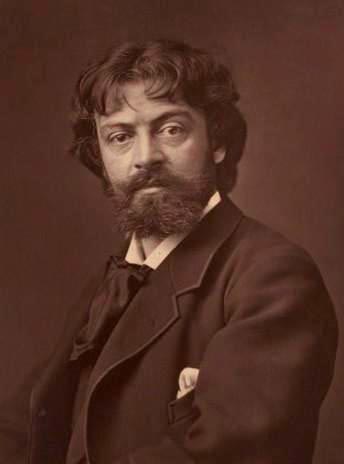
La collection Maurice Guyot, telle qu’elle apparaît dans la vente de Vichy Enchères du 13 août 2026, ne présente pas l’aspect d’une collection construite selon un programme esthétique rigide. Elle se caractérise plutôt par une cohérence relationnelle.
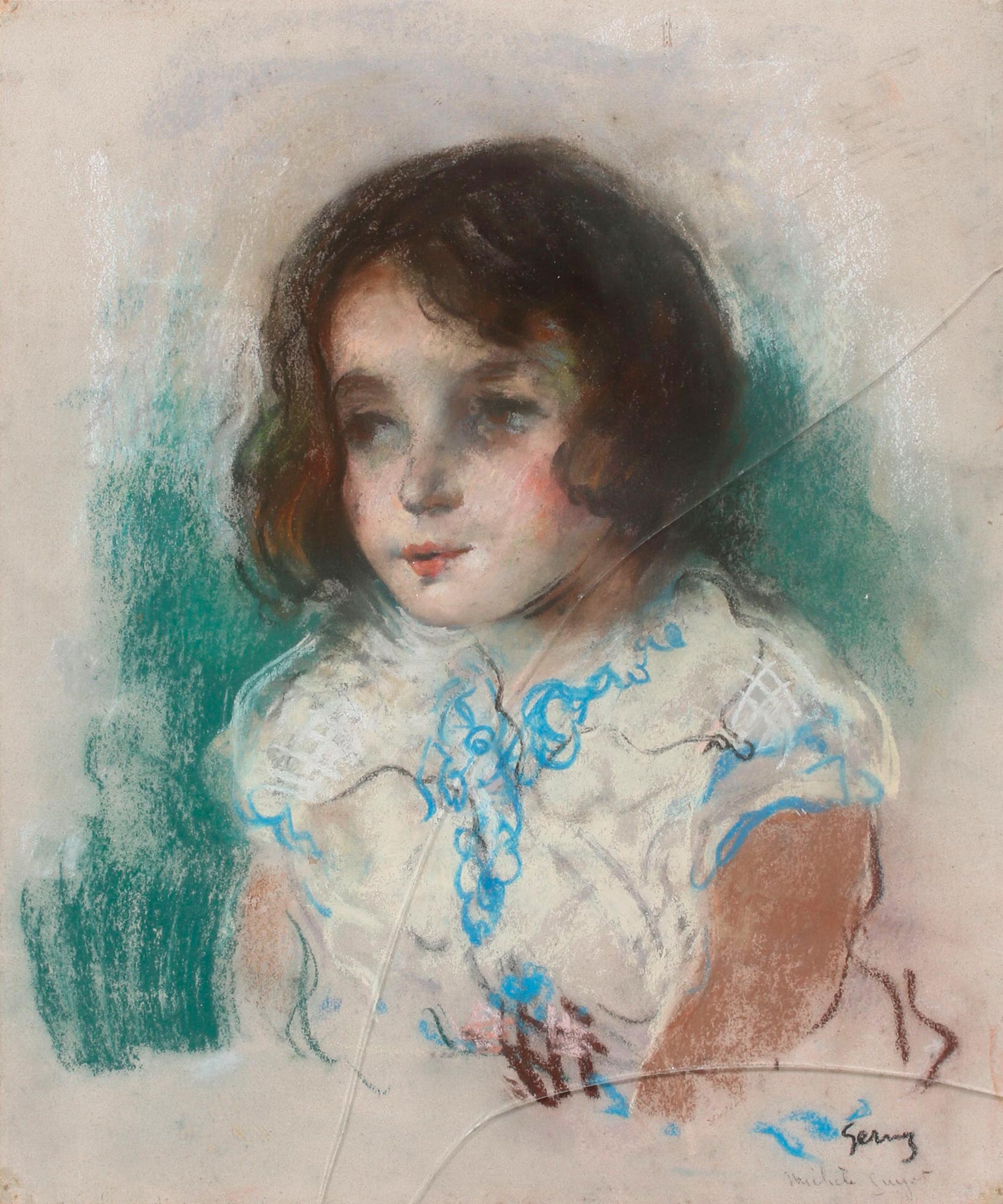
La collection comprend plusieurs œuvres à caractère familial ou personnel. Les portraits de sa fille, Michèle Guyot enfant, par Paul-Élie Gernez, les portraits de Maurice Guyot par Jean Dries, les gravures dédicacées ou les pastels offerts, donnent à l’ensemble une dimension mémorielle. Ces œuvres ne sont pas interchangeables. Elles n’ont pas été conservées uniquement pour leur valeur esthétique ; elles appartiennent à une histoire familiale et amicale.
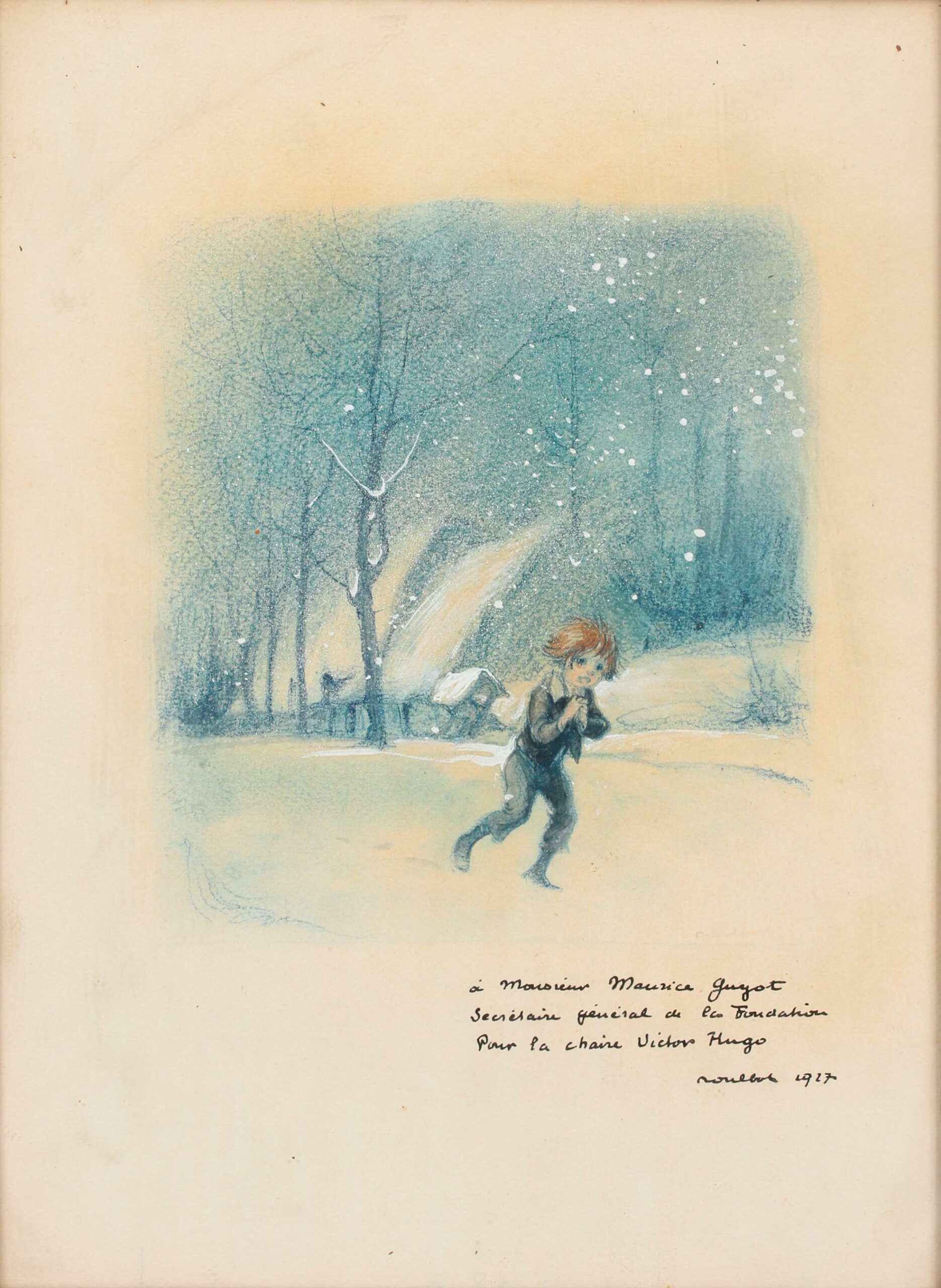
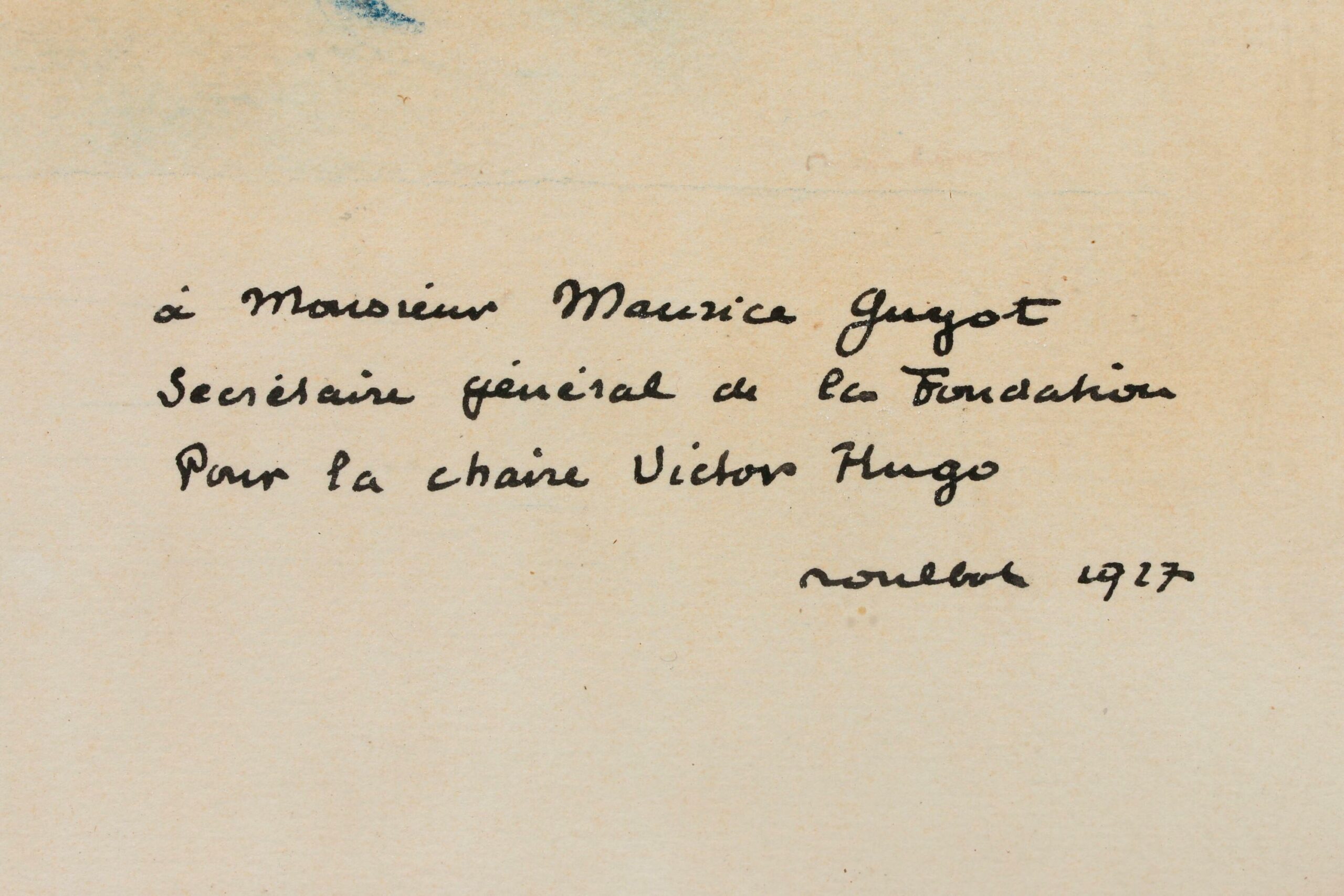
Le pastel de Francisque Poulbot, daté de 1927 et dédicacé à Monsieur Maurice Guyot, mérite à cet égard une attention particulière. Poulbot est étroitement associé à l’imagerie de l’enfance parisienne, mais aussi aux initiatives de diffusion de l’art. Or la Fondation Victor Hugo eut recours, dans les années 1920, à des cartes postales signées Poulbot pour soutenir ses actions autour de Victor Hugo poète de l’enfance. La présence d’un Poulbot dédicacé à Guyot prend dès lors une signification plus précise, puisqu’elle relie l’artiste, la Fondation et le réseau de diffusion de la mémoire de Victor Hugo.
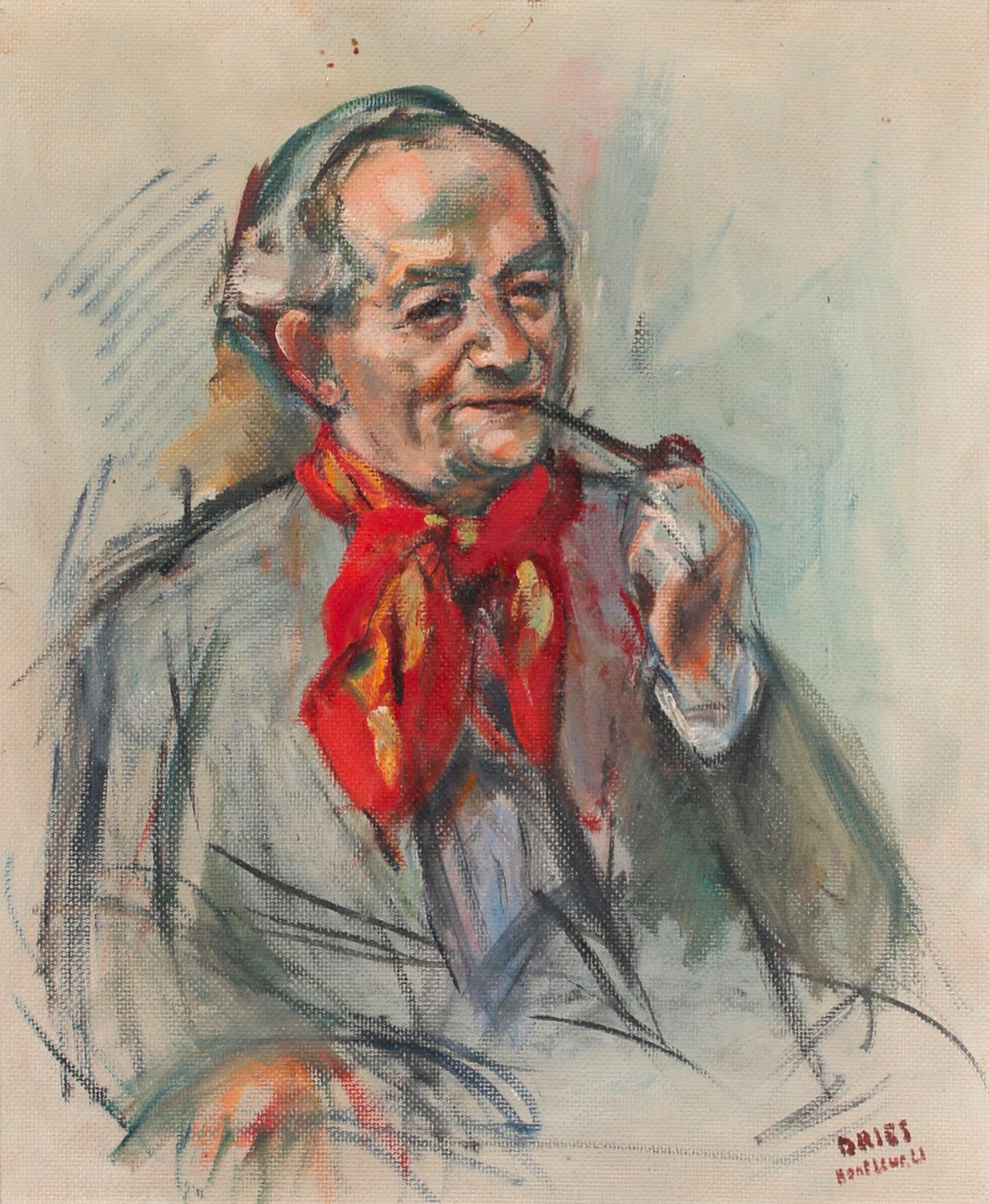
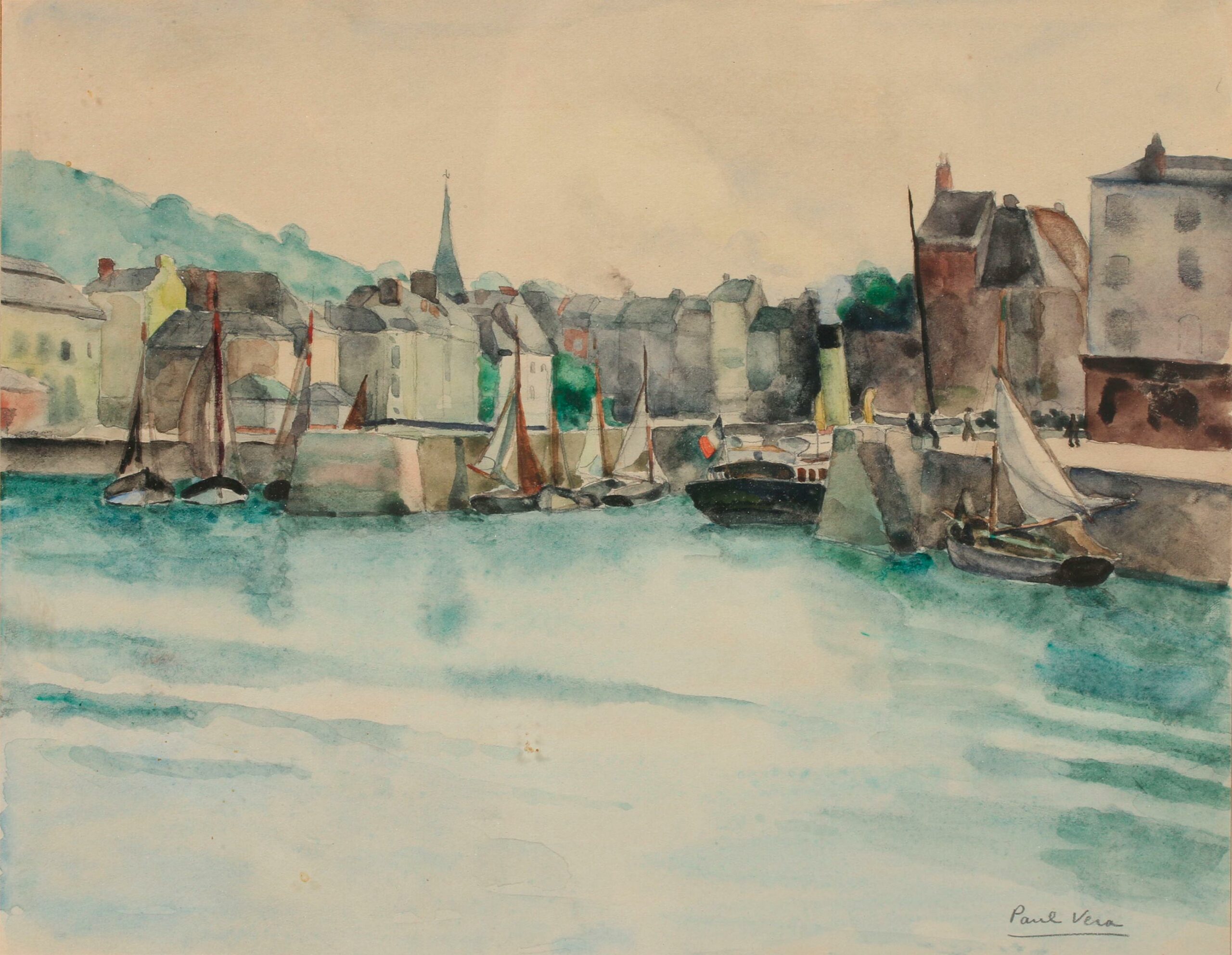
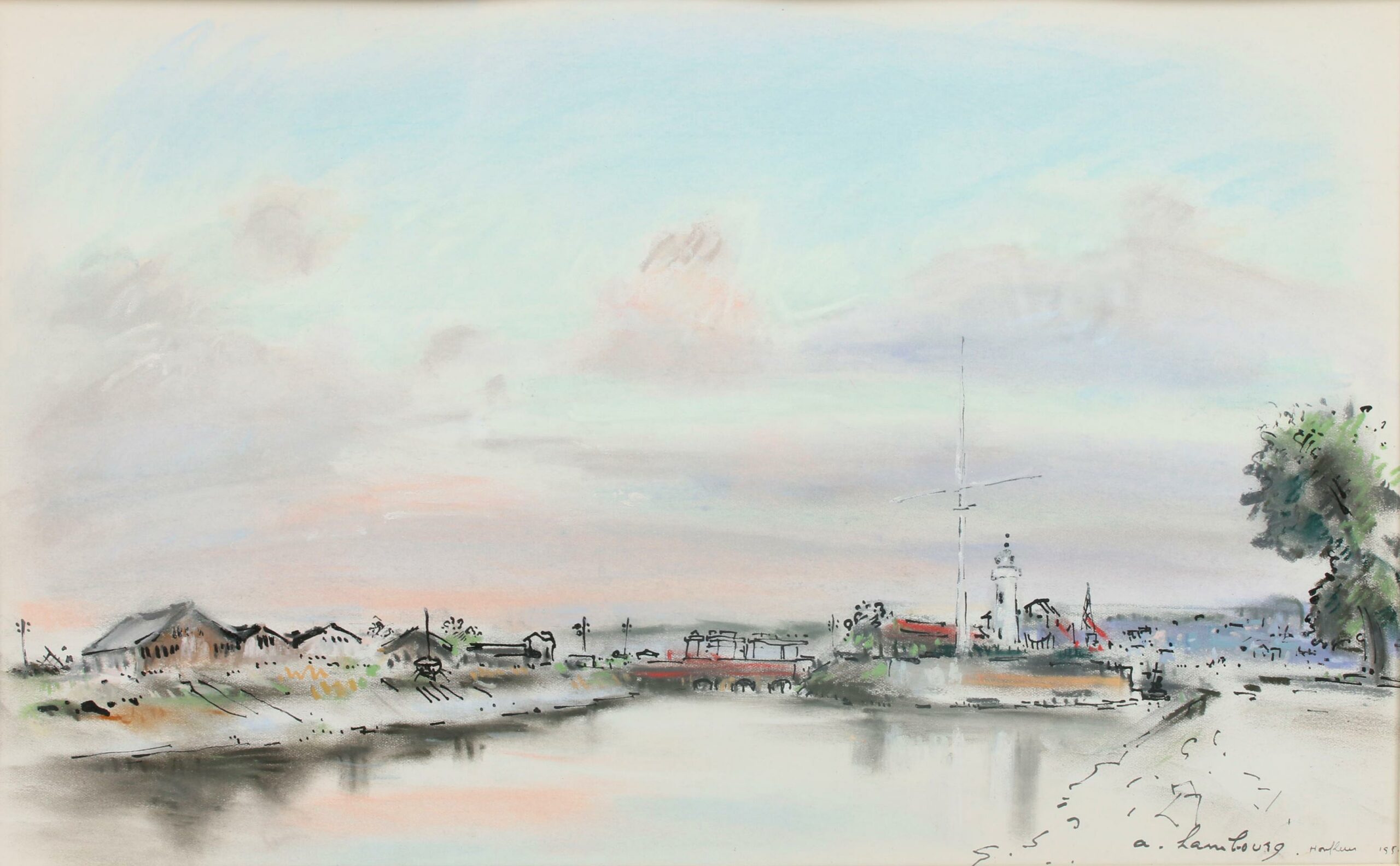
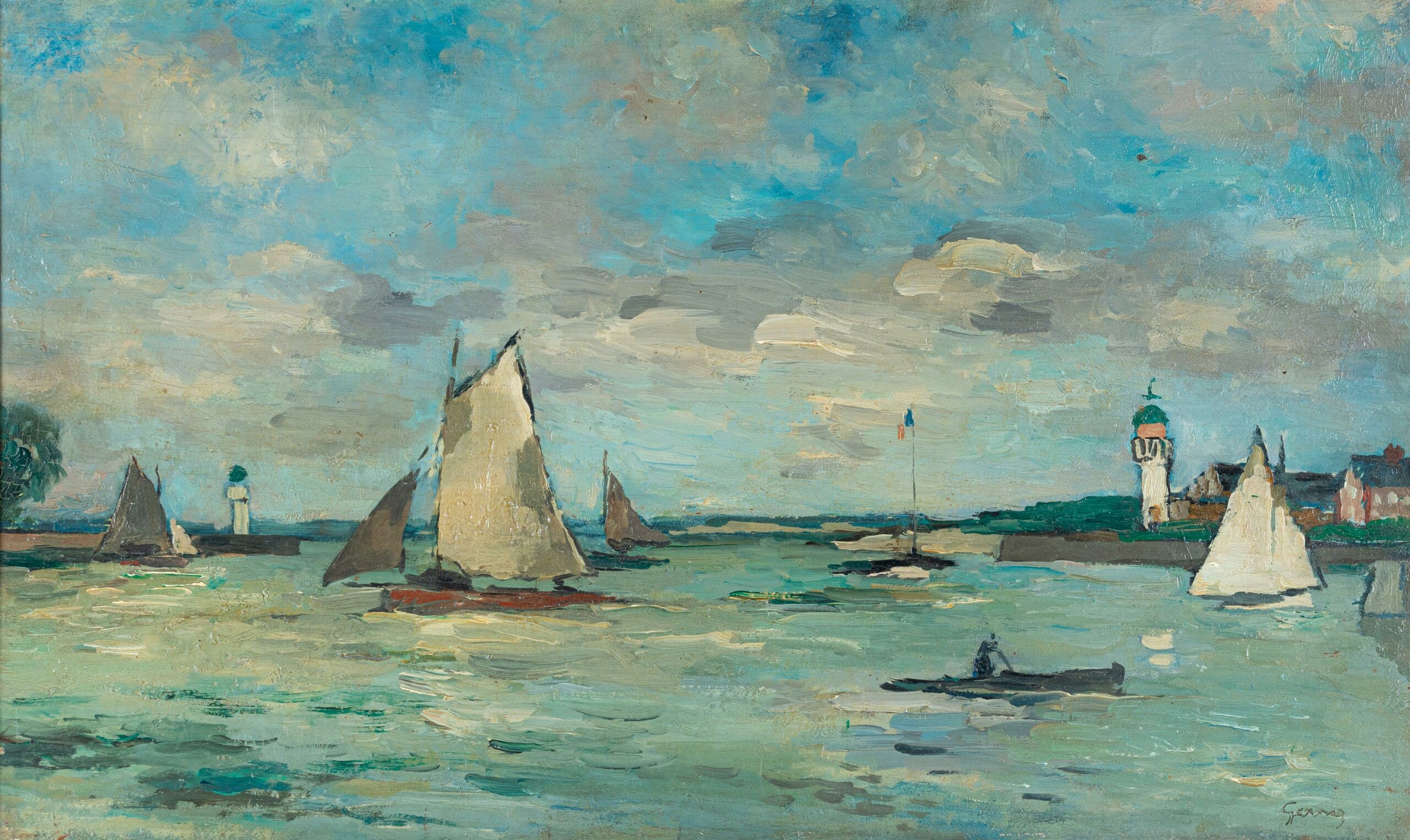
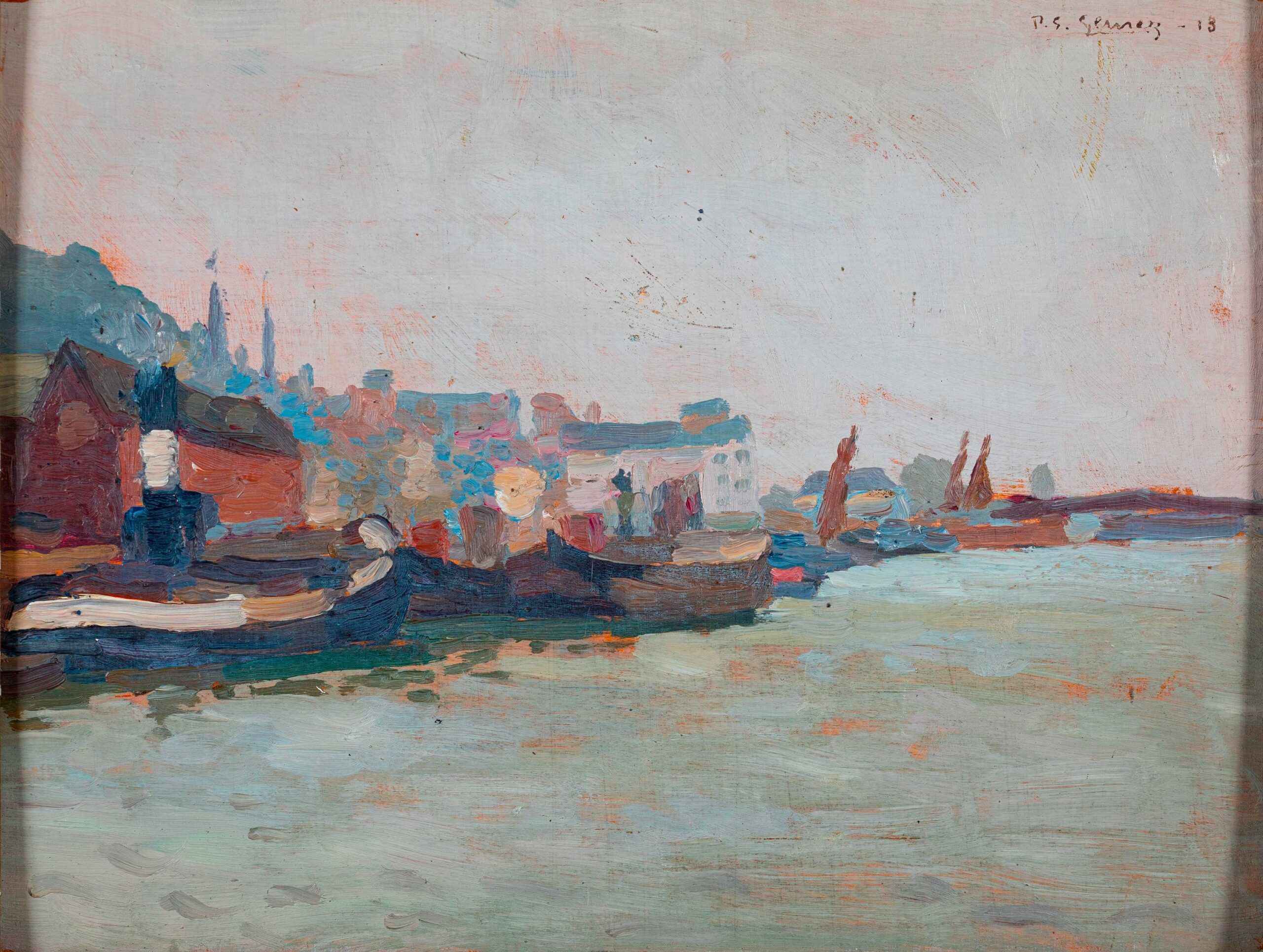
Un nombre important d’œuvres est consacré à Honfleur et aux paysages normands. Paul-Élie Gernez, Jean Dries, André Hambourg et Paul Vera y sont représentés par des vues de ports, de quais, de voiliers, de paysages au bord de l’eau. Cette récurrence suggère un attachement personnel à la Normandie, où Guyot a pu séjourner comme l’indique une note de Jean Dries sur le portrait de Guyot à la pipe, mais aussi à un goût pour la peinture de plein air et pour le fugitif.
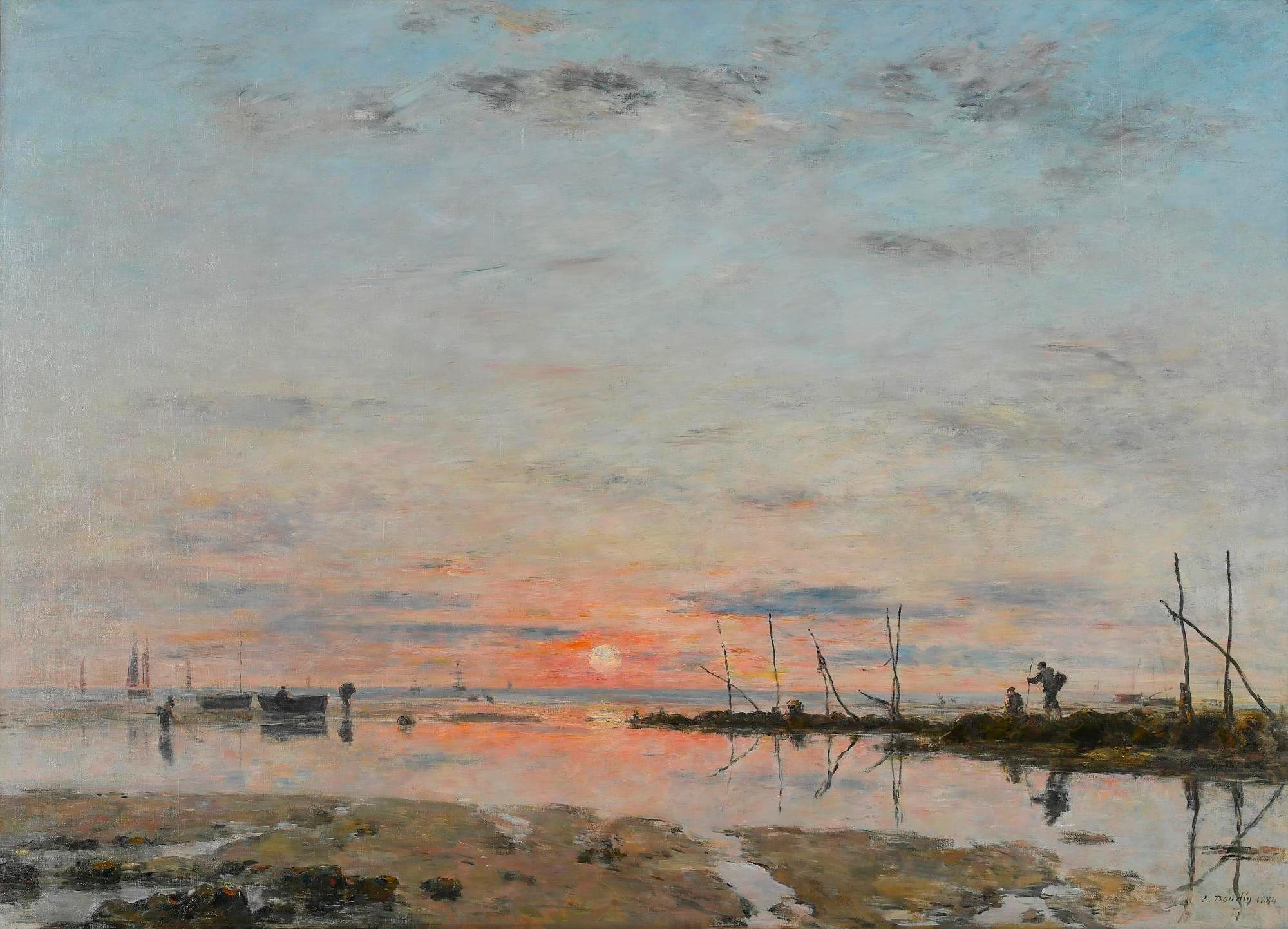
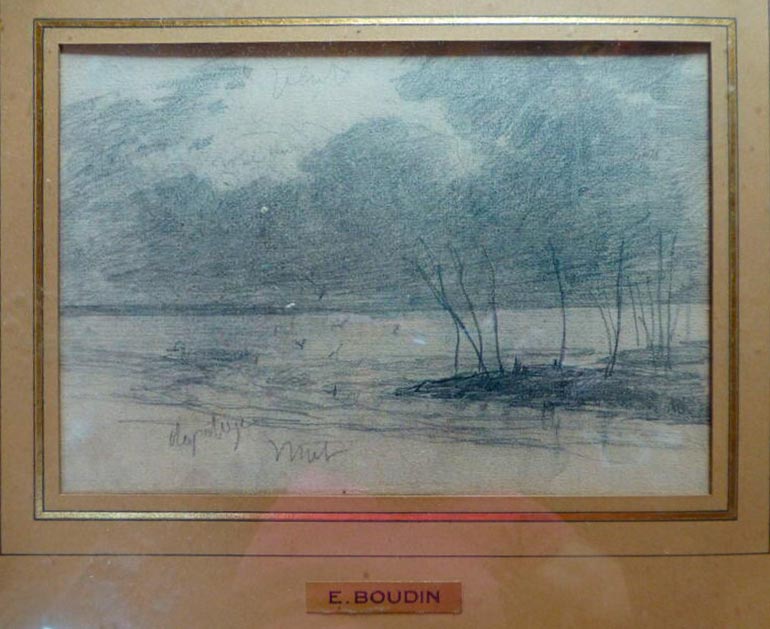
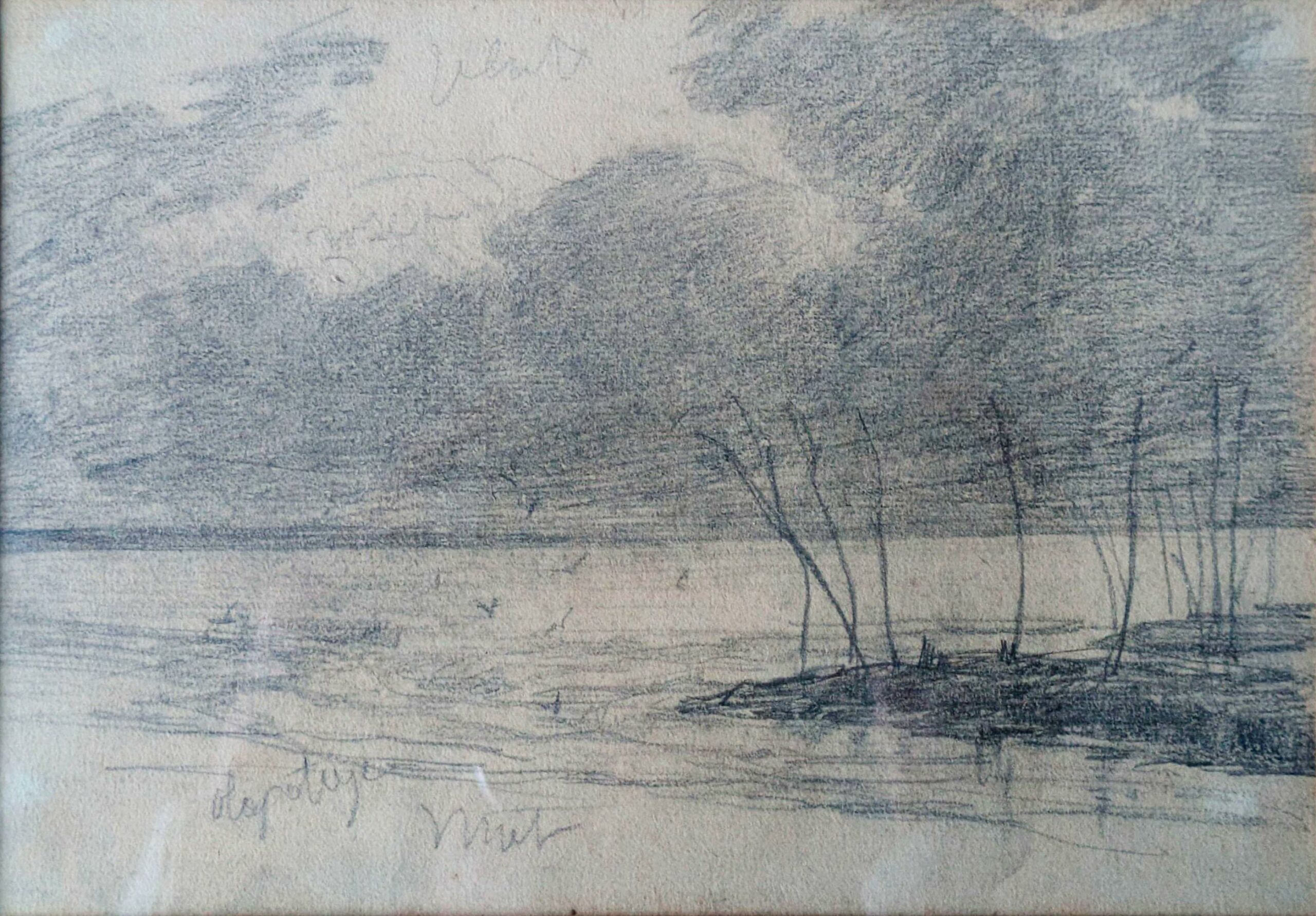
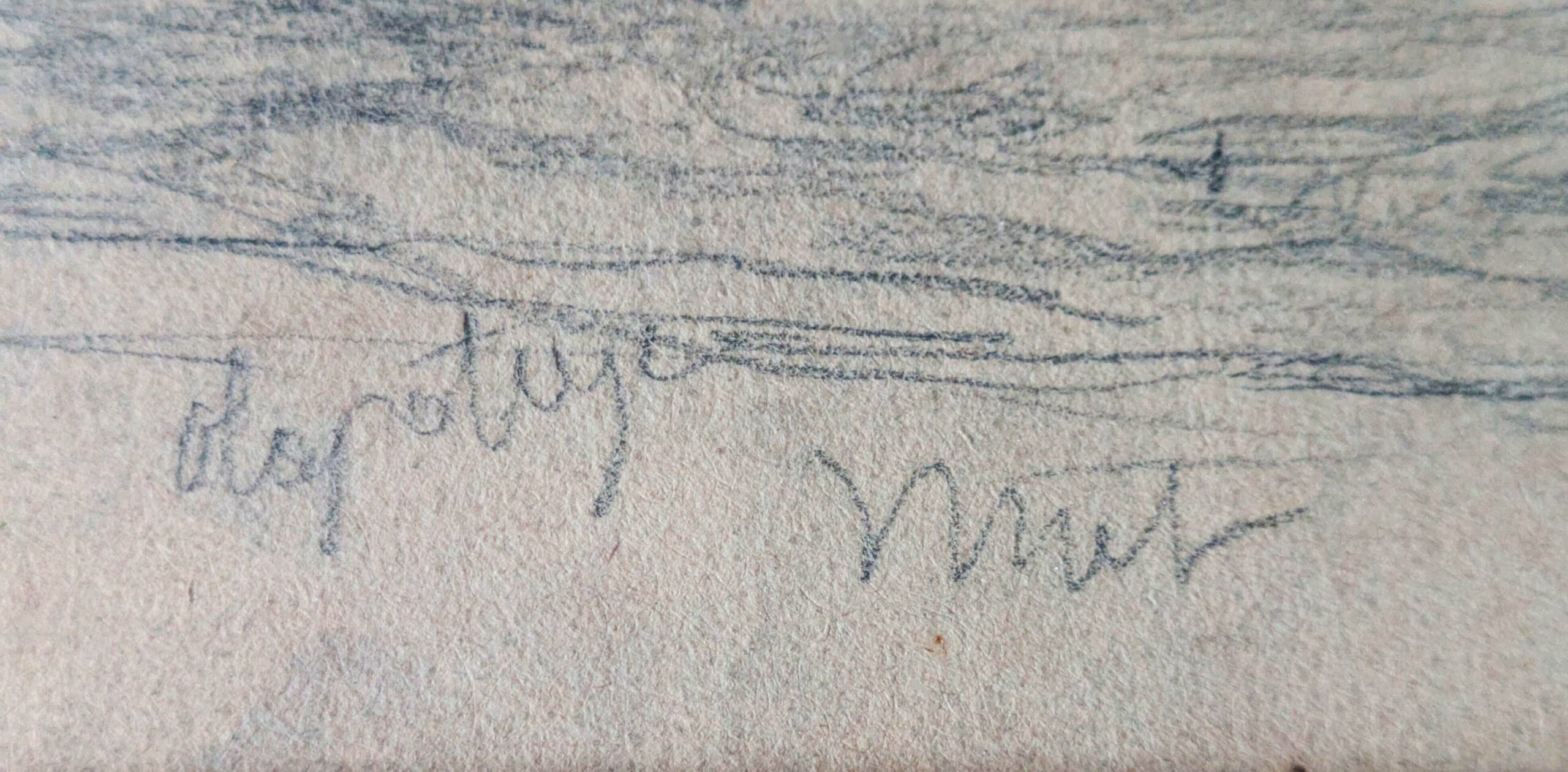
Parmi les œuvres réunies par Maurice Guyot figure également un paysage maritime attribué à Eugène Boudin. Le dessin représente une étendue d’eau bordée d’un rivage où quelques pieux émergent de la grève. Le regard est immédiatement attiré par l’immense ciel, traité par de larges hachures qui traduisent le passage des nuages et les variations de la lumière. La feuille comprend plusieurs annotations manuscrites, telles que « clapotage », « vent » et « mer », venant fixer les conditions météorologiques observées au moment de l’exécution. Cette attention portée aux phénomènes atmosphériques est l’une des caractéristiques majeures de l’œuvre d’Eugène Boudin. Cette feuille trouve un rapprochement particulièrement convaincant avec la toile Le Havre.
Coucher de soleil sur le rivage (vers 1885-1890), conservée au musée des Beaux-Arts de Saint-Lô et reproduite par Robert Schmit dans son catalogue raisonné (Eugène Boudin. 1824-1898, vol. II, 1973, n° 2008). Les deux œuvres présentent une composition très proche, organisée autour d’une vaste étendue d’eau dominée par un ciel occupant l’essentiel de la surface, tandis qu’une langue de terre s’avance sur la droite et se trouve ponctuée de pieux fichés dans l’estran. Ces derniers correspondent vraisemblablement à des guideaux, perches destinées à fixer les filets de pêche côtière, dont la représentation constitue un détail topographique caractéristique. Des recherches menées en 2016 auprès des archives municipales du Havre ont conduit à reconsidérer la localisation traditionnelle de cette peinture. La pêche au moyen de guideaux ayant disparu des plages havraises dès les années 1850, mais demeurant pratiquée sur les côtes bas-normandes jusqu’à la fin du XIXᵉ siècle, la scène représenterait plus vraisemblablement l’estuaire de la Seine, entre Honfleur et Villerville, plutôt que les environs du Havre. Cette réinterprétation éclaire également notre dessin, dont les caractéristiques topographiques semblent s’inscrire dans ce même paysage littoral. Elle trouve enfin un écho dans la provenance de l’œuvre, issue de la collection de Maurice Guyot, dont plusieurs œuvres témoignent de son attachement à Honfleur et à la Normandie. »
Plus qu’un simple ensemble d’œuvres, la collection de Maurice Guyot reflète le parcours d’un homme profondément engagé dans la transmission de l’héritage hugolien. Du dessin de Victor Hugo aux paysages normands de Gernez, Hambourg ou Boudin, chaque œuvre éclaire un aspect de ses goûts et de son environnement intellectuel. Sa dispersion par Vichy Enchères, le 13 août 2026, représente ainsi une occasion de redécouvrir cette personnalité discrète, mais importante dans l’histoire de la mémoire de Victor Hugo.
The sale of a collection is often the opportunity to rediscover the figure who assembled it. This is particularly true of the collection of Maurice Guyot (1884 – 1974), Secretary General of the Victor Hugo Foundation and a leading figure in the promotion of the writer’s work throughout the 20th century. His collection, built over a lifetime devoted to the University of Paris and to the study of Hugo’s works, brings together works that reflect both his personal interests and the artistic and intellectual relationships he cultivated. In particular, the collection includes a remarkable drawing by Victor Hugo from 1864, “Souvenir d’une demolition”, whose provenance links it directly to the writer’s inner circle. This drawing is, naturally, the highlight of the collection, and helps shed light on its coherence.
Maurice Guyot was born in Coulommiers on 31 December 1884 and died in Paris on 28 April 1974. He spent most of his career at the University of Paris. He held important positions within the French university administration, serving as Secretary of the Academy of Paris and then Secretary General of the University of Paris, at a time when universities played a vital role in producing research, spreading knowledge and preserving intellectual heritage. These positions naturally led him to participate in initiatives dedicated to Victor Hugo. As early as the 1920s, he took part in the project to establish a Victor Hugo Chair at the Sorbonne, serving as treasurer of its sponsorship committee. This initiative aimed to ensure that Victor Hugo’s work would be firmly established in the higher education curriculum, to raise awareness of his works, and to support research about the author. It was based at 5 Rue de la Sorbonne, and brought together academics, scholars, descendants of Victor Hugo and enthusiasts around a common purpose: preserving and passing on the legacy of the author of Les Misérables [1].
He also played a part in relaunching the institution after the Second World War [2].
[1] Maurice Guyot, “La fondation Victor Hugo va renaître”, Le Monde, 5 décembre 1962.
[2] Bulletin de la Fondation Victor Hugo, 1930.
This position explains the presence of works and memorabilia related to Victor Hugo within his collection.
It makes sense to consider his collection as a natural extension of his professional commitments. For the Secretary General of the Victor Hugo Foundation, preserving a drawing by the writer, which originated from his inner circle, was not merely a matter of personal taste, but a testament to a deep attachment to Hugo’s body of work.
Among the works collected by Maurice Guyot, Souvenir d’une démolition holds a special place. This drawing, which is signed and dated « Victor Hugo 1864 », dates from the writer’s period of exile in Guernsey.
The year 1864 corresponds to a significant period in his creative output. At the time, Victor Hugo was working on Toilers of the Sea, a novel published two years later, while his artwork was undergoing remarkable development. Drawings, sketchbooks and wash drawings accompanied his literary work throughout his life.
The drawing that belonged to Maurice Guyot depicts a manor house with an aesthetic rooted in the « Dark Romanticism » that runs through part of Victor Hugo’s artwork. The title, Souvenir d’une démolition (Memory of a Demolition), evokes the disappearance of a building while inviting melancholic reflection on the memory of places and their ruins. As with many of the ink drawings executed by Victor Hugo, the use of wash effects and ghostly architectural silhouettes creates a landscape alternating between dream and reality.
This drawing’s interest is enhanced by its connection to a notebook held at the Bibliothèque nationale de France under the reference NAF 13459. This notebook, which was started on 24 May 1864, contains early preparatory notes for Toilers of the Sea, maps of the reefs around Guernsey, and several drawings. The same manor house appears on folio 81 verso. As the final pages of the notebook were completed during Victor Hugo’s trip to Brussels in July 1865, certain architectural details, in particular the stepped gables visible on the building to the left of the composition, lead us to believe that the inspiration for this manor house might have been found in Brussels as well.
Beyond its artistic merits, this drawing is of remarkable historical interest due to the quality of its provenance, which can be traced with rare precision thanks to surviving documents.
The drawing first belonged to Pierre Lefèvre-Vacquerie, a member of the Vacquerie family, which was closely linked to Victor Hugo since the marriage of Léopoldine Hugo to Charles Vacquerie. It was subsequently in the possession of Gustave Simon, a close associate of Victor Hugo, who served as a witness at his marriage to Sarah Sourdis in 1879, and was the publisher of several posthumous works, as well as the writer’s new literary executor. Upon Gustave Simon’s death, the drawing passed to his daughter, Marguerite Simon, before entering the collection of Georges Van den Plas, and subsequently that of Maurice Guyot.
A letter sent to Maurice Guyot by Georges Van den Plas on 29 April 1956 discusses these details regarding its provenance.
« When I handed you the Victor Hugo drawing that Mother had bequeathed to you, I told you that she had received it from Marguerite Simon following the death of her father, who had himself acquired it from Pierre Lefèvre-Vacquerie. However, that was merely my word, which could be disputed. I have just come across an article by Gustave Simon about Sarah Bernhardt in the Revue de Paris dated 1 September 1923. He speaks of a portrait she had given him and adds: ‘This photograph is positioned in my study above my desk, between photographs of the two Mounets and above a small exquisite drawing by Victor Hugo that was given to me by Pierre Lefèvre-Vacquerie. Sarah is among friends there.‘ «
Lettre adressée à Maurice Guyot par Georges Van den Plas le 29 avril 1956
The text referred to by Georges Van den Plas is an article on Sarah Bernhardt published by Gustave Simon in the Revue de Paris on 1 September 1923. While discussing a photograph with a dedication the actress had given him in 1911, Simon describes his study and the presence of this drawing by Victor Hugo.
This mention is significant for reasons beyond mere provenance. It confirms, first of all, that Gustave Simon already owned the drawing in the early 1920s. It also allows us to visualize the setting in which the work was displayed: above his desk, alongside the dedicated photograph of Sarah Bernhardt and portraits of the Mounet brothers – who were among the most celebrated performers of Victor Hugo’s plays.
The choice of Sarah Bernhardt is significant. The actress shared a special relationship with Victor Hugo from the time she began her career at the Comédie-Française. The writer followed her career with interest, providing encouragement and entrusting her with several major roles from his repertoire, including the Queen in Ruy Blas and the title role in Marion de Lorme. In his article, Gustave Simon included several letters Hugo wrote to the actress, bearing witness to the mutual esteem that bound them together.
Therefore, when Gustave Simon describes his study, he is not merely cataloguing a few personal mementos. He reveals a cohesive ensemble in which Victor Hugo’s artwork, the great performers of his plays and one of his most celebrated actresses all resonate with one another.
The Maurice Guyot collection, as featured in the Vichy Enchères sale on 13 August 2026, does not come across as a collection simply assembled with aesthetic considerations in mind. Instead, it is characterized by a coherence rooted in personal relationships.
The collection includes several works of a familial or personal nature. Portraits of his daughter, Michèle Guyot, as a child by Paul-Élie Gernez, portraits of Maurice Guyot by Jean Dries, and dedicated prints or gifted pastels all lend the collection a commemorative quality. These works are not interchangeable; they were not kept solely for their aesthetic value, but rather belong to a shared history of family and friendship.
In this regard, a pastel by Francisque Poulbot, dated 1927 and dedicated to Monsieur Maurice Guyot, deserves special attention. Poulbot is closely associated with the imagery of Parisian childhood, as well as with initiatives aimed at bringing art to a wider audience. In the 1920s, the Victor Hugo Foundation used postcards signed by Poulbot in its efforts to promote Victor Hugo as a poet of childhood. The presence of a Poulbot dedicated to Guyot thus takes on added significance, linking the artist, the Foundation and the network dedicated to the promotion of Victor Hugo’s legacy.
A significant number of works are devoted to Honfleur and the landscapes of Normandy. Paul-Élie Gernez, Jean Dries, André Hambourg and Paul Vera are represented here by views of harbours, quays, sailing boats and waterside scenery. This recurring theme suggests a personal attachment to Normandy, where Guyot may have stayed, as indicated by a note by Jean Dries on the portrait of Guyot with a pipe, as well as a fondness for plein air painting and the depiction of fleeting moments.
Among the works collected by Maurice Guyot is also a seascape attributed to Eugène Boudin. The drawing depicts a stretch of water bordered by a shoreline where a few posts emerge from the sand. The eye is immediately drawn to the vast sky, rendered in broad hatching that captures the movement of the clouds and the variations in light. The sheet contains several handwritten annotations, such as ‘ripples’, ‘wind’ and ‘sea’, recording the weather conditions observed at the time of its creation. This attention to atmospheric phenomena is one of the defining characteristics of Eugène Boudin’s work. This sheet bears a particularly striking resemblance to the painting Le Havre.
Sunset on the Shore (c. 1885–1890), held at the Musée des Beaux-Arts in Saint-Lô and reproduced by Robert Schmit in his catalogue raisonné (Eugène Boudin. 1824–1898, vol. II, 1973, no. 2008). The two works share a very similar composition, centred on a vast expanse of water dominated by a sky that occupies most of the picture plane, whilst a strip of land juts out on the right, punctuated by stakes driven into the foreshore. These are likely to be ‘guideaux’ – poles used to secure coastal fishing nets – the depiction of which constitutes a characteristic topographical detail. Research carried out in 2016 at the municipal archives of Le Havre led to a reassessment of the traditional location of this painting. As fishing using guide poles had disappeared from Le Havre’s beaches by the 1850s, though continued to be practised on the Lower Normandy coast until the end of the 19th century, the scene more likely depicts the Seine estuary, between Honfleur and Villerville, rather than the vicinity of Le Havre. This reinterpretation also sheds light on our drawing, whose topographical features appear to fit within this same coastal landscape. It is further supported by the work’s provenance: it comes from the collection of Maurice Guyot, several works in which bear witness to his attachment to Honfleur and Normandy.
Beyond being simply an ensemble of artworks, Maurice Guyot’s collection reflects the journey of a man deeply committed to preserving and sharing Victor Hugo’s legacy. From the drawing by Victor Hugo to the Normandy landscapes of Gernez, Hambourg or Boudin, each work sheds light on an aspect of his tastes and intellectual world. Its sale by Vichy Enchères on 13 August 2026 provides an opportunity to rediscover a figure who, while unassuming, played a significant role in the history of Victor Hugo’s legacy.