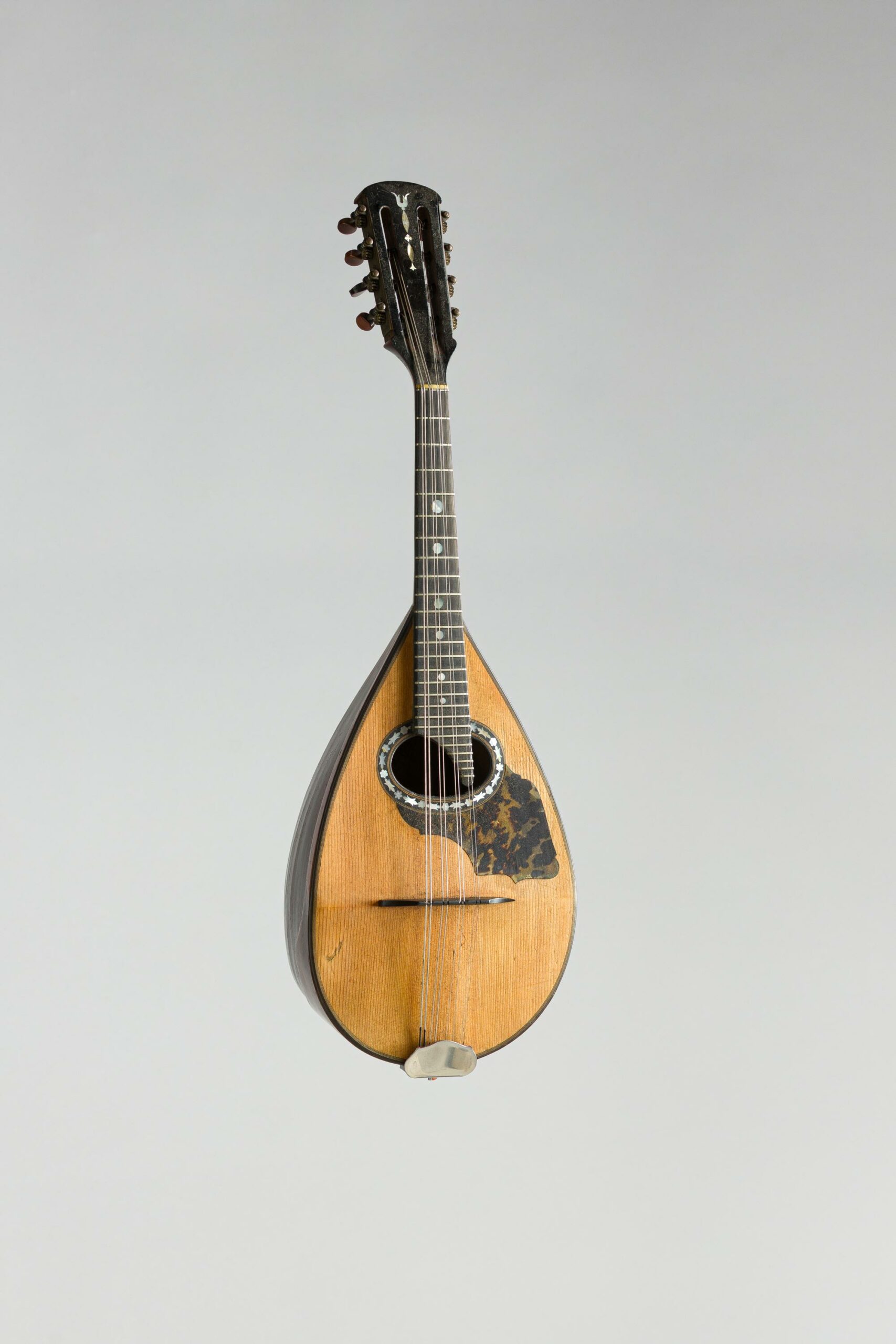
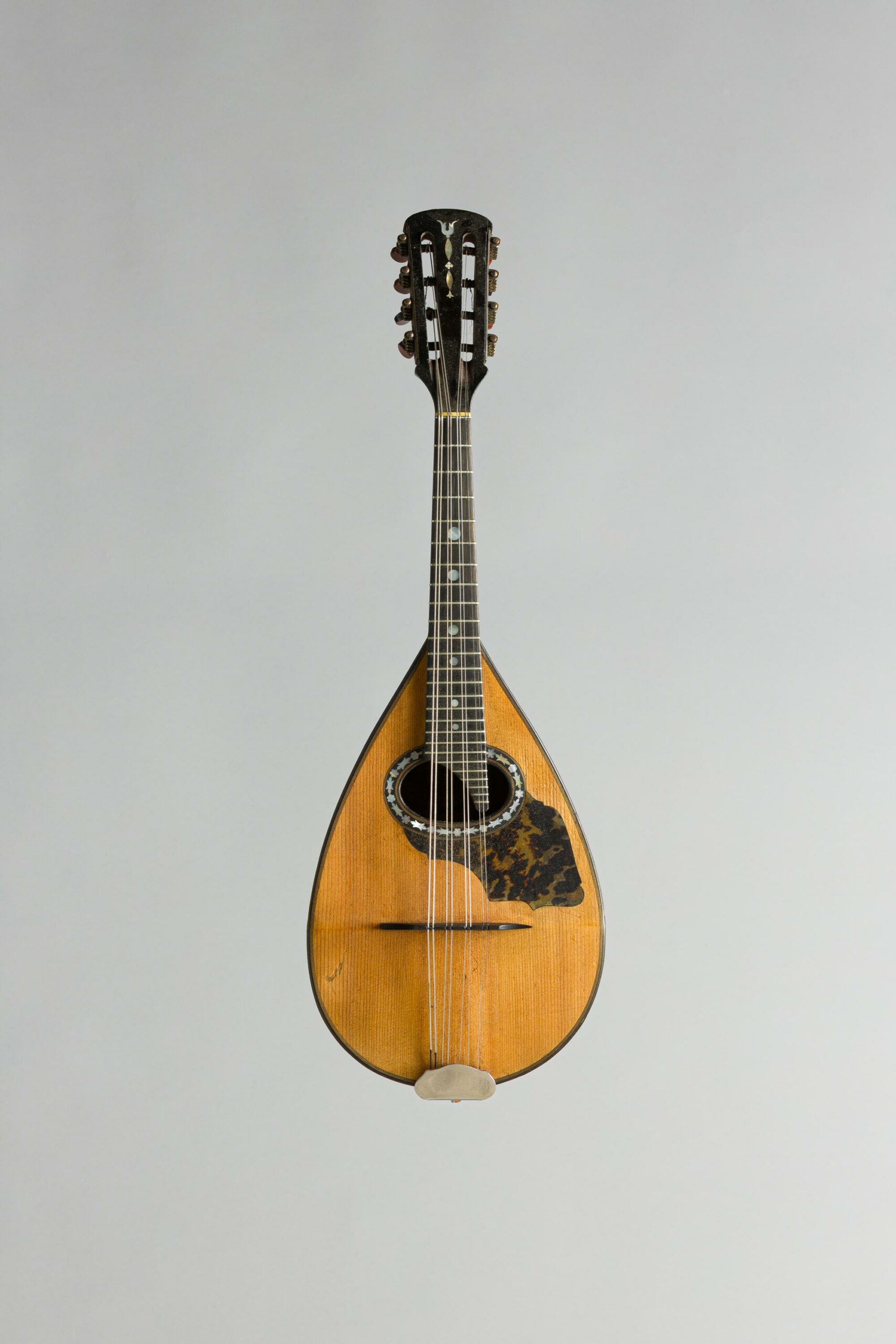
Vichy Enchères vous propose de découvrir quatre mandolines retraçant trente-cinq ans de l’histoire de l’incontournable maison Luigi Embergher. De l’Orchestra 2 de 1913 au Model B de 1948, en passant par l’Orchestra 1 de 1921 et le célèbre 5 Bis de 1927, ces instruments témoignent de l’évolution de la production Embergher et de la transmission de son savoir-faire.
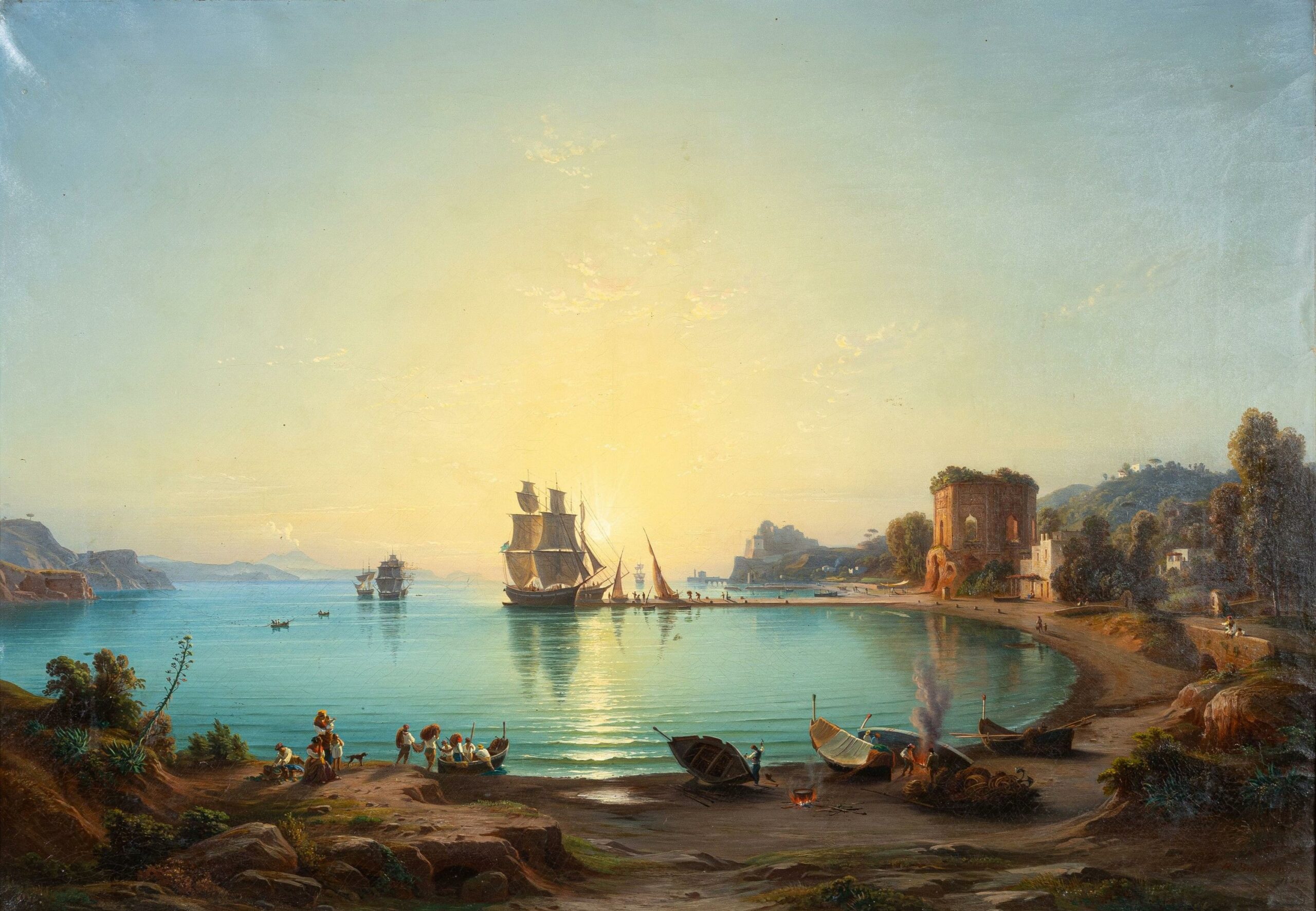
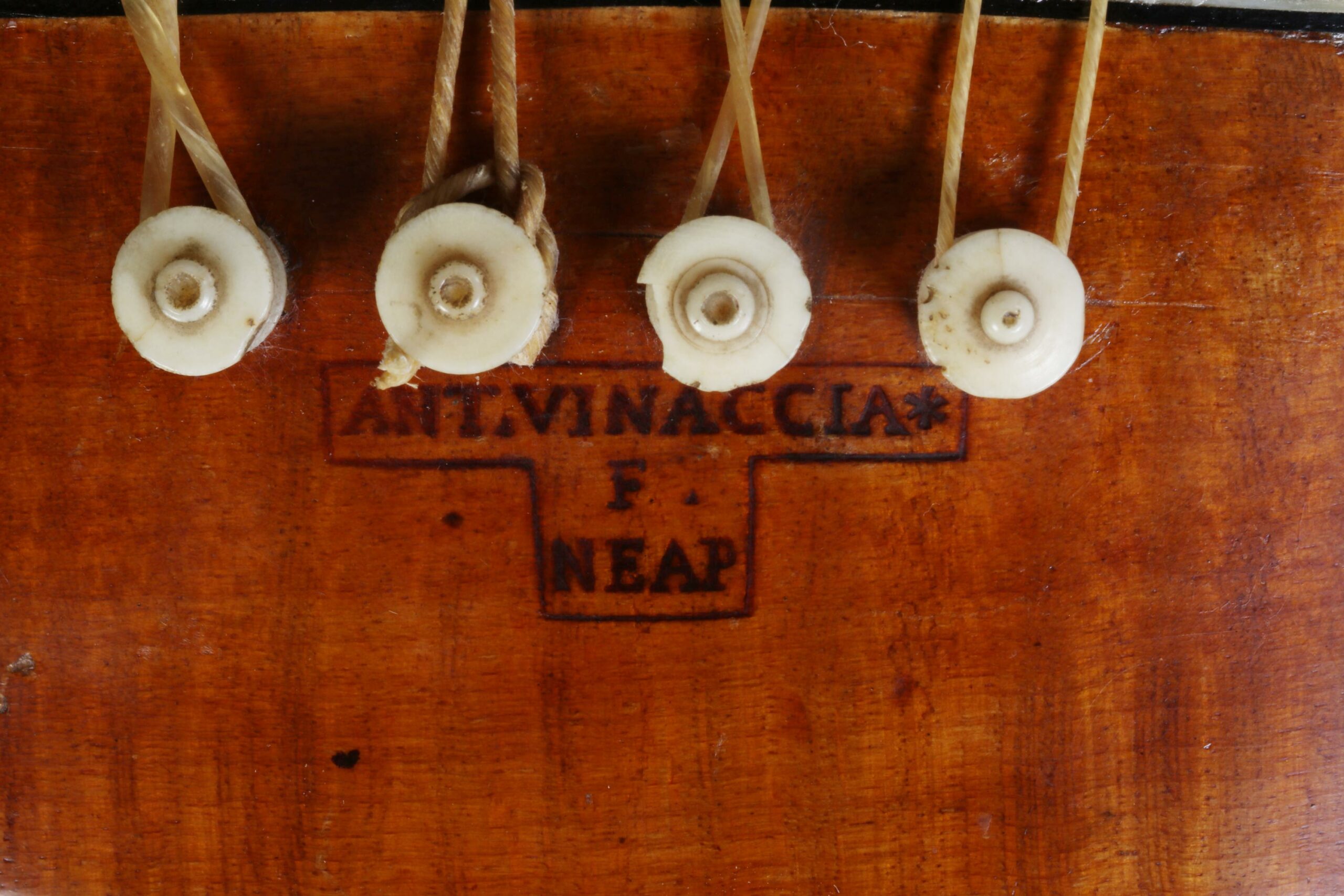
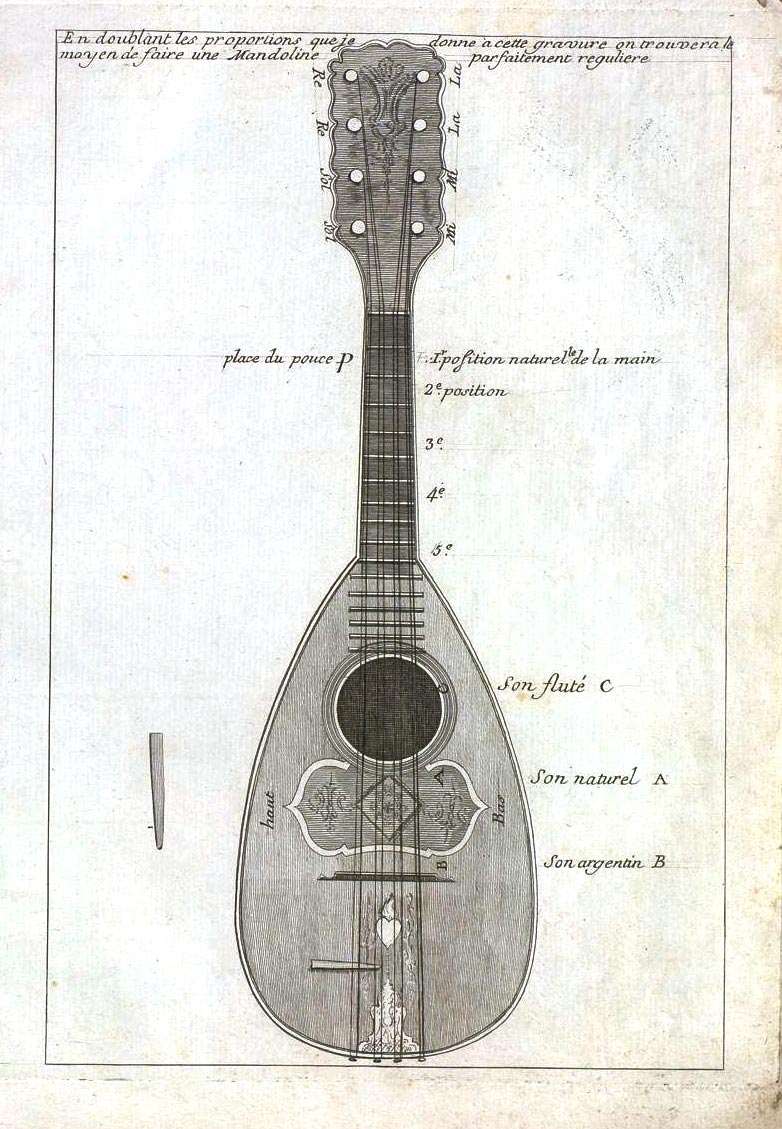
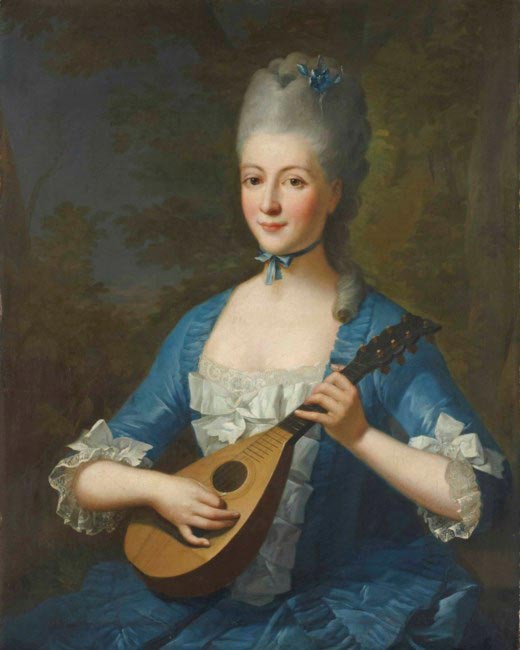
L’histoire de la mandoline moderne est tout d’abord étroitement liée à celle de Naples. Durant la seconde moitié du XVIIIème siècle, la mandoline baroque évolua progressivement pour donner naissance à un nouveau type d’instrument, qualifié de mandoline napolitaine. La famille Vinaccia, et tout particulièrement Gennaro et Antonio, joua un rôle majeur dans son développement. Les proportions de l’instrument furent revues, la table élargie, le chevalet rehaussé et les cordes en boyau remplacées par des cordes métalliques accordées en quintes. La caisse était quant à elle constituée de côtes de bois courbé et la table d’harmonie s’inclinait désormais à partir du chevalet. Grâce à ces innovations, Naples s’affirma comme la capitale de la mandoline et l’instrument rencontra un important succès en Italie, mais également dans tout le reste de l’Europe, où il intégra les cours royales.
Toutefois, comme le souligne Alfred Woll dans The Art of Mandolin Making :
“[I]l y a toujours eu des luthiers de renom dans de nombreuses autres régions d’Italie. Des maîtres luthiers innovants, à Rome et dans ses environs, ont également contribué à faire évoluer la mandoline. L’un des plus experts et des plus renommés d’entre eux était Antonio Luigi Embergher (1856-1943).”
Alfred Woll, The Art of Mandolin Making: Historical Development and Construction of the Mandolin, Edition MANDO, 2021, traduction personnelle du texte original, p.54
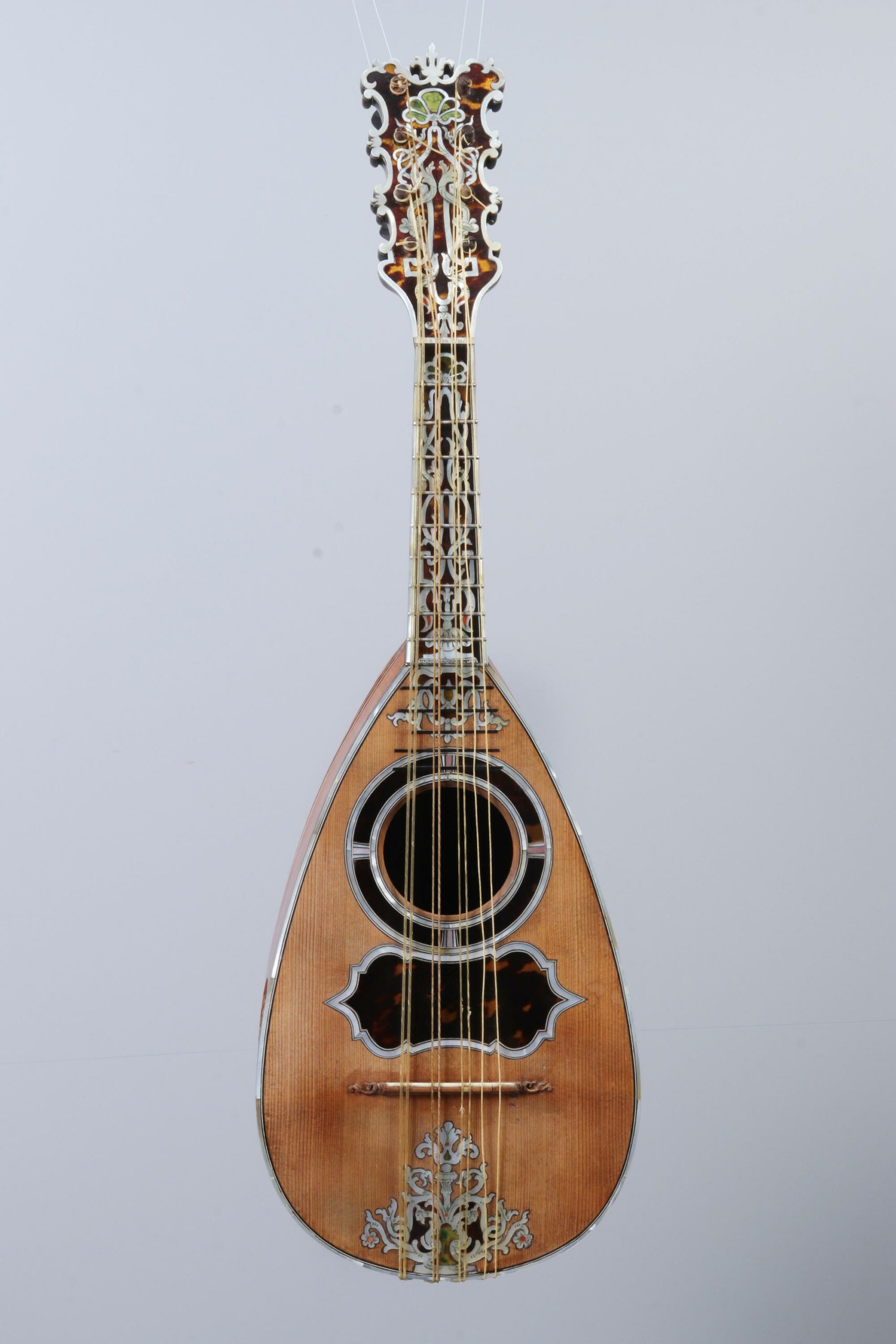
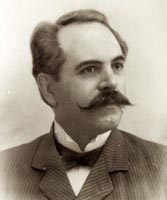
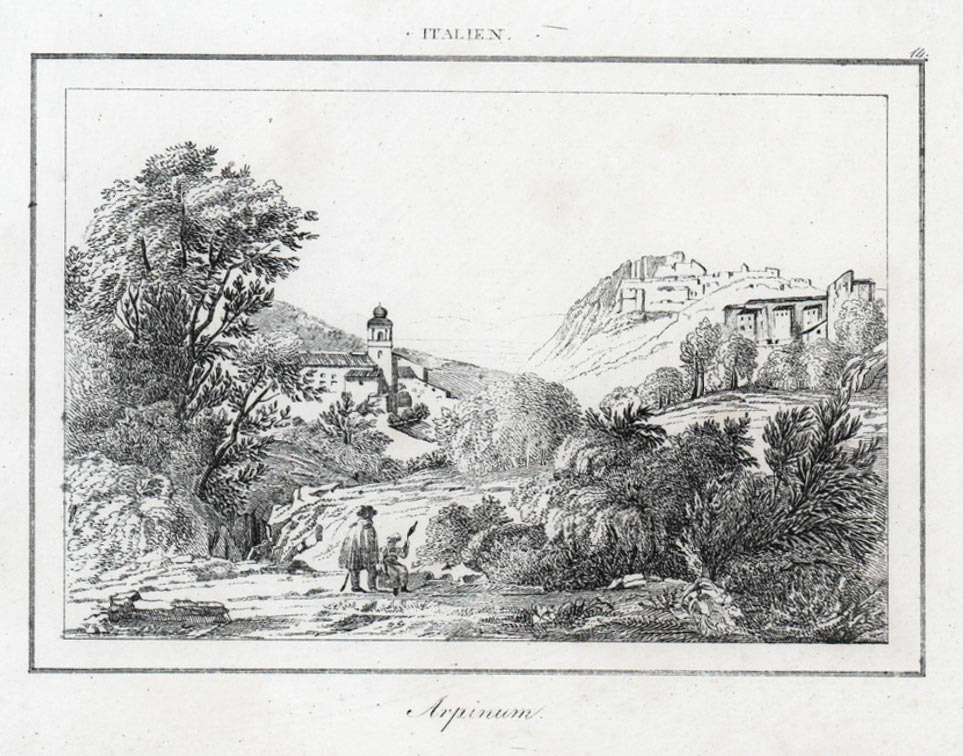
Antonio Luigi Embergher naît le 4 février 1856 à Arpino, entre Rome et Naples, dans le Latium. Son père, Pietro Embergher, était un ébéniste d’origine austro-hongroise.
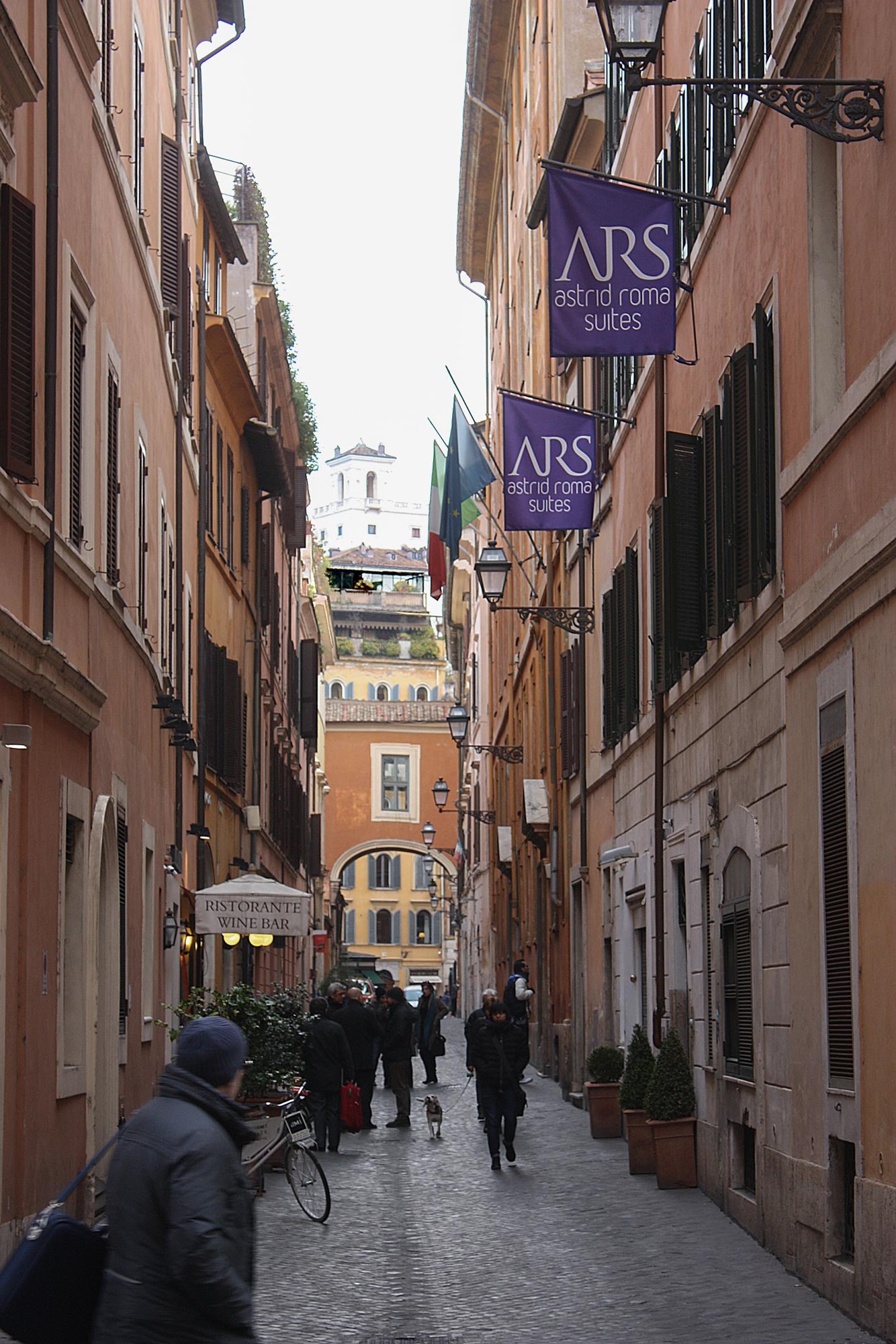
Certains historiens pensent que le père de Luigi aurait aussi été luthier et que Luigi Embergher se serait formé auprès de lui, dans l’atelier familial, avant d’en prendre la direction dans les années 1880. Luigi Embergher a également probablement été formé auprès d’un luthier romain, à la suite de cette potentielle formation avec son père. Quoiqu’il en soit, on sait qu’il ouvrit un atelier à Rome en 1890, 21 Via dei Greci [1], transféré en 1913 au 7 Via Belsiana jusqu’en 1962.
La plus ancienne mandoline connue portant sa signature est datée de 1888, soit avant son installation à Rome. En toute logique, l’étiquette de l’instrument indique ainsi l’adresse d’Arpino, au 26 de la Via Marco Agrippa. Contrairement à ce que pourrait laisser penser l’importance prise par Rome dans l’histoire de la maison, l’atelier familial d’Embergher resta toujours installé à Arpino.
“Il ne fait également aucun doute, comme en témoignent ses mandolines encore existantes, qu’Embergher a suivi l’école romaine de conception de mandolines au cours de ses premières années dans le métier. Ses instruments présentent le même design que les meilleures et les plus célèbres mandolines contemporaines de sa région, en particulier celles de De Santis et de Maldura.”
Stephen Morey, Mandolins of the 18th Century, Edition Turris, 1993, dans A. Woll, op. cit. , p.56
[1] Alfred Woll, op. cit., p.57,traduction personnelle du texte original
« Loin de se contenter de fabriquer des mandolines, il s’efforçait de les faire évoluer et d’explorer les limites du possible. Il abordait chaque détail, aussi infime soit-il, avec soin et attention. »
— Alfred Woll, op. cit. p.56, traduction personnelle du texte original
Luigi Embergher chercha avant tout à améliorer la justesse des mandolines et le confort de jeu des musiciens. Il mit ainsi au point différentes innovations, telles qu’un frettage optimisé, des chevalets compensés ou encore l’introduction d’une frette zéro, permettant un meilleur équilibre entre les cordes à vide et les notes frettées. Il expérimenta également différents barrages asymétriques afin d’équilibrer la réponse des graves et des aigus, tout en travaillant sur la légèreté et la résonance de la table d’harmonie. Enfin, il développa plusieurs solutions plus ponctuelles, comme une touche en porte-à-faux réglable ou des mécaniques facilitant le changement des cordes, témoignant de sa quête de l’instrument idéal.[2]
Ses mandolines pouvaient posséder 29 ou 31 frettes et, autour de 1900, il abandonna le tempérament égal pour adopter un système de frettage modifié, associé à des chevalets compensés.
[2] Alfred Woll, op. cit. p.62
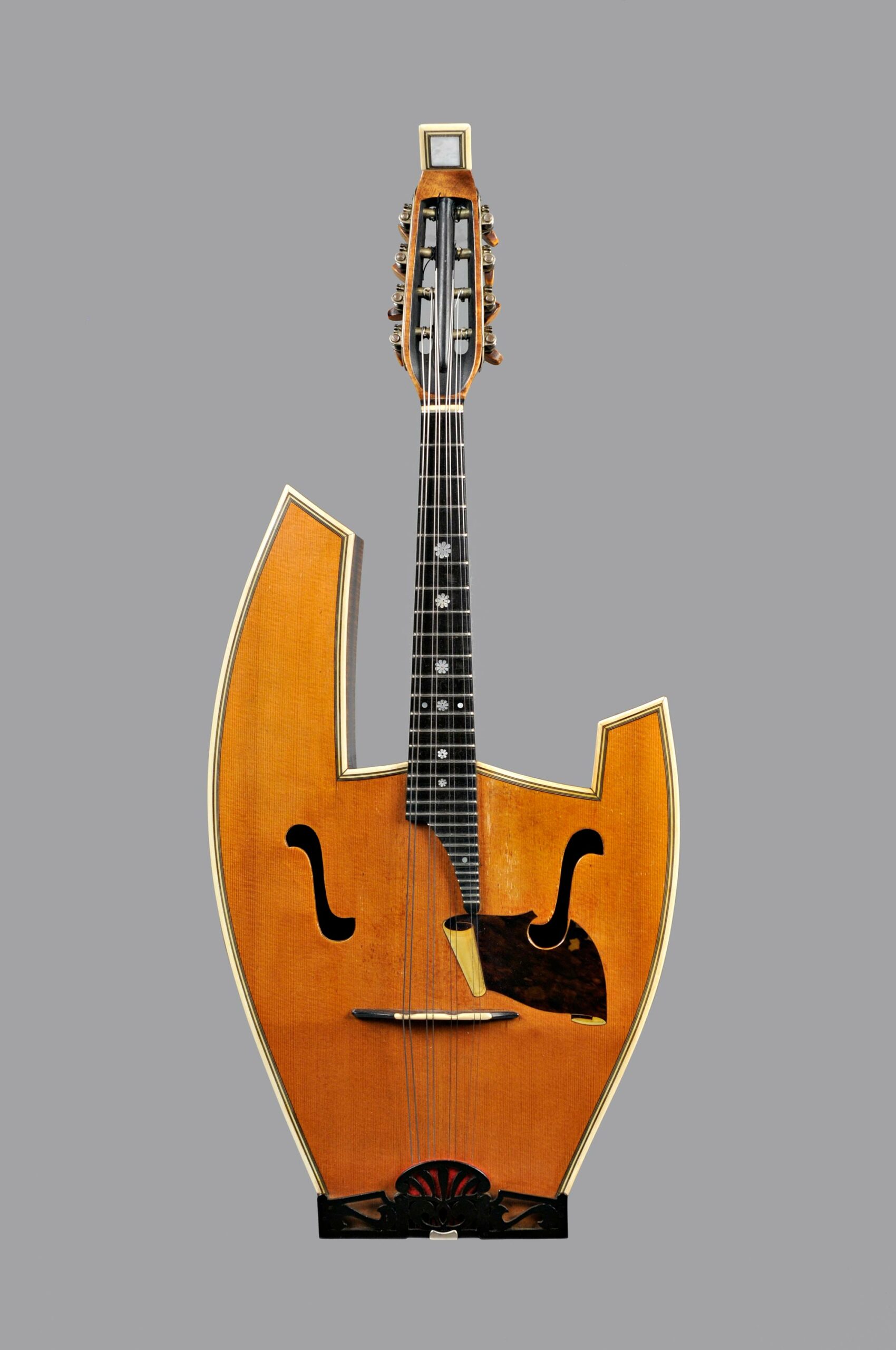
Embergher expérimenta ainsi tout au long de sa carrière de nouvelles solutions, même si certaines ne furent finalement utilisées que durant quelques années. Cette volonté d’expérimenter et d’être toujours à l’avant-garde l’amena à réaliser des instruments parfois particulièrement audacieux, comme nous avons pu en être témoins à Vichy Enchères, lors de la vente en 2012 d’une étonnante mandoline cubiste réalisée à Rome en 1929. Totalement subversive dans le domaine de la facture instrumentale et unique modèle connu, cet instrument était à la fois une œuvre d’art et un modèle 5bis très abouti.
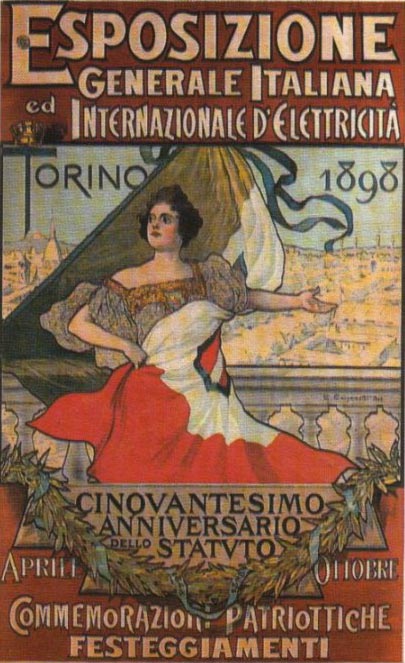
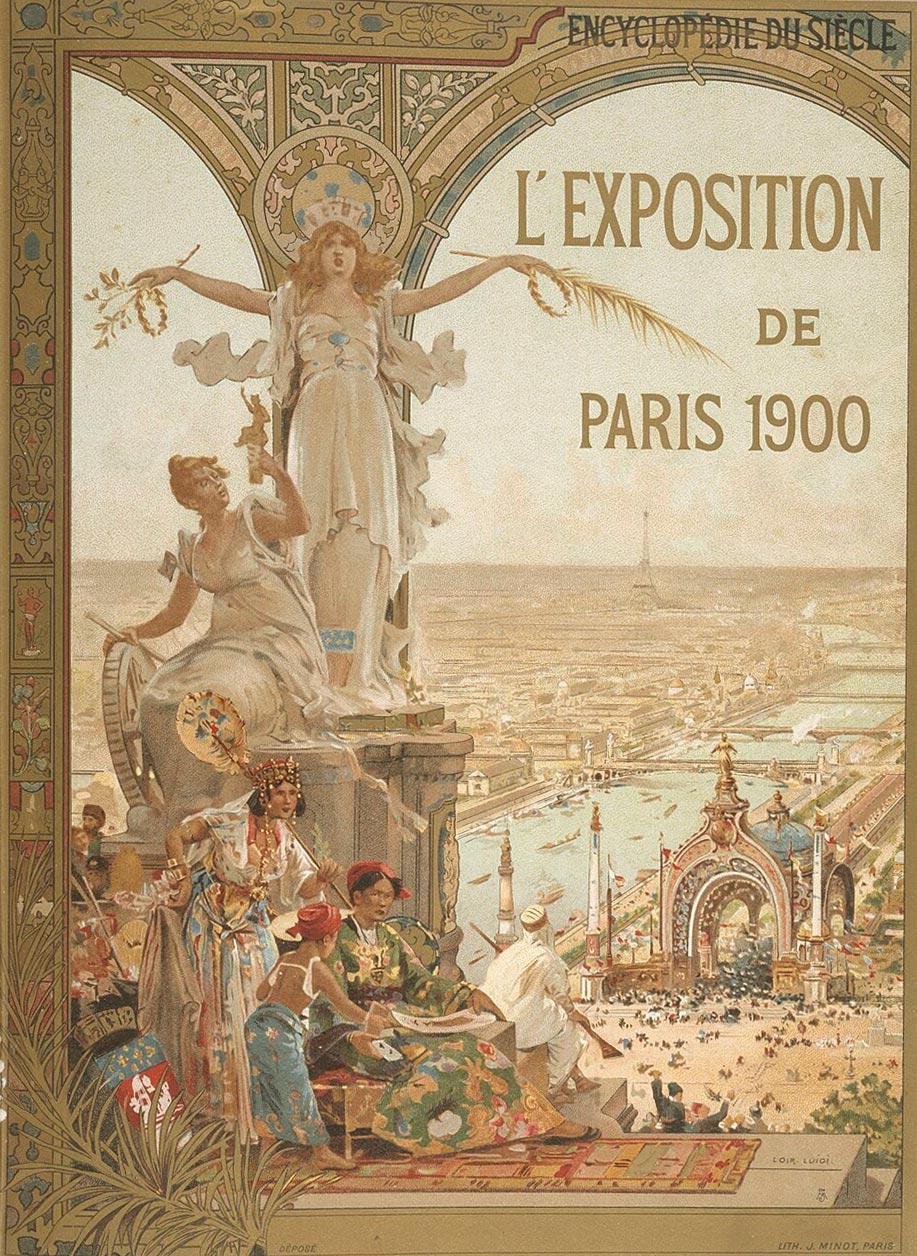
Moins d’une dizaine d’années après l’ouverture de son atelier romain, Embergher fut récompensé pour ses instruments. Ainsi, en 1897, il reçut une médaille d’or lors d’une exposition internationale consacrée aux nouvelles inventions à Vienne. Cette distinction intervint la même année que le dépôt, à Rome, le 23 janvier, d’un brevet concernant notamment une touche surélevée et réglable. De nouvelles récompenses suivirent à Turin en 1898 puis à Paris en 1900[1].
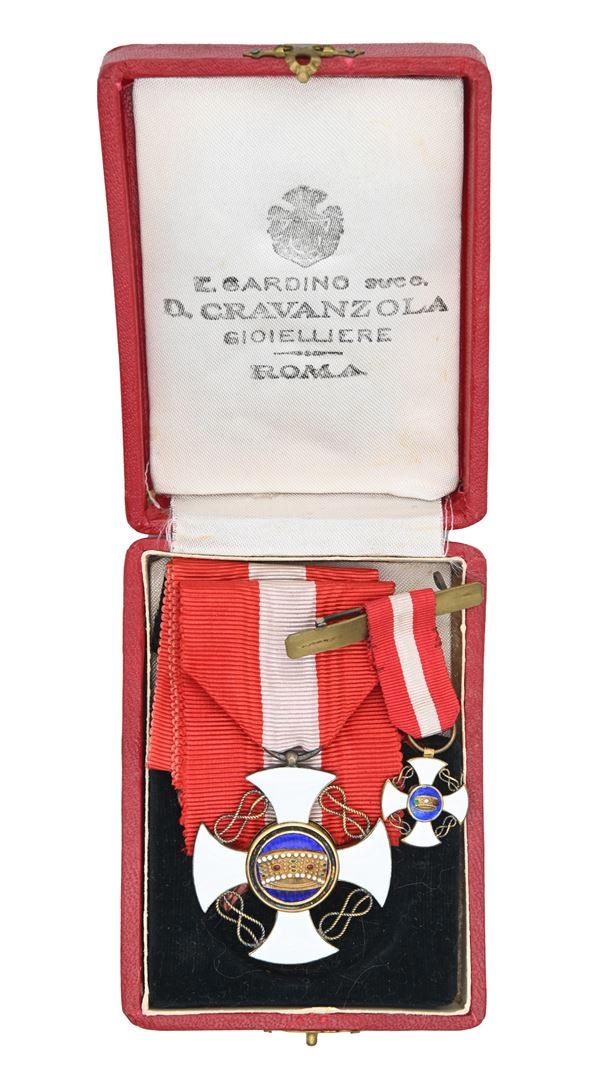
Le succès de la maison ne cessa dès lors de croître et en 1913, il fut fait Cavaliere della Corona d’Italia.
[1] Alfred Woll, op. cit., pp. 61-62
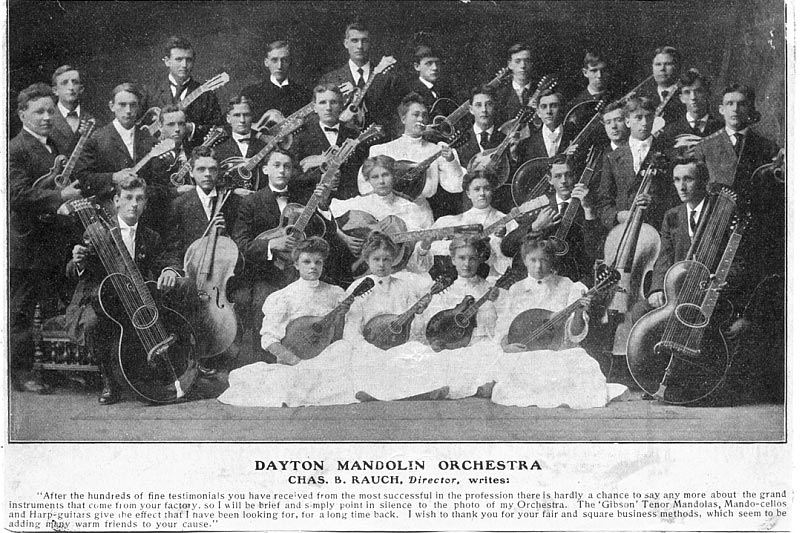
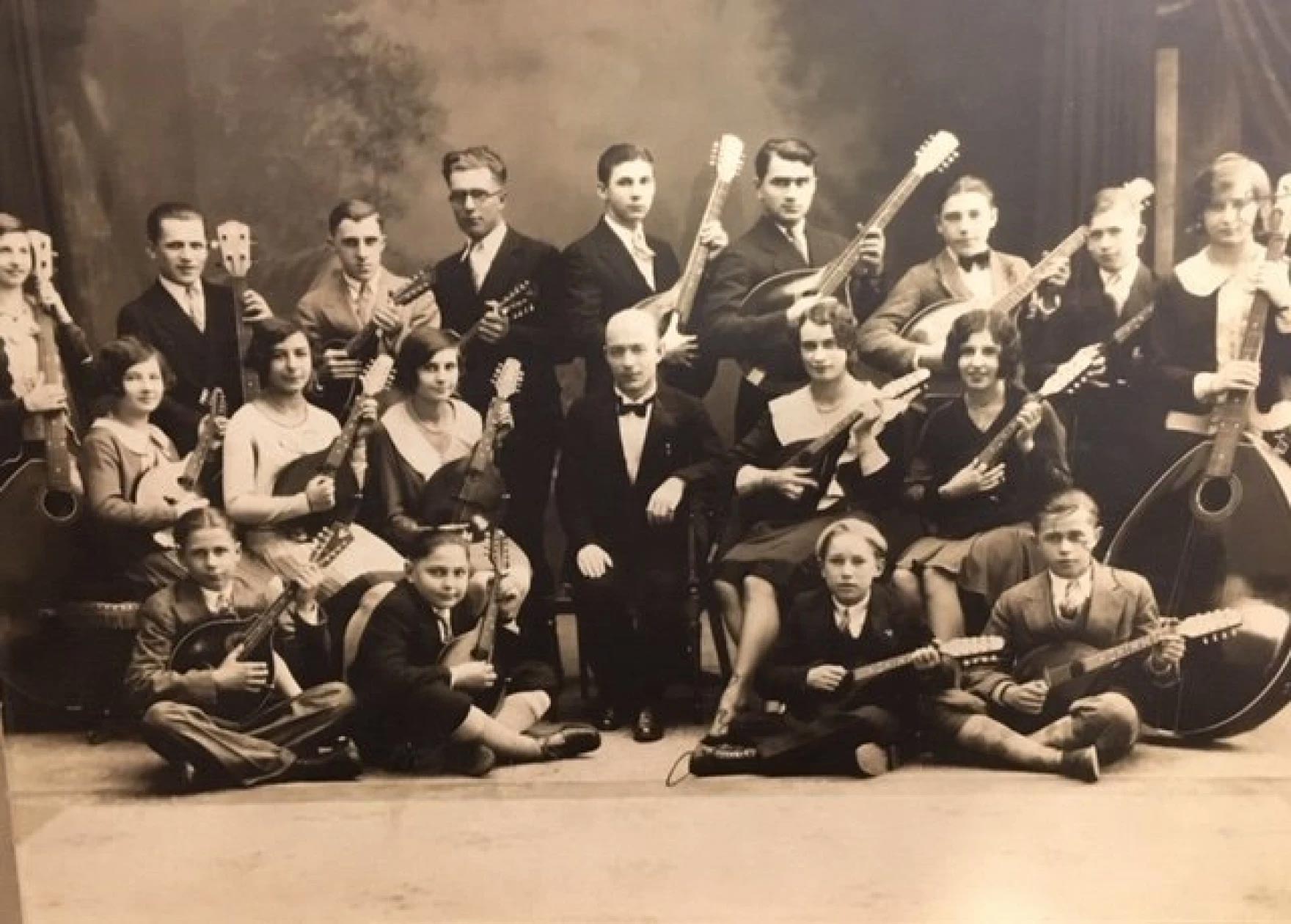
Les mandolines d’orchestre occupaient une place essentielle dans la pratique musicale de l’époque. À partir de la fin du XIXème siècle, le succès croissant de la mandoline favorisa en effet la multiplication des ensembles et des orchestres à plectre, réunissant plusieurs instruments de la même famille. Embergher participa pleinement à cette évolution en développant des instruments adaptés aux différents registres de ces formations. En 1897, il présenta ainsi un quatuor conçu sur le modèle du quatuor à cordes, composé de deux mandolines, d’une mandola ténor et d’un mandocello. Sa production s’étendait également à la mandola à l’octave, au liuto cantabile, au quartino, au terzino ou encore à la mando-basse, permettant ainsi de couvrir une large étendue de registres. Pour la mandoline elle-même, Embergher développa parallèlement plusieurs modèles destinés à la pratique orchestrale, numérotés de 1 à 4. Ces numéros ne correspondaient pas à des registres différents, mais à différentes déclinaisons de la mandoline d’orchestre, qui se distinguaient notamment par leur construction, leurs matériaux et leur degré de finition. Embergher proposait ainsi une gamme diversifiée, adaptée aux différentes pratiques de la mandoline. Les modèles Orchestra se déclinaient du n° 1 au n° 4, avec des constructions et des degrés de finition différents, tandis que les n° 5, 5 Bis et 6 étaient destinés au concert et aux solistes. Les mandolines d’orchestre n’en bénéficiaient pas moins des recherches menées par Embergher sur la sonorité et la construction de l’instrument, notamment sur le barrage de la table d’harmonie
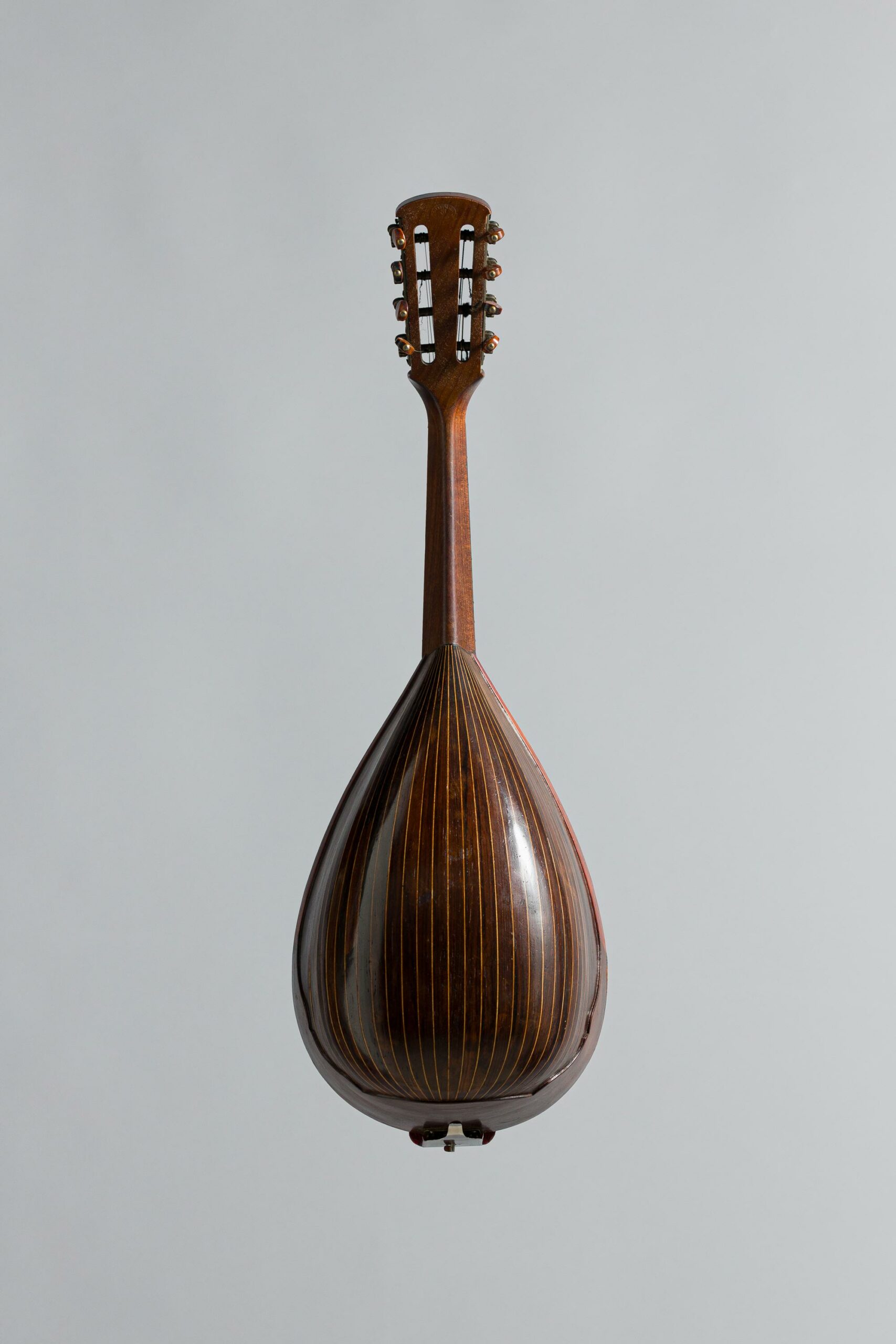
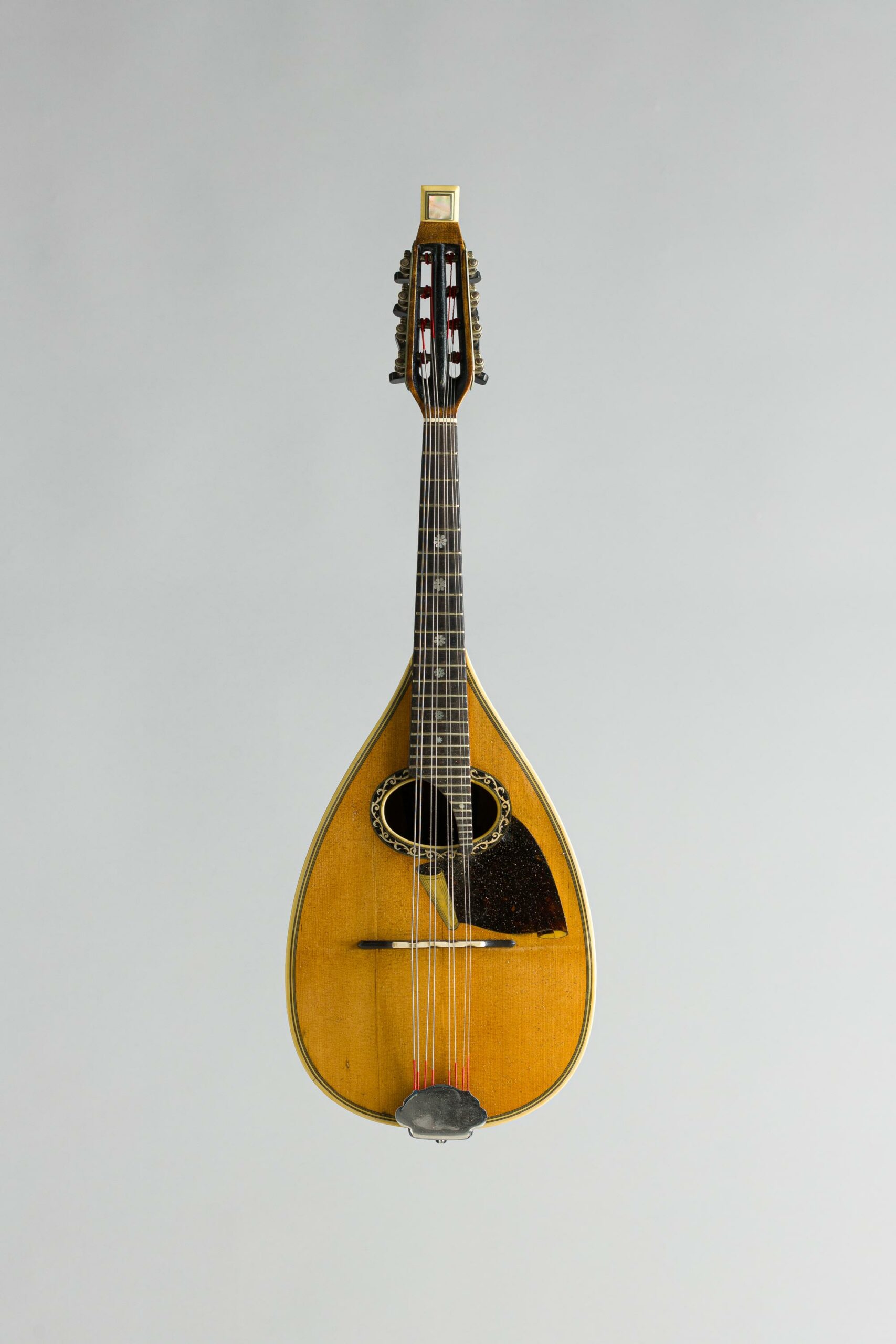
La plus ancienne mandoline de notre ensemble est un Model Orchestra 2 réalisé en 1913. L’Orchestra n° 2 était l’un des modèles conçus par Embergher pour la pratique collective de la mandoline. Comme souvent chez le luthier, sa conception évolua au cours du temps et les modèles conservés présentent certaines variations, notamment dans le nombre de côtes composant la caisse. Celui de 1913 présenté ici en possède vingt-six, tandis que des Orchestra n° 2 plus tardives peuvent en compter vingt-huit. Ce modèle conserve néanmoins les principales caractéristiques de la mandoline romaine développée par Embergher, associant une caisse profonde à une touche prolongée au-dessus de la table et une construction pensée pour offrir précision et équilibre sonore.
Sa caisse est constituée de vingt-six côtes et l’instrument porte une étiquette Luigi Embergher ainsi qu’une marque au fer “Luigi Embergher Roma” au revers de la tête. Comme de coutume chez les Embergher, l’instrument est soigné dans ses moindres détails et présente notamment sur la touche et le pourtour de la bouche des ornements de nacre. Les quatre modèles dits d’orchestre – dont fait partie celui-ci – étaient tous richement décorés.
Ce modèle mérite également notre attention puisqu’il correspond à une période particulièrement importante pour la maison. Comme nous l’avons vu, c’est précisément en 1913 qu’Embergher reçut le titre de Cavaliere della Corona d’Italia. C’est également cette année-là que son magasin romain fut transféré de la Via dei Greci à la Via Belsiana.
Le succès rencontré par les instruments d’Embergher s’accompagna d’un important développement de sa production.
“Vers 1920, à l’apogée de son succès, il employait 15 apprentis, ouvriers et maîtres artisans, fabriquant jusqu’à 100 mandolines par mois.”
Alfred Woll, op. cit. p.67
C’est précisément durant cette période de prospérité que furent réalisées les premières mandolines de notre ensemble. Ainsi, notre mandoline Model Orchestra 1 de 1921, réalisée dans le style des instruments de Luigi Embergher, illustre les caractéristiques de cette production au début des années 1920. Sa touche de concert et son décor de nacre ornant la touche et le pourtour de la tête rappellent les modèles de la maison.
La présence dans une même vente d’une Orchestra 1 et d’une Orchestra 2 offre par ailleurs une occasion intéressante de confronter deux instruments relevant de cette même tradition de facture, bien que huit années séparent nos deux exemplaires. Une différence apparaît immédiatement dans la construction de leur caisse, concernant les côtes, puisque l’Orchestra 2 de 1913 en possède vingt-six côtes, contre dix-huit pour l’Orchestra 1 de 1921. Le nombre de côtes constitue un élément important dans l’étude des mandolines Embergher, sans pouvoir naturellement être retenu comme seul critère d’identification.
Réalisée en 1921, notre Orchestra 1 précède de quelques années la standardisation progressive de la production Embergher. Au milieu des années 1920, la gamme est en effet largement établie et comprend deux modèles d’étude – les Tipo A et Tipo B -, quatre modèles d’orchestre numérotés de 1 à 4 et plusieurs mandolines destinées aux solistes et au concert.
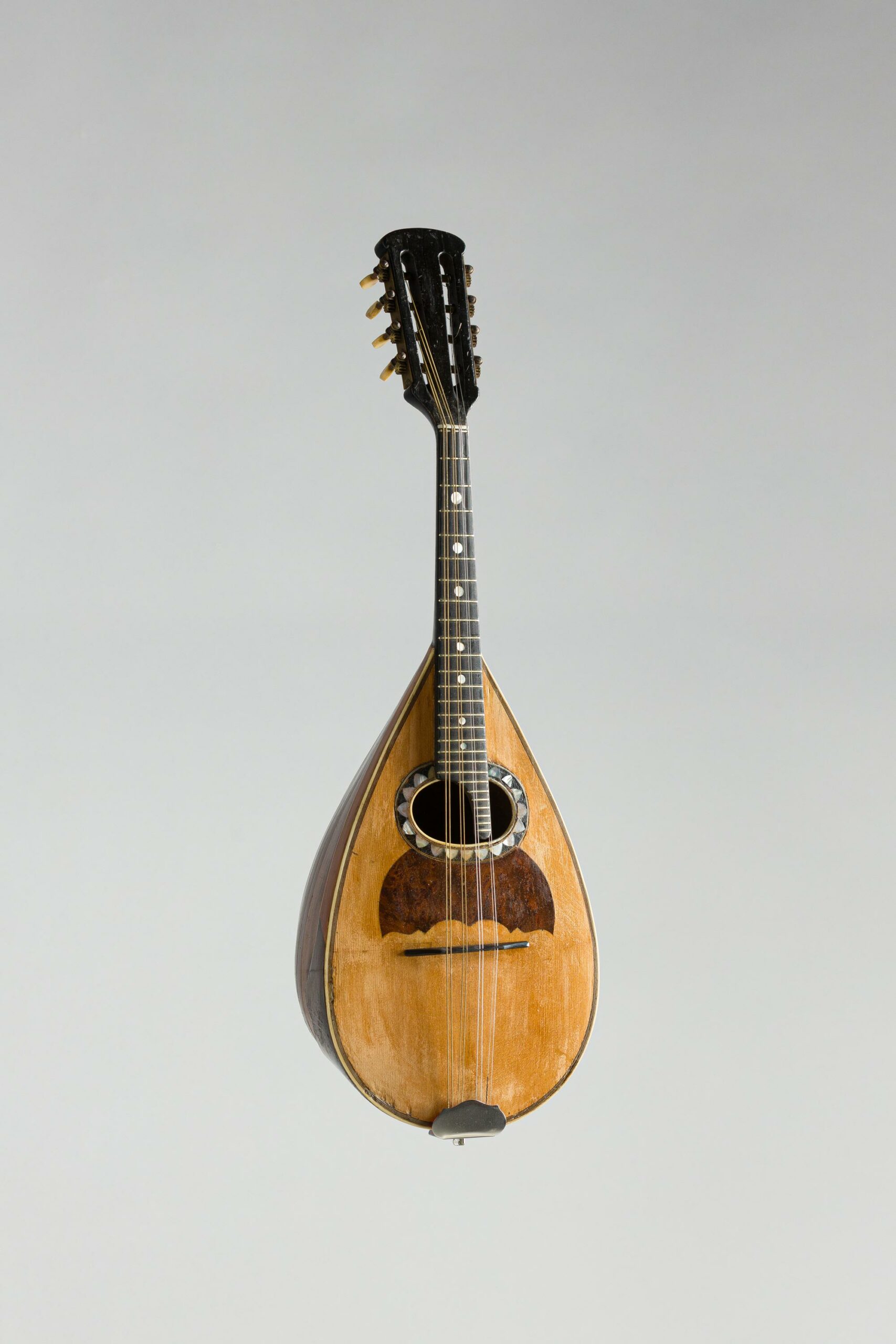
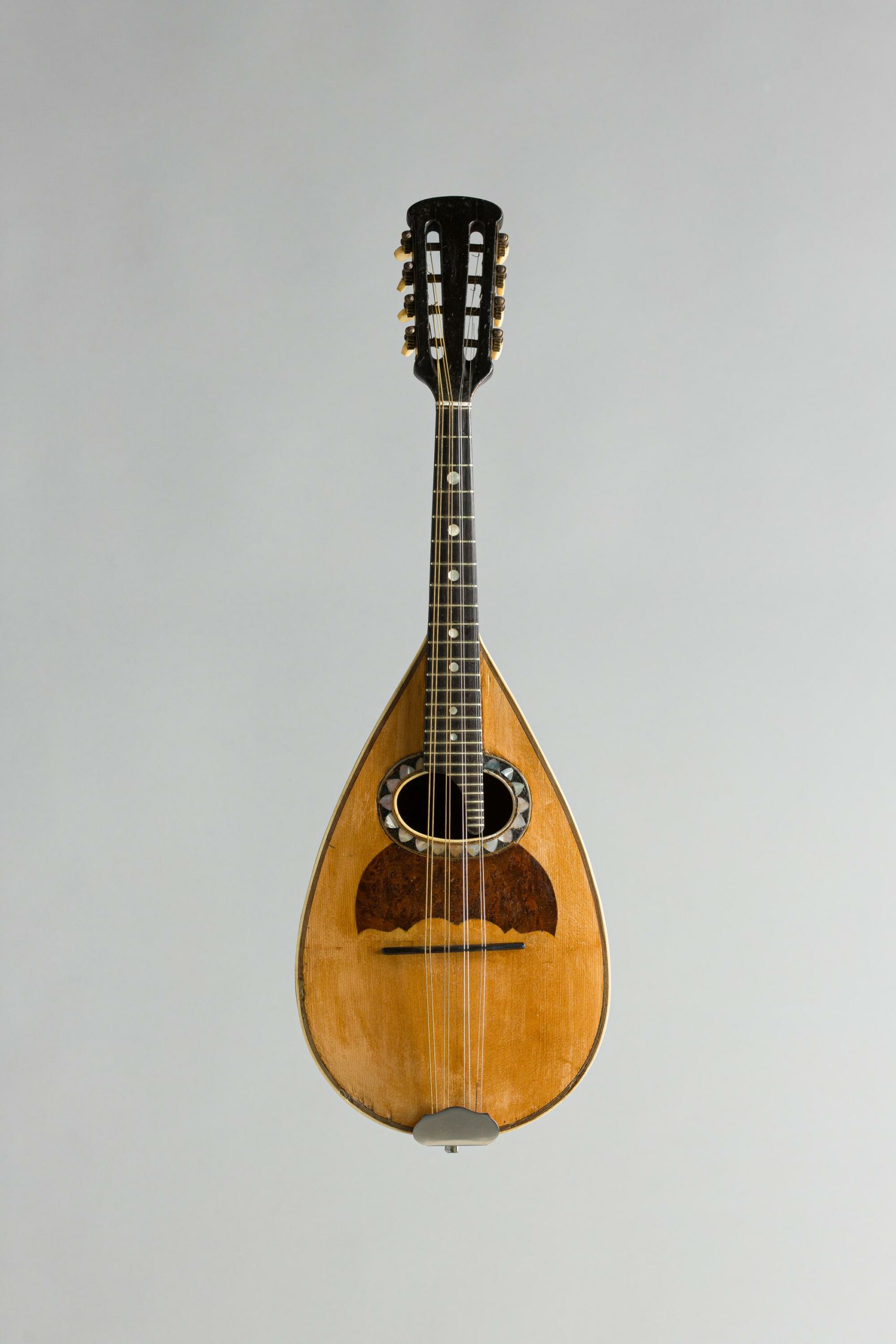
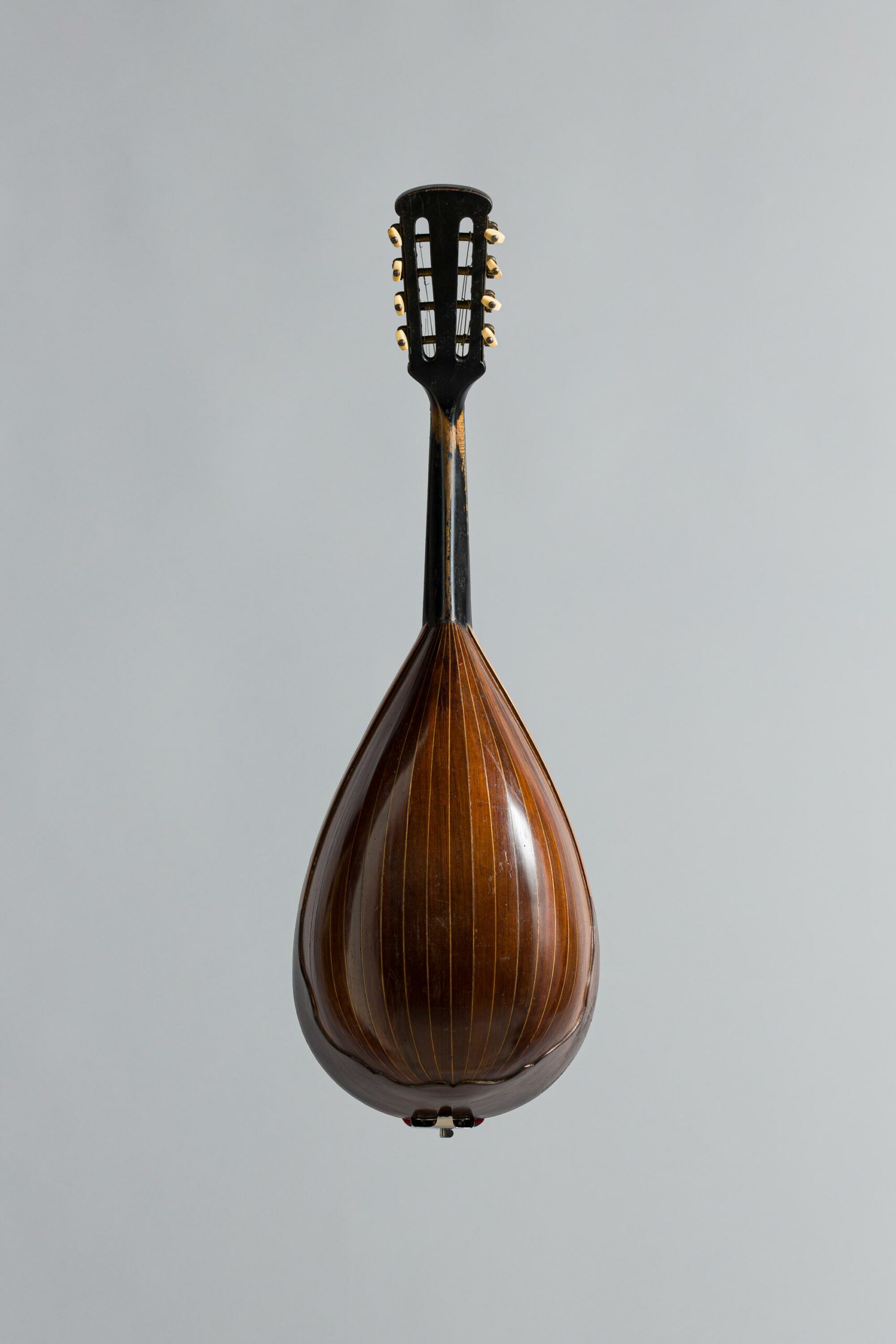
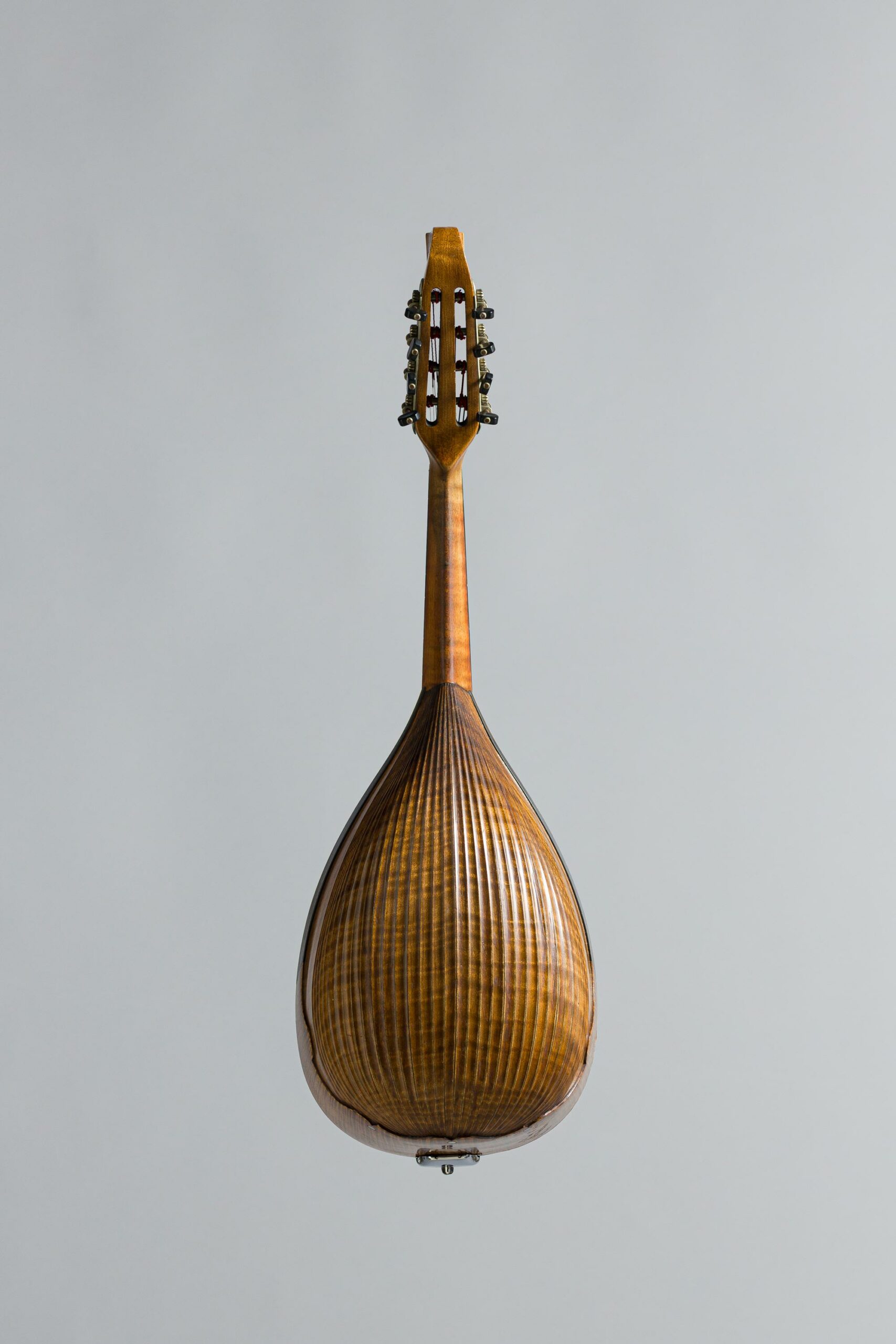
Le troisième instrument est sans doute le plus emblématique de notre ensemble. Réalisé en 1927, ce Model 5 Bis appartient aux mandolines de soliste et de concert les plus prestigieuses de la maison Embergher. Le modèle cristallise plusieurs décennies de recherches menées par le luthier sur la construction et les qualités acoustiques de la mandoline. Plus grand et plus robuste que les modèles antérieurs, il se distingue notamment par une caisse à trente-quatre côtes cannelées et par une conception privilégiant avant tout la sonorité de l’instrument pour la pratique soliste.
Le 5 Bis acquit ainsi une réputation particulière auprès des musiciens. Woll le présente comme le modèle phare d’Embergher en matière de sonorité et de confort de jeu, dont la conception resta pratiquement inchangée jusqu’à la fermeture de l’atelier. Il souligne notamment la puissance et la brillance de sa sonorité, qui lui permettaient aussi bien de répondre aux exigences d’un soliste que de s’imposer au sein d’un ensemble.
“Pour de nombreux musiciens, la légendaire Embergher n° 5b est un chef-d’œuvre abouti et le couronnement de l’œuvre d’Embergher. En tant que mandoline de solo, elle possède une sonorité puissante ; elle a un son brillant et sait s’imposer au sein d’un ensemble. La table d’harmonie est d’une qualité exceptionnelle.”
Alfred Woll, op. cit., p. 71
Notre exemplaire présente en outre l’intérêt d’avoir été réalisé en 1927, à la fin d’une période de grande prospérité pour la maison. En effet, dès 1928, la diminution des commandes entraîna une forte réduction de la production, suivie d’une fermeture temporaire de l’atelier, avant une reprise du travail en 1930. Cette mandoline s’inscrit ainsi dans les dernières années durant lesquelles Luigi Embergher demeura à la tête de l’entreprise, qu’il transmit finalement à Domenico Cerrone en 1938.
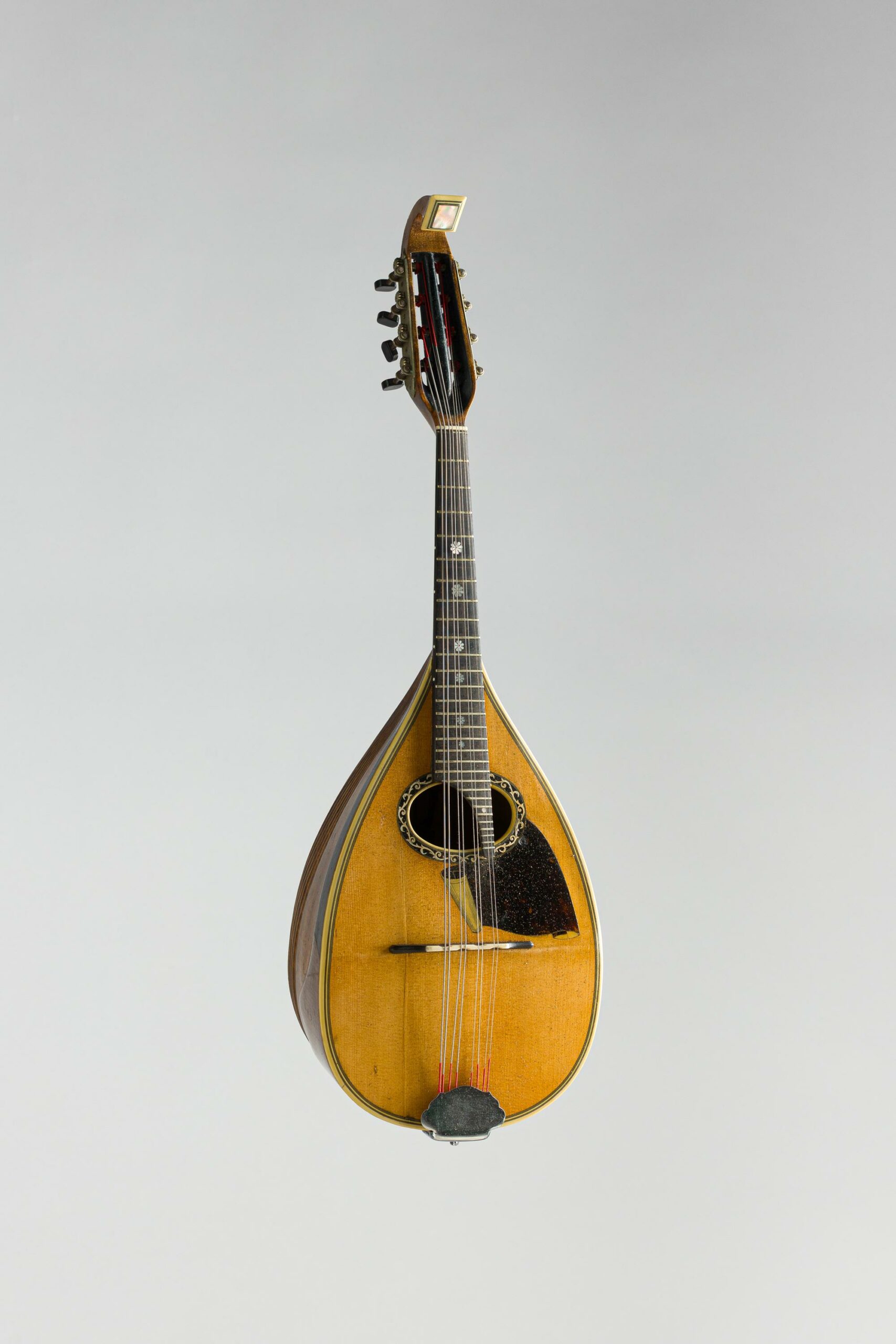
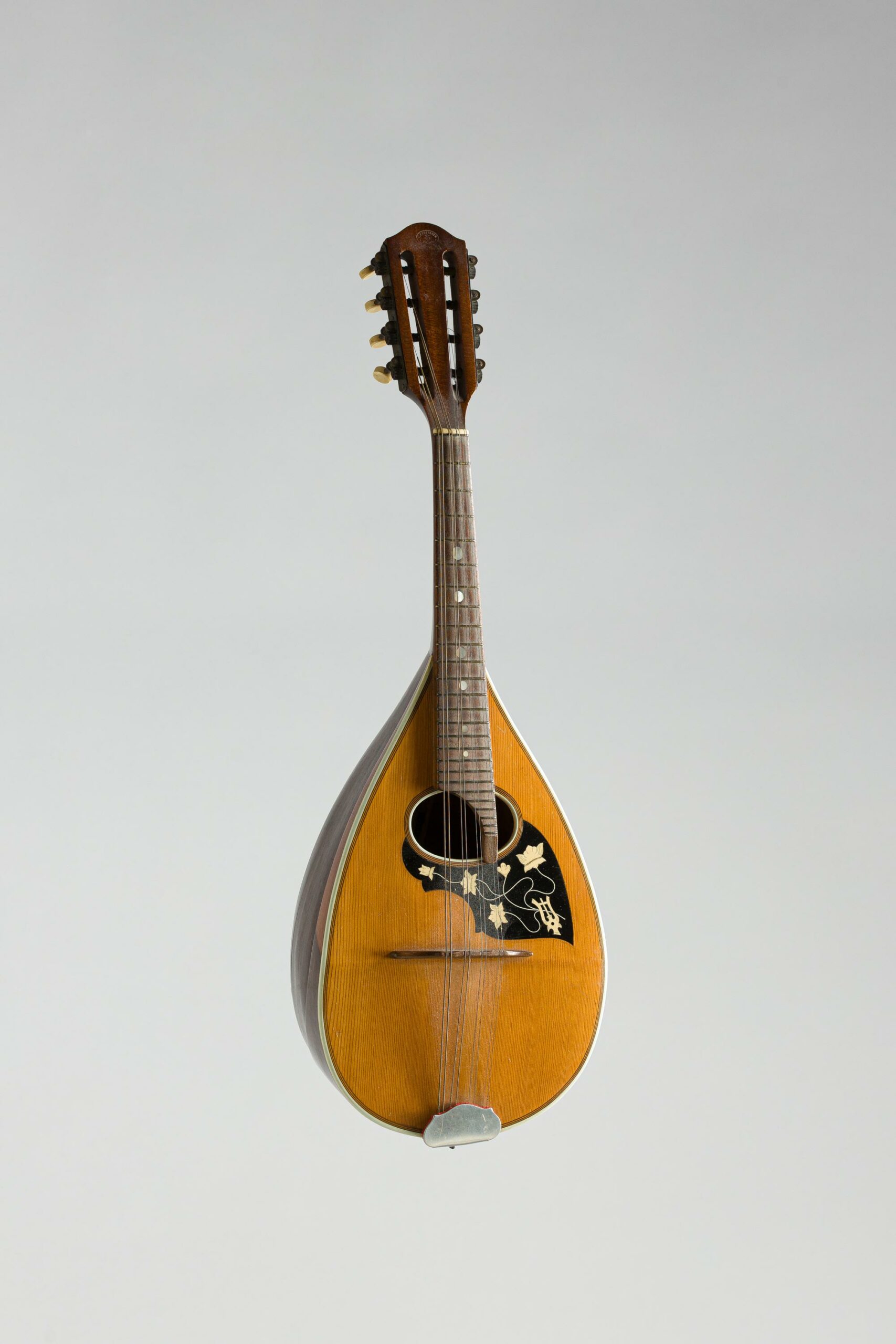
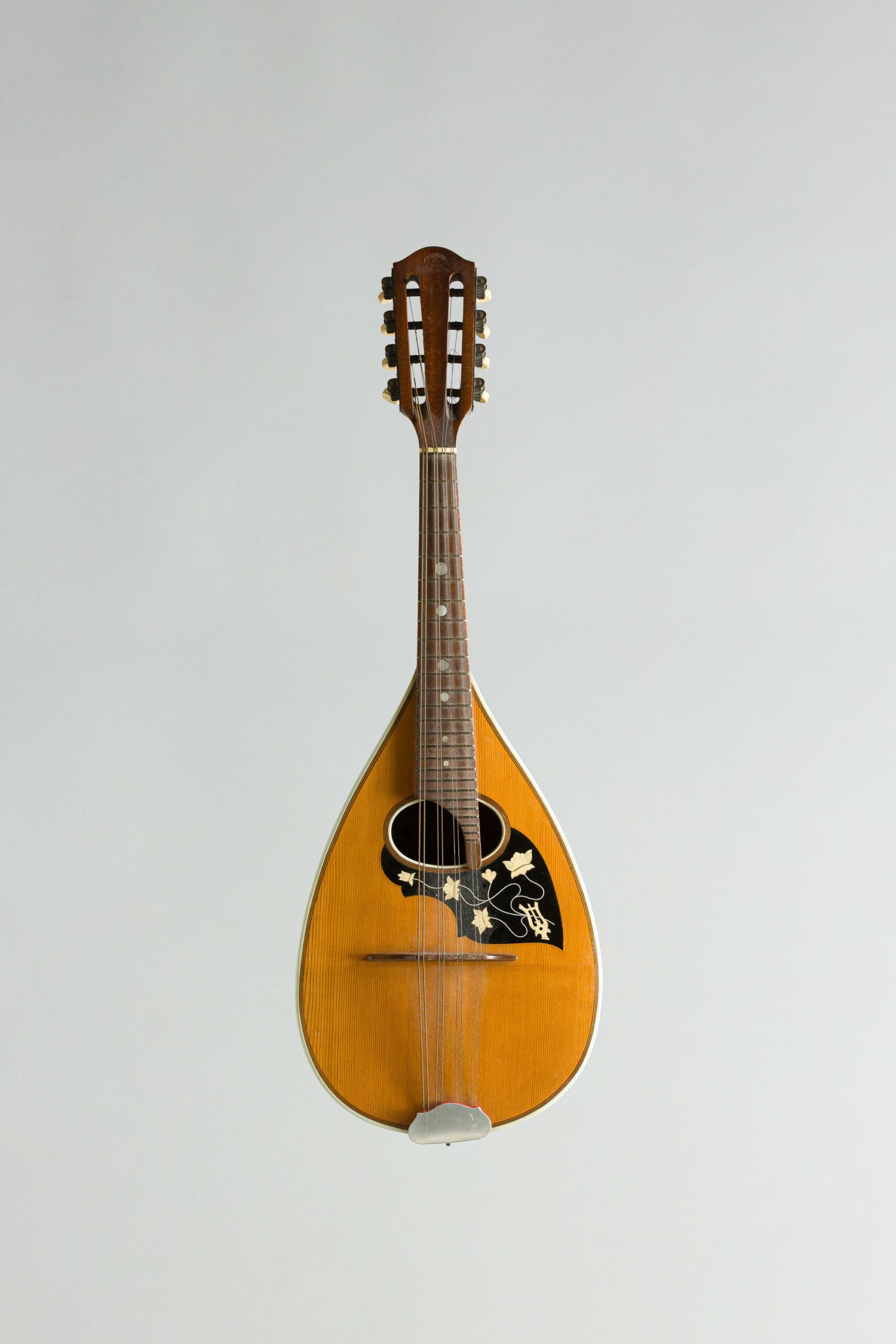
La dernière mandoline de notre ensemble s’inscrit dans une période de transition pour la maison Embergher. Datée de 1948, cette mandoline Model B, portant le numéro 548, conserve une étiquette et une marque au fer Luigi Embergher. Réalisée cinq ans après la disparition du luthier, elle témoigne ainsi de la permanence de son nom au sein de la production de l’atelier. En effet, Domenico Cerrone connaissait intimement la production d’Embergher. Né en 1891, il avait commencé très jeune son apprentissage auprès du luthier et devint l’un des principaux maîtres artisans de son atelier. Selon Alfred Woll, il en était probablement le meilleur [1]. En 1938, Luigi Embergher lui transmit finalement l’entreprise ainsi que le droit de poursuivre la production sous son nom.
Cerrone poursuivit dès lors la fabrication des mandolines et le savoir-faire de son maître.
[1] Alfred Woll, op. cit. p.70
“Cerrone poursuivit l’activité dans l’esprit d’Embergher et avec le même souci de qualité.”
Alfred Woll, op. cit., p. 70
Cerrone ne se contenta toutefois pas de reproduire les instruments de son prédécesseur. Après la mort d’Embergher en 1943, il fit notamment évoluer le barrage de la table d’harmonie en utilisant des barres moins hautes, au profil plus triangulaire et à l’inclinaison plus prononcée. Ces modifications semblent témoigner de nouvelles expérimentations destinées à faire évoluer la sonorité des instruments. Réalisé en 1948, notre Model B appartient à cette période de transition. Cinq ans après la disparition de Luigi Embergher, il témoigne de la permanence de son héritage au sein de l’atelier. La marque Embergher apposée sur sa tête prend alors tout son sens, rappelant la continuité de la maison après la mort de son fondateur.
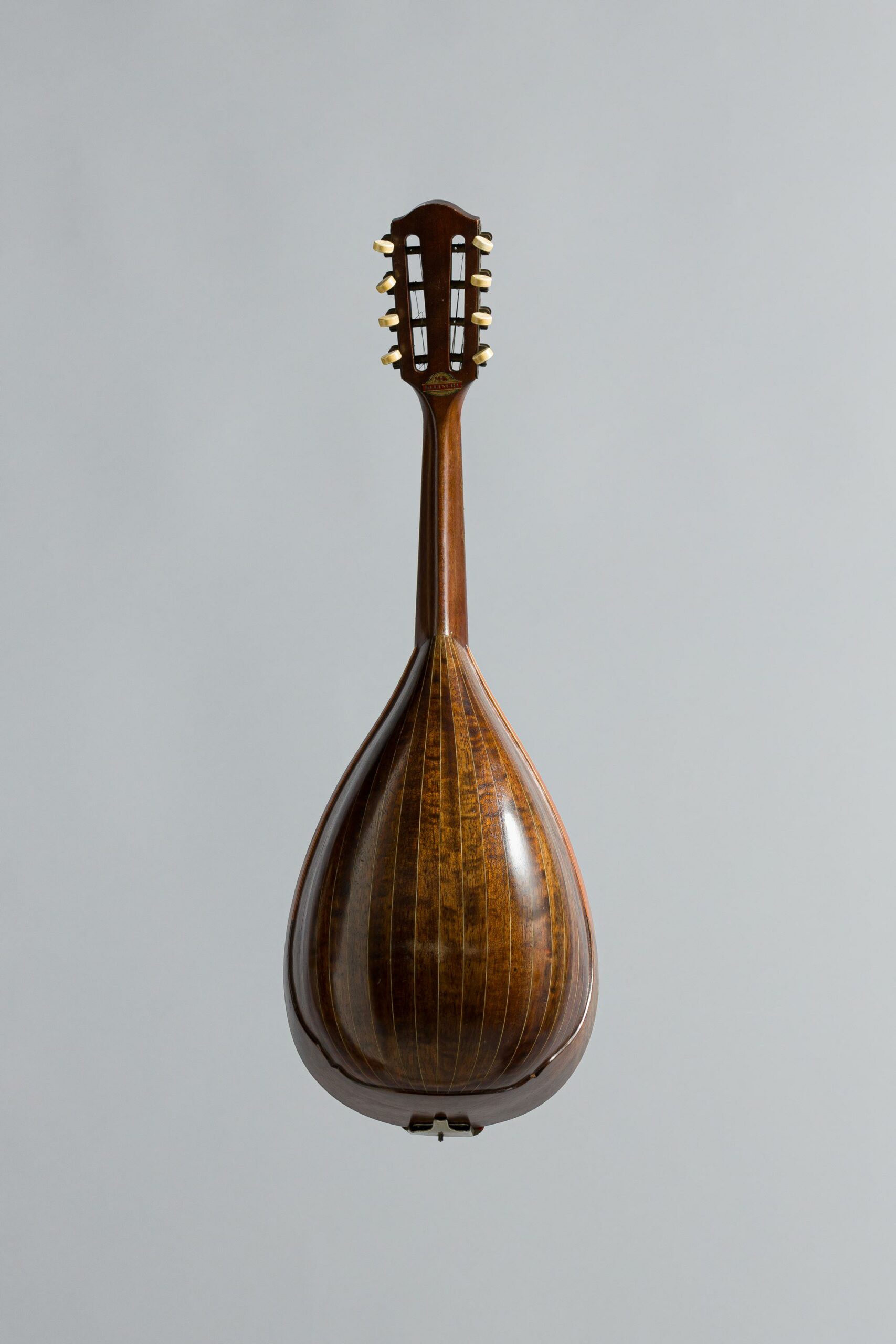
Réunies dans une même vente, ces quatre mandolines permettent ainsi de parcourir trente-cinq ans d’histoire de la maison Embergher. Des modèles d’orchestre aux instruments destinés aux solistes, elles témoignent de l’évolution constante d’une production marquée par les recherches de Luigi Embergher sur la construction et les qualités sonores de la mandoline. Le Model B de 1948 prolonge enfin cette histoire au-delà de la disparition du luthier, illustrant la transmission de son savoir-faire et la permanence de son héritage.
Vichy Enchères invites you to discover four mandolins spanning 35 years of the history of the renowned firm of Luigi Embergher. From the Orchestra 2 from 1913 to the Model B from 1948, and including an Orchestra 1 from 1921 and a famous 5 Bis from 1927 in between, these instruments bear witness to the evolution of Embergher’s output and the passing down of his craftsmanship.
The history of the modern mandolin is inextricably linked to Naples. During the second half of the 18th century, the Baroque mandolin gradually evolved into a new type of instrument, known as the Neapolitan mandolin. The Vinaccia family, and in particular Gennaro and Antonio, played a pivotal role in its development. The instrument’s proportions were altered, the body was widened, the bridge raised and gut strings were replaced by metal strings tuned in fifths. The body was constructed from bent wooden ribs and the soundboard featured a distinct angle starting at the bridge. Thanks to these innovations, Naples established itself as the capital of the mandolin, and the instrument achieved great success, not only in Italy, but throughout the rest of Europe, where it found its way into royal courts.
However, as Alfred Woll points out in The Art of Mandolin Making:
“[T]here have always been renowned luthiers in many other regions of Italy. Innovative master makers, in Rome and its surrounding area, also contributed to the evolution of the mandolin. One of the most skilled and renowned among them was Antonio Luigi Embergher (1856 – 1943).”
Alfred Woll, The Art of Mandolin Making: Historical Development and Construction of the Mandolin, Edition MANDO, 2021, traduction personnelle du texte original, p.54
Antonio Luigi Embergher was born on 4 February 1856, in Arpino, which is located in the Lazio region between Rome and Naples. His father, Pietro Embergher, was a cabinetmaker of Austro-Hungarian origin.
Some historians believe that Luigi’s father was also a luthier and that Luigi Embergher trained under him in the family workshop, before taking over its management in the 1880s. Luigi Embergher likely also trained with a Roman luthier, after his possible apprenticeship with his father. In any case, what is certain is that he opened a workshop in Rome in 1890 at 21 Via dei GreciCertains historiens pensent que le père de Luigi aurait aussi été luthier et que Luigi Embergher se serait formé auprès de lui, dans l’atelier familial, avant d’en prendre la direction dans les années 1880. Luigi Embergher a également probablement été formé auprès d’un luthier romain, à la suite de cette potentielle formation avec son père. Quoiqu’il en soit, on sait qu’il ouvrit un atelier à Rome en 1890, 21 Via dei Greci[1], which was relocated in 1913 to 7 Via Belsiana, where it remained until 1962.
The oldest known mandolin bearing his signature dates from 1888, i.e. before he settled in Rome. Consequently, the instrument’s label includes the address in Arpino, at 26 Via Marco Agrippa. Despite the importance of Rome in the firm’s history, the Embergher family workshop always remained based in Arpino.
“There is also no doubt, as evidenced by his surviving mandolins, that Embergher followed the Roman school of mandolin making during his early years in the trade. His instruments share the same design as the mandolins made in his region by his finest and most renowned contemporaries, particularly De Santis and Maldura.”
Stephen Morey, Mandolins of the 18th Century, Edition Turris, 1993, dans A. Woll, op. cit. , p.56
[1] Alfred Woll, op. cit., p.57,traduction personnelle du texte original
« Far from being content with merely manufacturing mandolins, he strove to evolve the instrument and push the boundaries of what was possible. He approached every detail, however minute, with care and attention. »
— Alfred Woll, op. cit. p.56, personal translation of the original text
Luigi Embergher’s primary goal was to improve the mandolin’s intonation and its ease of play. To this end, he developed and introduced various innovations, such as a more effective fret placement, compensated bridges, and a zero fret, which improved the balance between open strings and fretted notes. He also experimented with asymmetrical bracing patterns to balance the response of the bass and treble registers, while simultaneously working to enhance the lightness and resonance of the soundboard. Finally, he developed several solutions to particular challenges posed by the instrument, such as an adjustable cantilevered fingerboard, and tuning machines that made string changes easier, attesting to his quest for the ideal instrument[2]. His mandolins featured either 29 or 31 frets and, around 1900, he abandoned equal temperament in favour of a modified fret-spacing system, paired with compensated bridges.
[2] Alfred Woll, op. cit. p.62
Throughout his career, Embergher experimented with new ideas, even though some of the resulting innovations only lasted a few years. This desire to experiment and remain at the forefront of innovation led him to create instruments that were at times strikingly bold, as illustrated by a surprising Cubist mandolin made in Rome in 1929, which was sold by Vichy Enchères in 2012. This instrument, which is very radical in terms of instrument making, and the only known example of its kind, was both a work of art and a highly accomplished Model 5bis.
Less than a decade after opening his workshop in Rome, Embergher received recognition for his instruments. In 1897, for instance, he was awarded a gold medal at an international exhibition dedicated to new inventions in Vienna. This distinction came the same year he filed in Rome, on 23 January, a patent for, among others, a raised and adjustable fingerboard. Further awards followed in Turin in 1898 and Paris in 1900[1].
The firm’s success continued to grow from then on and, in 1913, he was made Cavaliere della Corona d’Italia.
[1] Alfred Woll, op. cit., pp. 61-62
Orchestral mandolins played a vital role in the musical practice of the time. From the late 19th century onwards, the mandolin’s rising popularity led to the proliferation of plectrum ensembles and orchestras that played several instruments from the same family. Embergher played a key role in this evolution by developing instruments tailored to the different registers of these ensembles. In 1897, he introduced a quartet based on the string quartet, consisting of two mandolins, a tenor mandola and a mandocello. His production also expanded to include the octave mandola, liuto cantabile, quartino, terzino and even the mando-bass, thereby covering a wide range of registers. Regarding the mandolin itself, Embergher developed simultaneously several models for orchestral use, numbered 1 through 4. These numbers did not correspond to different registers, but rather to different forms of the orchestral mandolin, distinguished in particular by their construction, materials and level of finish. Embergher thus offered a diverse range, suited to the different ways of playing the mandolin. The Orchestra models ranged from no. 1 to 4, featuring varying qualities of construction and finish, while models no. 5, 5 Bis and 6 were intended for concert use and soloists. Nevertheless, the orchestral mandolins benefited from Embergher’s research into the instrument’s sound and construction, particularly in relation to the bracing of the soundboard.
The oldest mandolin in our selection is a Model Orchestra 2 made in 1913. The Orchestra no. 2 was one of the models Embergher intended for mandolin ensemble playing. As was often the case with this maker, its design evolved over time, and surviving examples feature some variations, particularly in the number of ribs making up the body. The 1913 example presented here has twenty-six ribs, whereas later Orchestra no. 2 models may have twenty-eight. However, this model retains the key characteristics of the Roman mandolin developed by Embergher, combining a deep body and a fingerboard extending over the soundboard, as well as a construction designed to deliver precision and tonal balance.
Its body is composed of twenty-six ribs, and the instrument bears a Luigi Embergher label as well as a « Luigi Embergher Roma » brand on the back of the headstock. As is customary with Embergher instruments, this example was manufactured with meticulous attention to detail, and features in particular mother-of-pearl ornamentation on the fingerboard and around the soundhole. The four so-called orchestra models – of which this one is part of – were all richly decorated.
This example is also interesting for dating from a particularly significant period for the firm. As previously noted, it was in 1913 that Embergher was awarded the title of Cavaliere della Corona d’Italia. That same year, his workshop in Rome was relocated from Via dei Greci to Via Belsiana.
The success of Embergher’s instruments led to a significant expansion of his production.
“Around 1920, at the height of his success, he employed 15 apprentices, workmen and master craftsmen, producing up to 100 mandolins per month.”
Alfred Woll, op. cit. p.67
It was precisely during this period of prosperity that the earliest mandolins in our selection were made. Indeed, our Model Orchestra 1 from 1921, made in the style of Luigi Embergher’s instruments, exhibits the features typical of this production in the 1920s. Its concert-style fingerboard and the mother-of-pearl ornamentation adorning both the fingerboard and the perimeter of the headstock are reminiscent of the models of that firm.
Furthermore, the inclusion of both an Orchestra 1 and an Orchestra 2 in the same sale provides an interesting opportunity to compare two instruments rooted in the same manufacturing tradition, despite the eight-year gap between them. One difference is immediately apparent in the construction of their bodies, specifically the ribs, as the 1913 Orchestra 2 features twenty-six ribs, compared to eighteen for the 1921 Orchestra 1. The number of ribs is a significant element when examining Embergher mandolins, although, naturally, it cannot be relied upon as the sole criterion for authentication.
Our Orchestra 1, which was made in 1921, predates the gradual standardization of Embergher’s production by a few years. By the mid-1920s, the product range was well established, and included two student models (the Tipo A and Tipo B), four orchestra models numbered 1 through 4, and several mandolins designed for soloists and concert performance.
The third instrument is arguably the most iconic in our selection. This Model 5 Bis, made in 1927, ranks among the most prestigious soloist and concert-grade mandolins ever produced by the firm of Embergher. The model crystalises decades of research conducted by the maker into the mandolin’s construction and acoustic qualities. It is larger and more robust than earlier models, and is distinctive, in particular, for its body featuring thirty-four fluted ribs and a construction designed to optimize the instrument’s tone for solo performance.
The 5 Bis thus earned a special reputation among musicians. Woll describes it as Embergher’s flagship model in terms of tone and playability, and its design remained virtually unchanged until the workshop closed. He highlights, in particular, the power and brilliance of its tone, which allowed it to both meet the demands of a soloist and hold its own within an ensemble.
“For many musicians, the legendary Embergher no. 5b is a consummate masterpiece and the crowning achievement of Embergher’s work. As a solo mandolin, it boasts a powerful tone; its sound is brilliant, allowing it to cut through within an ensemble. The soundboard is of exceptional quality.”
Alfred Woll, op. cit., p. 71
Our particular example is also notable for having been made in 1927, i.e. towards the end of a period of great prosperity for the firm. Indeed, as early as 1928, a decline in orders led to a sharp reduction in production, followed by the temporary closure of the workshop, before activity resumed in 1930. This mandolin thus dates from the final years of Luigi Embergher’s reign over the firm, before he eventually handed it over to Domenico Cerrone in 1938.
The final mandolin in our selection belongs to a transitional period for the Embergher firm. This Model B mandolin, dating from 1948 and bearing the number 548, retains both a label and a brand stamp of Luigi Embergher. Produced five years after the maker’s passing, it serves as a testament to the enduring presence of his name within the workshop’s output. Indeed, Domenico Cerrone was intimately familiar with Embergher’s production. He was born in 1891, and began his apprenticeship with Embergher at a very young age, eventually becoming one of the workshop’s leading master craftsmen. According to Alfred Woll, he was arguably the best of them all [1]. In 1938, Luigi Embergher finally handed over the business to him, along with the rights to continue trading under the Embergher name.
As a result, Cerrone continued manufacturing mandolins according to the traditional methods learned from his master.
[1] Alfred Woll, op. cit. p.70
“Cerrone continued the business in the spirit of Embergher and with the same commitment to quality.”
Alfred Woll, op. cit., p. 70
However, Cerrone did not merely reproduce his predecessor’s instruments. In particular, following Embergher’s death in 1943, he modified the bracing of the soundboard, by using lower bars with a more triangular profile and a steeper angle. These changes seem to reflect new experiments aimed at improving the instruments’ tonal qualities. Our Model B from 1948 belongs to that transitional period. Five years after Luigi Embergher’s death, it stands as evidence that his legacy remained firmly rooted in the workshop. The Embergher brand stamped on the headstock therefore makes perfect sense, underscoring the continuity of the firm following the death of its founder.
Brought together in a single sale, these four mandolins take us on a journey through 35 years of the history of the Embergher firm. Ranging from orchestral examples to instruments designed for soloists, they reflect the constant evolution of an output shaped by Luigi Embergher’s research into the construction and tonal qualities of the mandolin. The Model B from 1948 extends this history beyond the maker’s lifetime, illustrating the passing down of his craftsmanship and the lasting impact of his legacy.