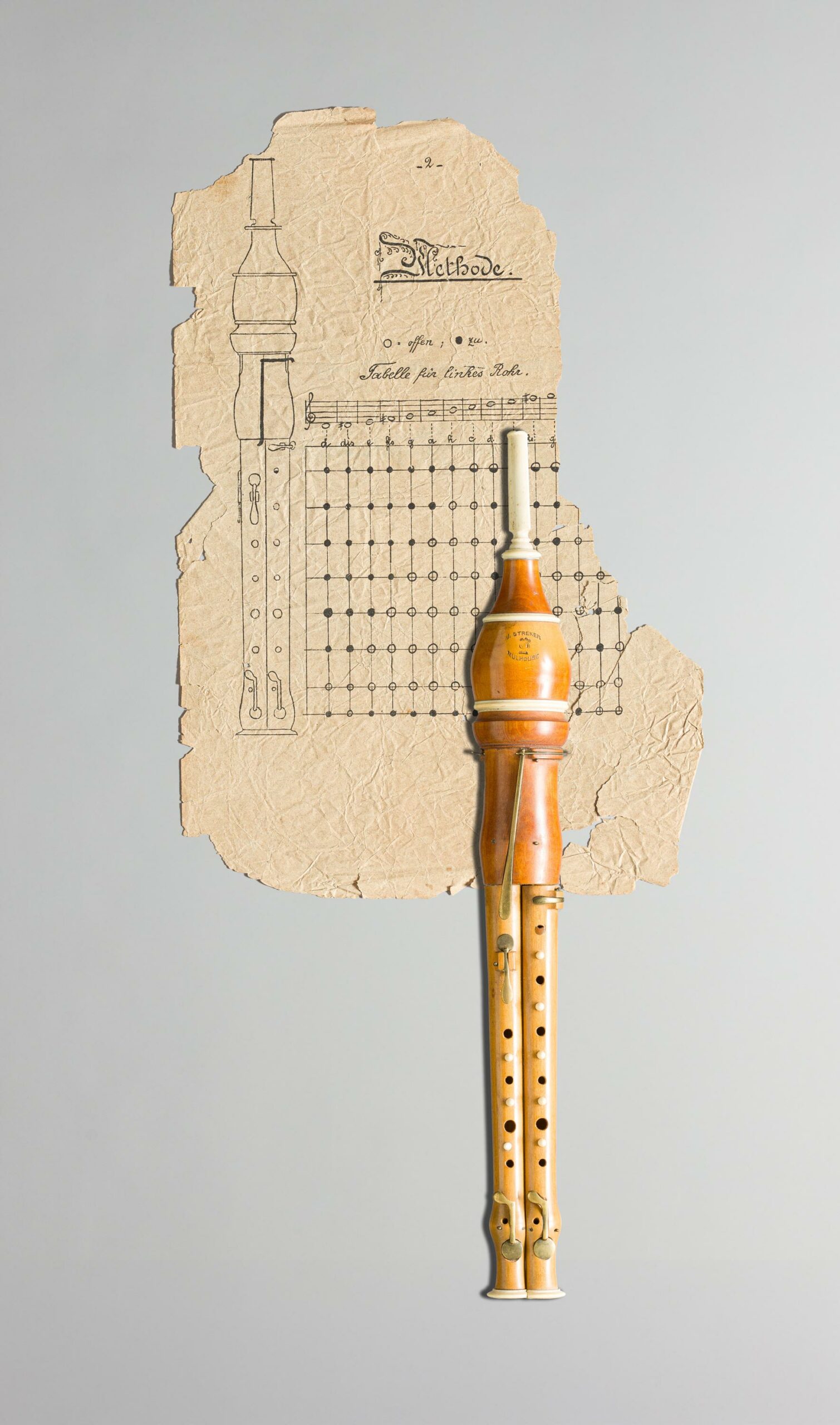
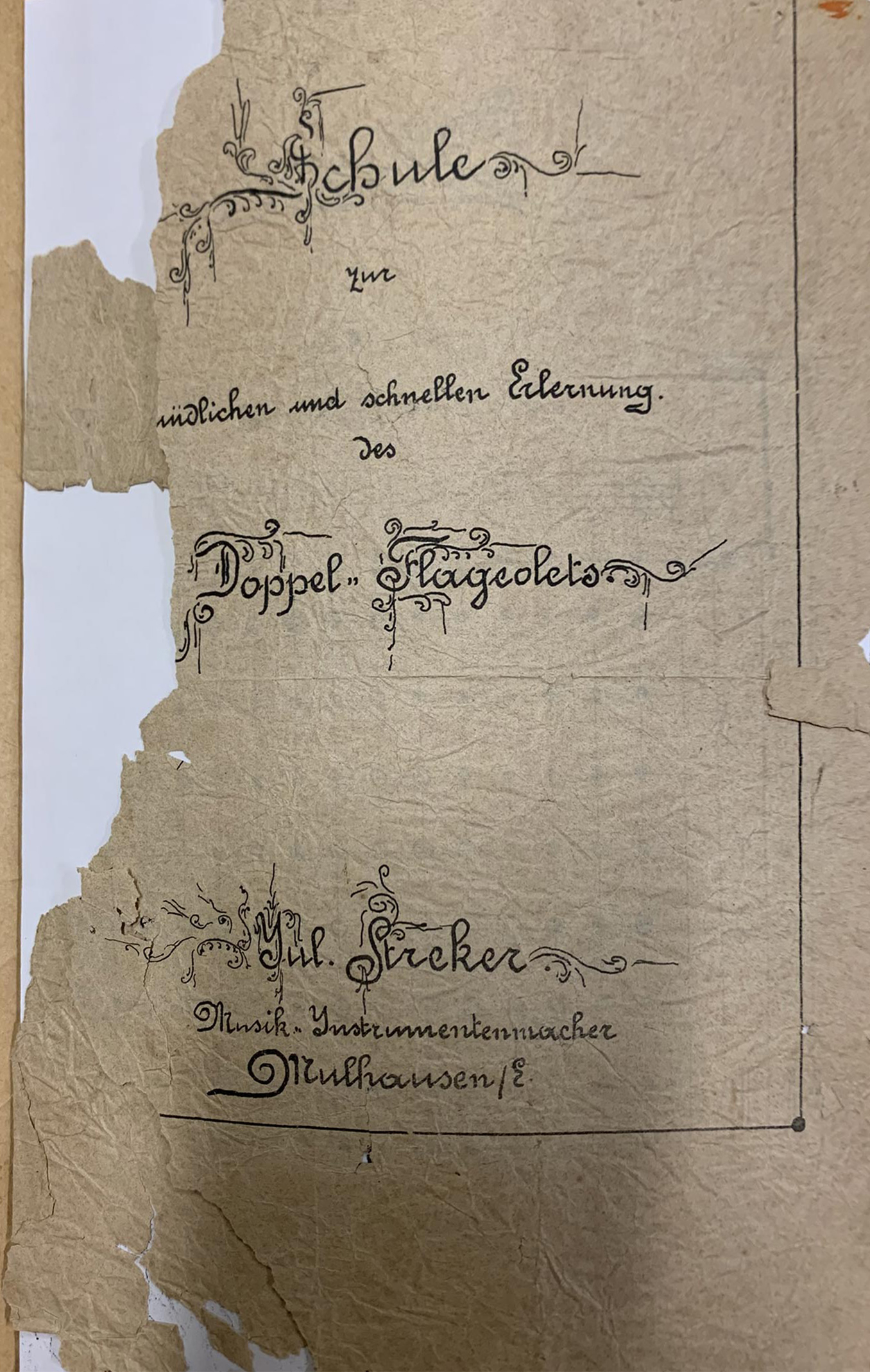
Comme chaque année, nos ventes d’instruments sont l’occasion de mettre en lumière des instruments ou facteurs méconnus. Le 7 novembre 2026, Vichy Enchères présentera ainsi un flageolet double portant l’estampille “J. STREKER [lyre] MULHOUSE”. L’instrument est accompagné de son étui, d’une méthode manuscrite de Streker intitulée “Schule zur gründlichen und schnellen Erlernung des Doppelflageolets” et d’une tablature ancienne. Julius Streker était jusque-là très peu documenté. Son nom et sa production de flageolets doubles étaient principalement connus par une notice de William Waterhouse dans The New Langwill Index en 1993, et par une note du même auteur dans The Galpin Society Journal en 1999. Cette note pourrait être anecdotique, mais il se trouve qu’elle mentionne précisément la méthode qui accompagne l’instrument de la prochaine vente Vichy Enchères. Cela est particulièrement remarquable sur le plan historique et patrimonial, car aucun exemplaire n’avait pu être localisé à ce jour. Sa découverte est donc exceptionnelle et vient apporter une preuve matérielle et unique du travail de Julius Streker. La découverte de cet ensemble a été le point de départ de recherches plus approfondies sur Streker, qui ont permis de préciser son identité et son activité, ainsi que sa postérité professionnelle, tout en replaçant sa production dans l’histoire de la diffusion continentale du flageolet double.
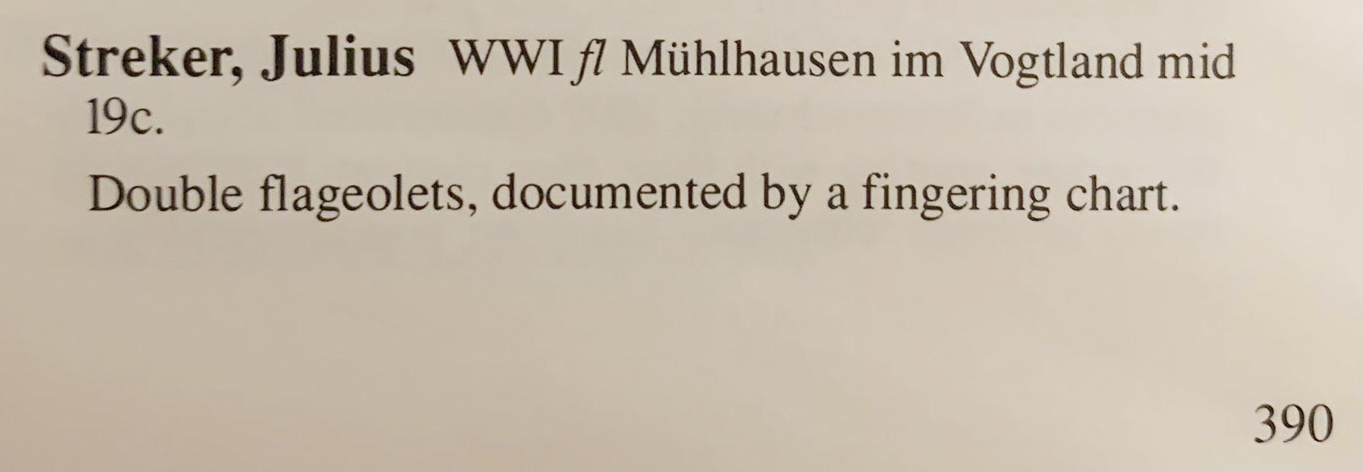
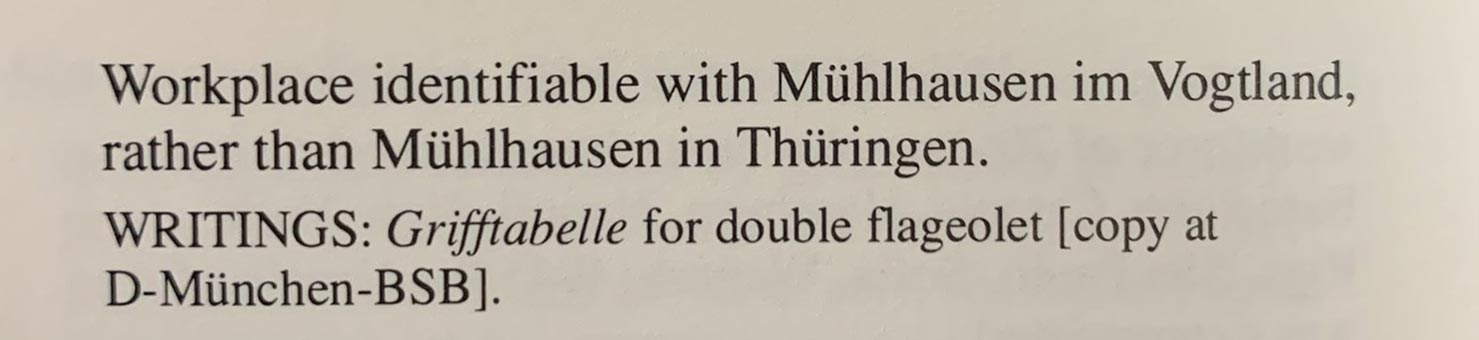
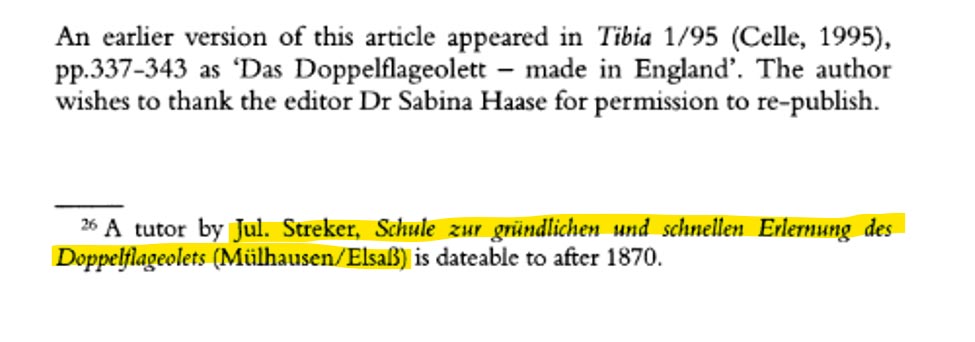
La principale source concernant Julius Streker est le New Langwill Index (1993)[1] de William Waterhouse, qui ne livre que de brèves informations à son sujet. Waterhouse y situe son activité à Mühlhausen, dans le Vogtland en Allemagne, vers le milieu du XIXème siècle. En 1999, dans son article consacré au flageolet double anglais, Waterhouse mentionne Streker dans une note, pour signaler l’existence d’une méthode de flageolet double écrite par le facteur et intitulée Schule zur gründlichen und schnellen Erlernung des Doppelflageoletts (une méthode d’apprentissage du flageolet double avec table de doigtés). Il précise qu’elle a été rédigée vers 1870 à “Mülhausen/Elsaß”[2], mais n’en donne aucune localisation. Cette note est particulièrement intéressante puisqu’elle cite précisément le titre de la méthode qui accompagne l’instrument en vente à Vichy Enchères, alors qu’on n’en connaissait pas d’exemplaire jusque-là. Elle est aussi significative car, à la différence de ce que Waterhouse avait écrit dans le Langwill, elle situe la réalisation de la méthode à “Mülhausen/Elsaß”, c’est-à-dire à Mulhouse en Alsace, et non plus Mühlhausen dans le Vogtland.
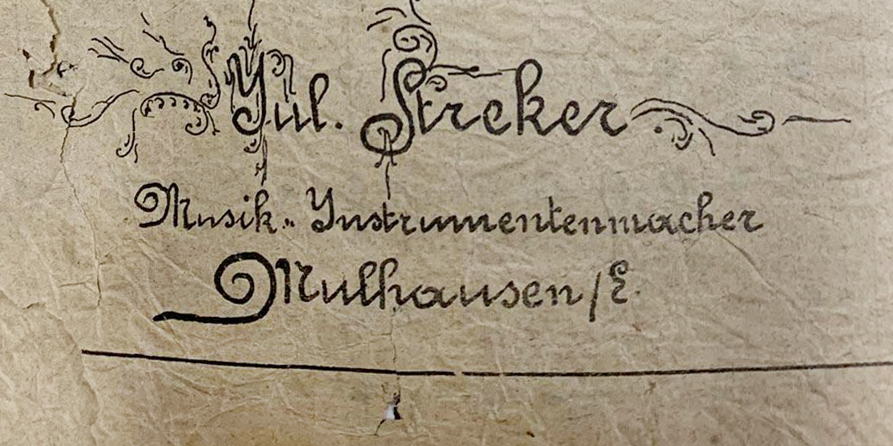
La découverte de la méthode à Vichy Enchères permet de confirmer cela, car elle est bien inscrite “Jul. Streker / Musik Instrumentenmacher / Mulhausen/E”, (E pour Elsaß, Alsace).
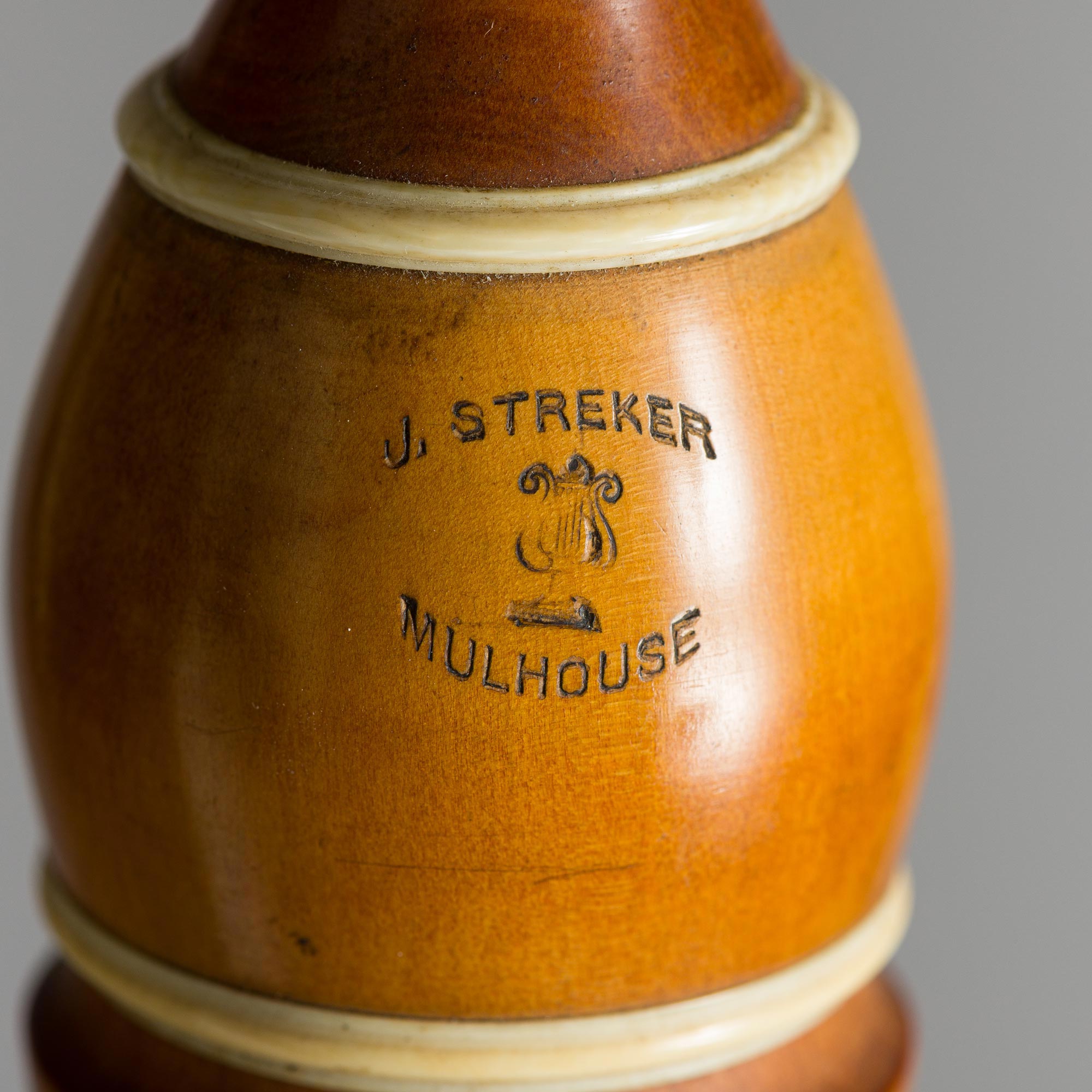
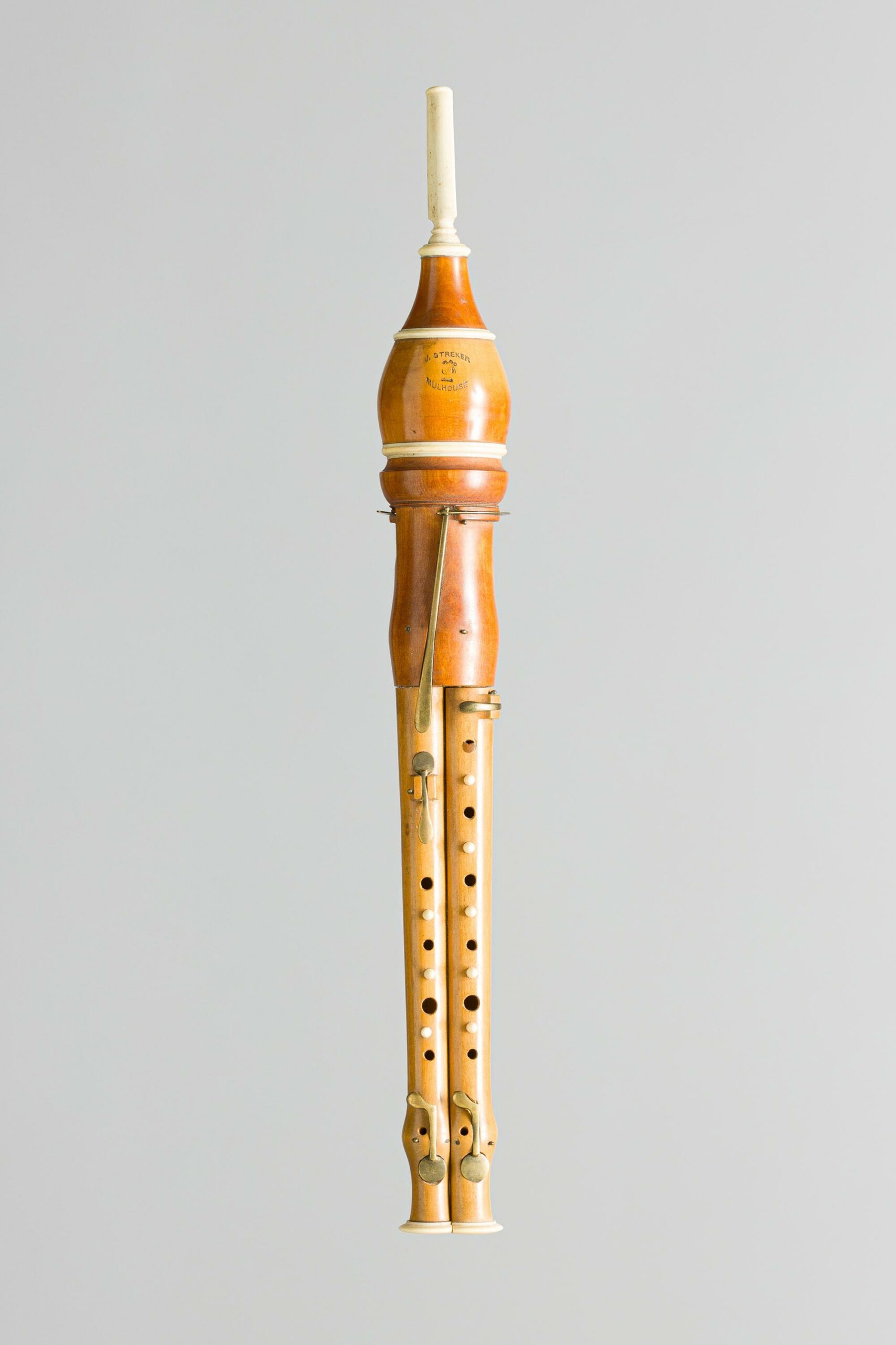
De plus, le flageolet double qui accompagne la méthode porte une estampille en français indiquant “J. STREKER [lyre] MULHOUSE”. L’emploi de la forme française de “Mulhouse” confirme ainsi la localisation de Streker à Mulhouse plutôt qu’à Mühlhausen dans le Vogtland.
Afin d’enrichir cette donnée, nous avons épluché la presse contemporaine de Mulhouse.
[1] William Waterhouse, The New Langwill Index, A Dictionary of Musical Wind-Instrument Makers and Inventors, Tony Bingham, London, 1993
[2] William Waterhouse, “The flageolet double-Made in England”, The Galpin Society Journal, vol. 52, avril 1999, p. 182
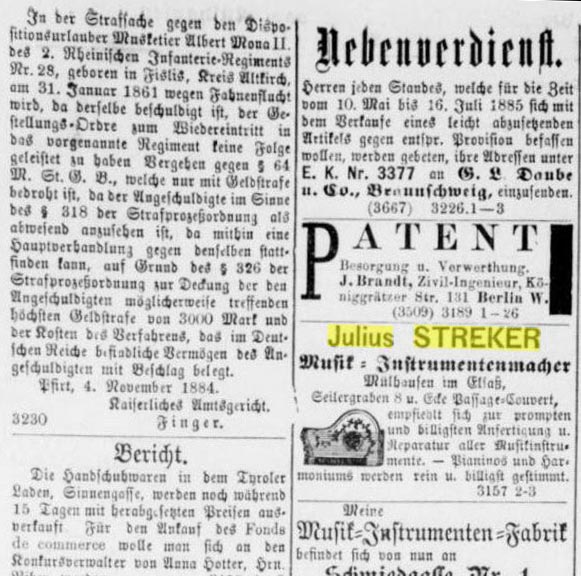
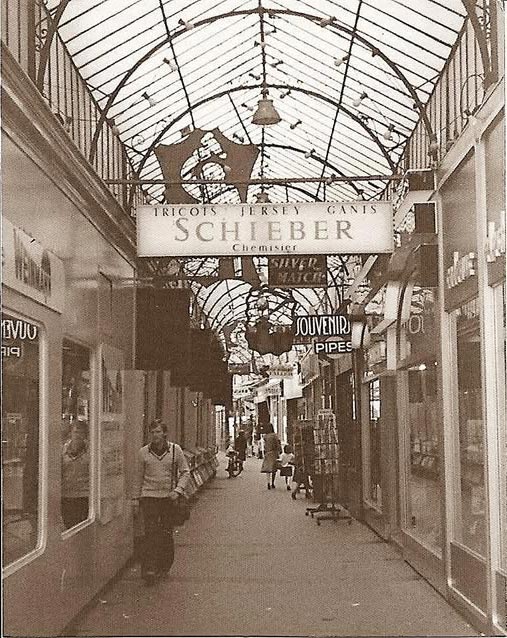
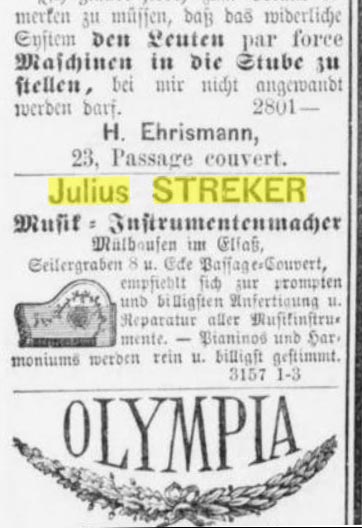
Deux annonces publiées dans la Neue Mülhauser Zeitung, les 1er et 9 novembre 1884, ont permis d’établir précisément son adresse, ainsi que son prénom et sa profession de “Musik-Instrumentenmacher”. Ces annonces donnent l’adresse suivante : “Seilergraben 8 u. Ecke Passage-Couvert, Mülhausen im Elsaß”, c’est-à-dire “8 Seilergraben et angle Passage-Couvert, Mulhouse en Alsace”. Celle-ci correspond aujourd’hui à l’intersection de la rue des Cordiers et du Passage du Théâtre, dans le centre historique de Mulhouse.
Les annonces présentent Streker comme un facteur d’instruments proposant la fabrication et la réparation “rapides et à bon prix de tous les instruments de musique”. Il est également précisé que les pianinos et les harmoniums sont accordés avec soin et à un prix modéré. Il s’occupait donc d’un large panel d’instruments.
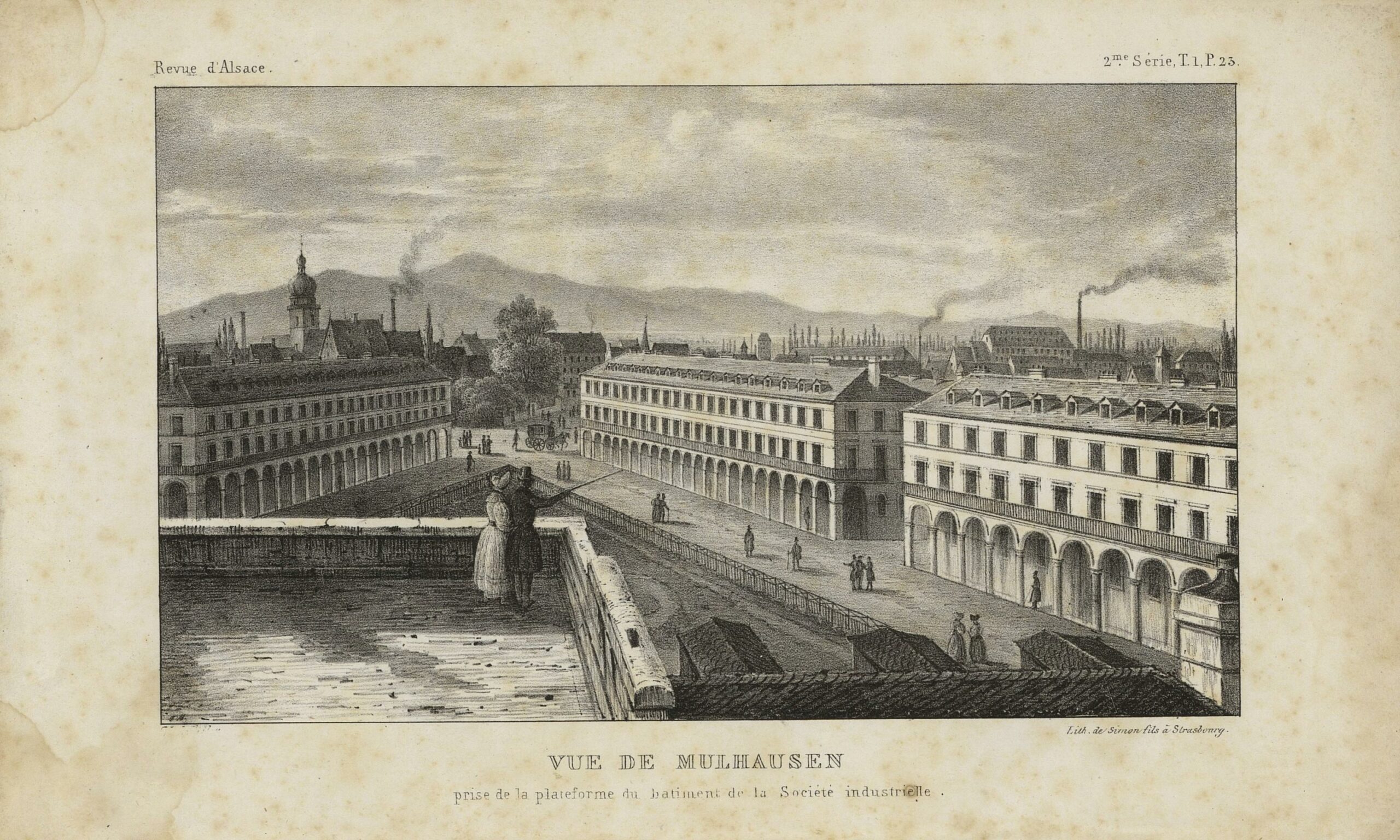
L’activité de Julius Streker s’inscrit dans le contexte commercial et culturel de Mulhouse. Au XIXème siècle, la ville était un important centre industriel, notamment textile et mécanique. L’expansion d’une bourgeoisie urbaine, d’établissements d’enseignement, de sociétés musicales, théâtres et de pratiques domestiques de la musique assurait aux artisans une clientèle aisée.
Après la guerre franco-prussienne et l’annexion de l’Alsace-Lorraine à l’Empire allemand en 1870, Mulhouse prit officiellement le nom de “Mülhausen” – d’où la confusion avec la ville allemande. Mulhouse se développa alors dans un environnement linguistique et culturel complexe, au contact des espaces français, allemand et suisse. La coexistence chez Streker du français – pour les estampilles -, et de l’allemand – pour les annonces -, reflète ce contexte particulier.
Dans son article sur le flageolet double publié dans The Galpin Society, William Waterhouse date justement la méthode pour flageolet de Streker d’après 1870, soit après l’annexion de l’Alsace-Lorraine.
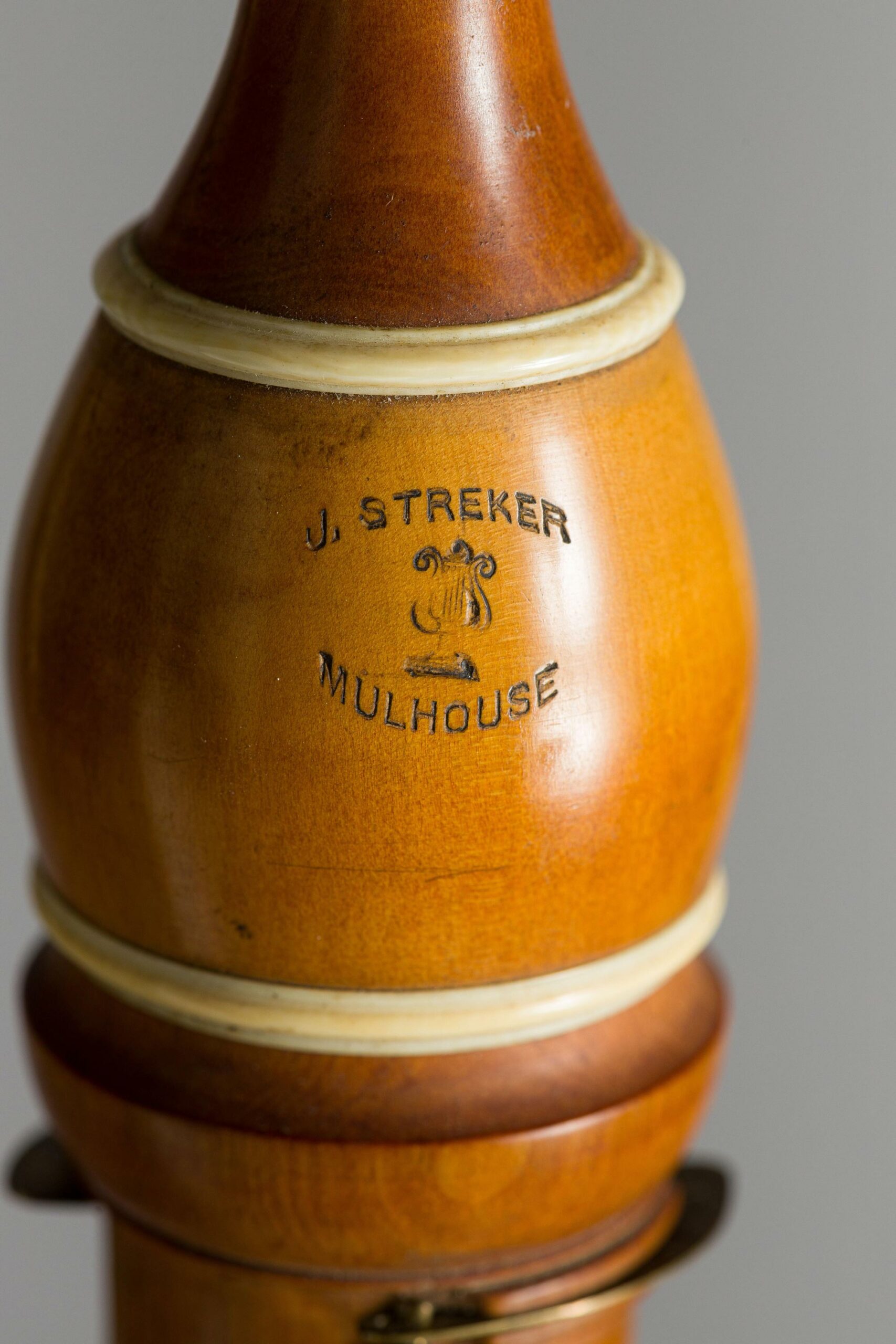
L’estampille du flageolet double de Streker associe l’initiale et le patronyme du facteur, une petite lyre et le nom de la ville où il était établi, soit “J. STREKER [lyre] MULHOUSE”. Le motif de la lyre est intéressant puisqu’il apparaît aussi – parfois plus sous forme de cithare – dans ses annonces publicitaires publiées en 1884. La répétition de cette lyre sur l’instrument et dans la presse laisse donc penser qu’elle était l’emblème, ou le signe distinctif, de sa maison.
Cette correspondance est digne d’intérêt car elle pourrait orienter certaines attributions futures, dans le cadre de découvertes d’instruments à estampille illisible mais présentant une lyre et une facture proches de celle de Julius Streker.
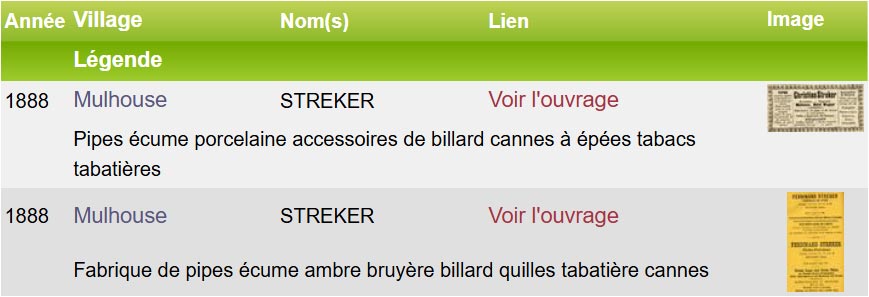
Concernant l’activité et la formation de Julius Streker, des recherches supplémentaires ont permis d’établir de nouvelles hypothèses sur son parcours. En effet, nous avons pu retrouver deux annonces contemporaines publiées dans des journaux de Mulhouse en 1888, qui associent le nom de “Streker” à la fabrication de pipes, de cannes, d’accessoires de billard ou encore de tabatières[1].
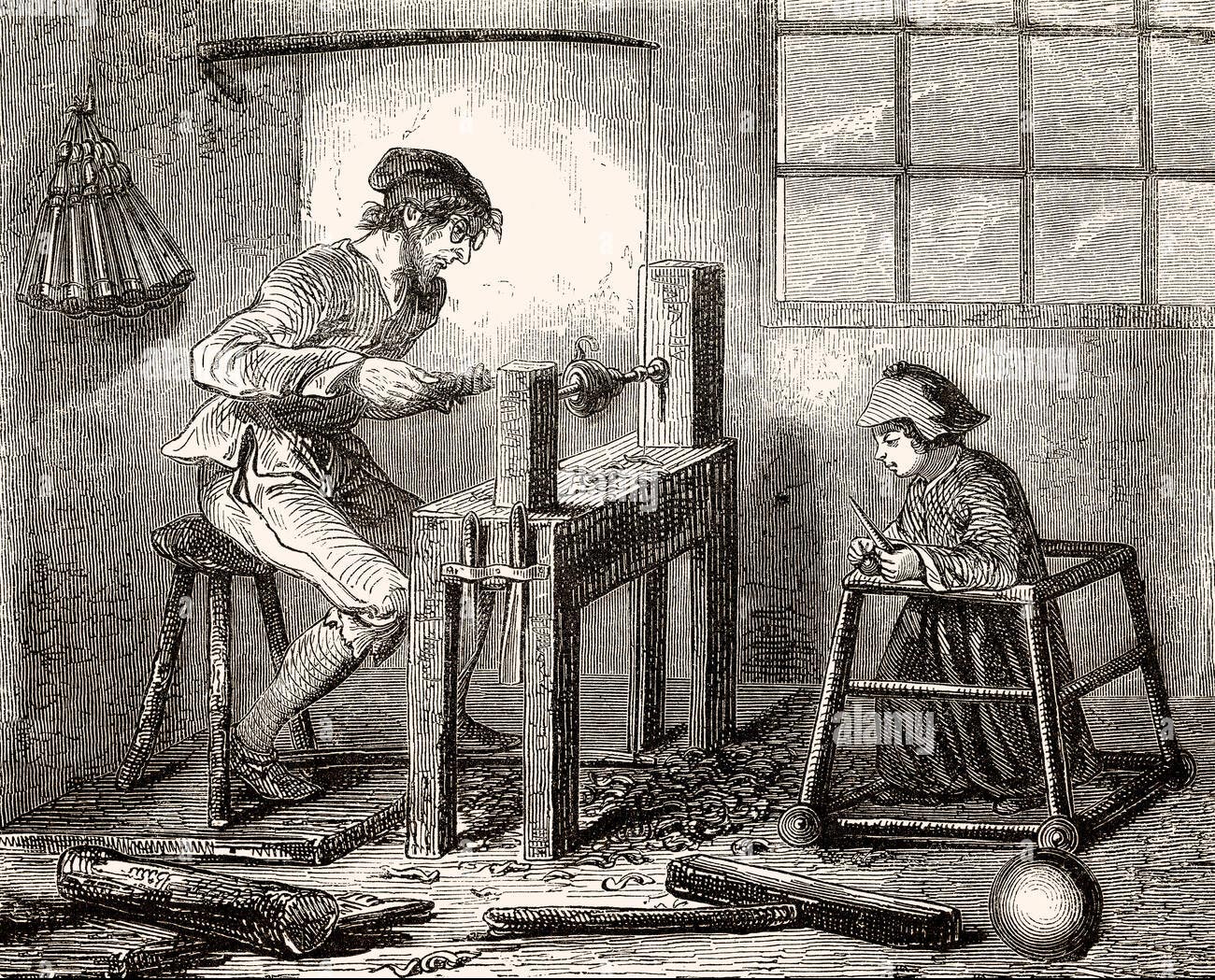
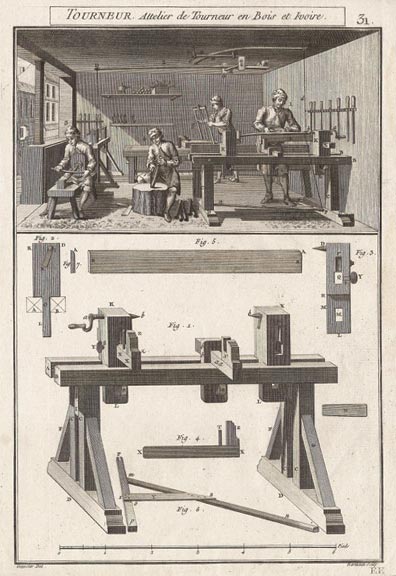
En l’absence de prénom, il est impossible d’affirmer avec certitude qu’elles se rapportent directement à Julius Streker. Mais la concordance entre le nom, le lieu et la période d’activité donnent toutes les raisons de penser que Julius Streker, ou au moins un membre de sa famille, travaillaient les objets tournés.
Ce rapprochement entre les tourneurs de bois et les facteurs d’instruments est d’ailleurs connu dans l’histoire de la facture instrumentale. La fabrication des pipes comme celle des instruments à vent exigeait la maîtrise du tournage et du percement régulier du bois. Plusieurs facteurs importants furent ainsi tourneurs de formation.
A titre d’exemples, Johann Andreas Kinigsperger, facteur de flûtes et de bassons à Roding, semble avoir d’abord appris le métier de tourneur sur bois.
Johann Heitz fut lui aussi tourneur et ébéniste avant d’être nommé, en 1710, “tourneur de la cour royale et des arts, ainsi que fabricant d’instruments de musique”.
Enfin, au XIXème siècle, Charles-Joseph Sax, père d’Adolphe Sax, était également issu du métier de tourneur sur bois. Cette interconnexion se retrouve encore à l’époque de Julius Streker dans le bassin de La Couture-Boussey, où les maisons Lot, Godfroy, Noblet ou Djalma Julliot entretenaient cette tradition de facture instrumentale issue du tournage du buis.
[1] Centre de recherches sur l’histoire des familles du Haut-Rhin, base “Publicités anciennes”, notices “STREKER”, Mulhouse, 1888
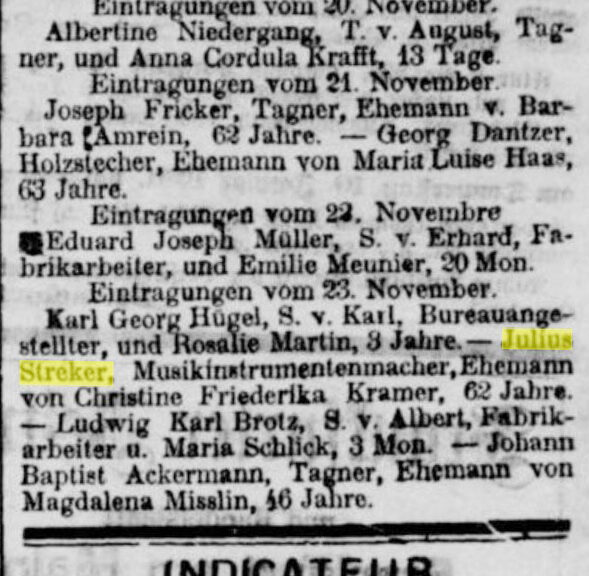
Nos recherches dans les archives ont également permis de retrouver plusieurs informations inédites qui complètent la biographie encore lacunaire de Julius Streker et éclairent la postérité de son activité à Mulhouse. Alors qu’il était jusque-là connu comme actif autour du milieu du XIXème siècle, nous sommes parvenus à retrouver l’enregistrement de son décès à Mulhouse le 23 novembre 1900. Cela est particulièrement intéressant, car l’annonce précise qu’il avait alors 62 ans, ce qui situe sa naissance en 1838. La presse le présente comme facteur d’instruments de musique et époux de Christine Friederika Kramer[1].
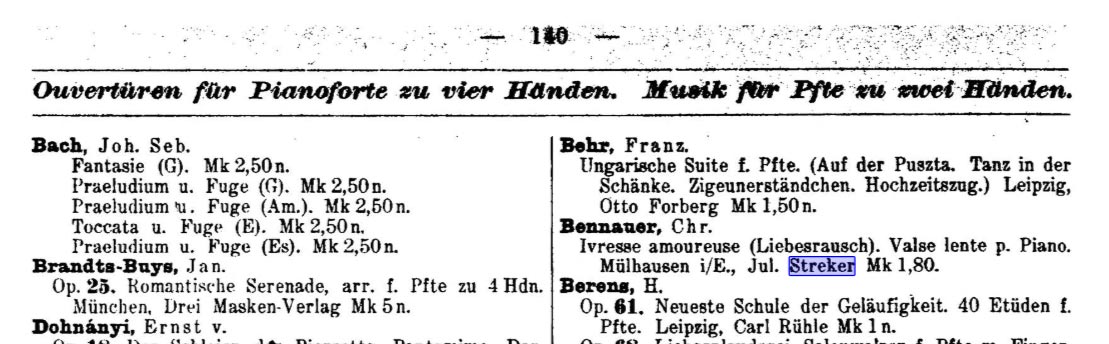
Nous avons également retrouvé la mention de “Jul. Streker” dans le Musikalisch-literarischer Monatsbericht de 1911, comme éditeur à Mulhouse d’Ivresse amoureuse ou Liebesrausch, une valse lente pour piano de Chr. Bennaner[2]. Cette mention peut correspondre au maintien du nom commercial de la Maison ou à la reprise de l’activité par un successeur. Elle montre en tout cas que l’établissement Streker participait également à la diffusion de musique imprimée, dans le prolongement de la méthode de flageolet double signalée par William Waterhouse[3] et aujourd’hui retrouvée à Vichy Enchères.
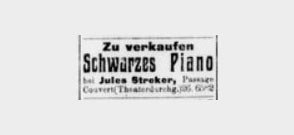
Enfin, nos recherches dans la presse mulhousienne ont fait apparaître un certain Jules Streker, vraisemblablement un fils de Julius, bien que cette filiation reste à confirmer. La mention de “Jul. Streker” comme éditeur d’une valse pour piano en 1911 pourrait ainsi se rapporter à ce successeur, d’autant plus que l’on a aussi retrouvé une annonce de Jules Streker proposant un piano à la vente en 1913[4].
[1] Express, journal politique paraissant à Mulhouse, 9 décembre 1900, rubrique “Todesfälle”, p. 3-4
[2] Musikalisch-literarischer Monatsbericht über neue Musikalien, musikalische Schriften und Abbildungen, Leipzig, Friedrich Hofmeister, 1911, p. 140-141
[3] William Waterhouse, “The flageolet double-Made in England”, The Galpin Society Journal, vol. 52, avril 1999, p. 182
[4] Neue Mülhauser Zeitung, Mulhausen, 8 novembre 1913
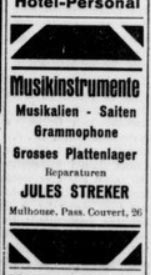
En 1929, il tient au “Passage Couvert, 26”, un commerce d’instruments, de partitions, de cordes, de gramophones et de disques, assurant également les réparations[2]. L’adresse semble être la même ou tout proche de celle de Julius Streker, dans le Passage Couvert (certainement celui du Théâtre). Ces documents dessinent ainsi le profil d’un professionnel particulièrement lié au piano et à la diffusion de musique imprimée. Son activité semble prolonger et élargir celle de Julius – probablement son père -, qui proposait déjà en 1884 la réparation des instruments ainsi que l’entretien et l’accord des pianos et harmoniums.
[2] Der Republikaner, Mülhauser Volkszeitung, Sozialistisches Organ für den Ober-Rhein, 31 juillet 1929
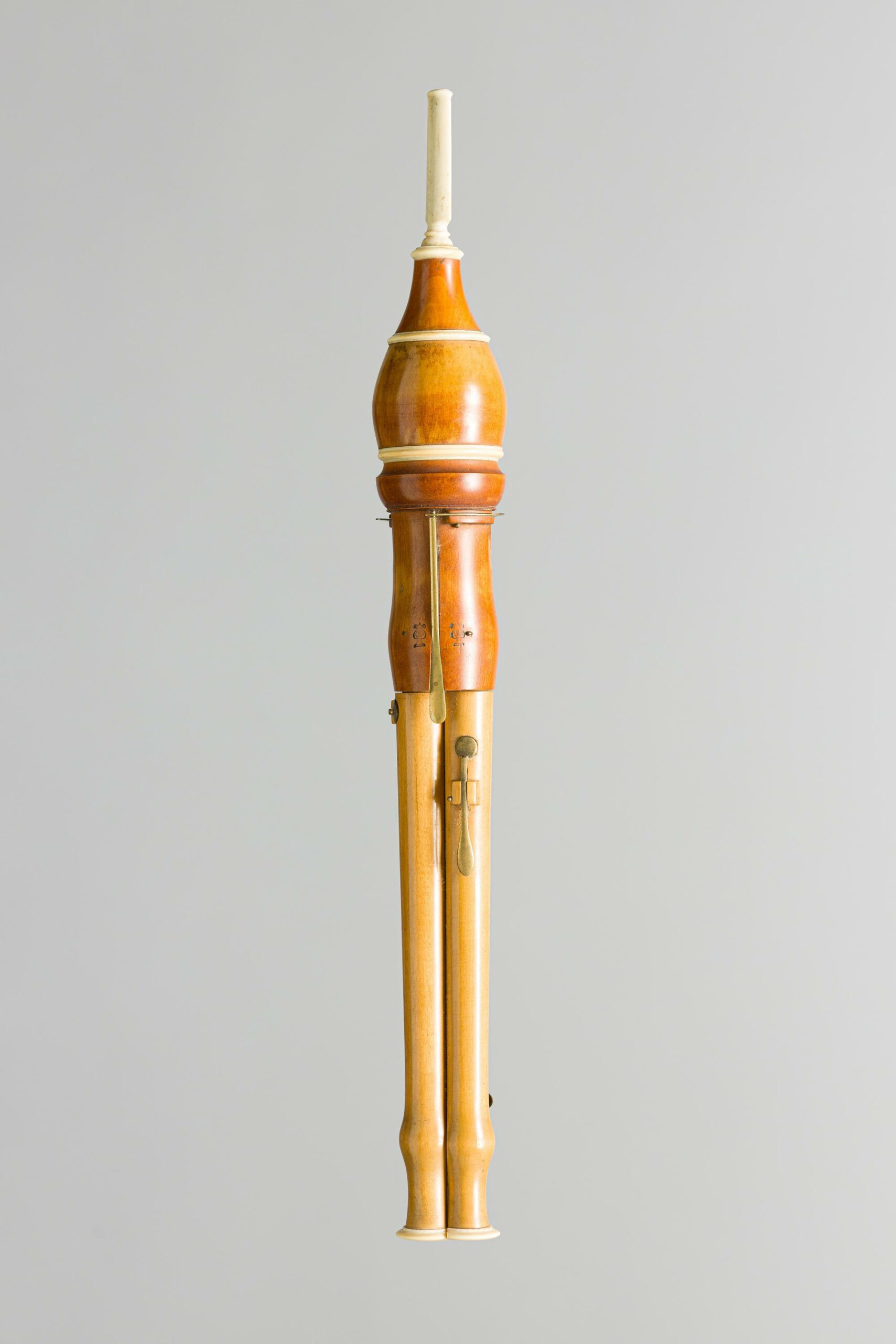
Le flageolet double présenté par Vichy Enchères est réalisé en buis. Ses deux corps parallèles sont reliés à une tête commune chargée de distribuer le souffle. Le facteur devait équilibrer les deux conduits afin que les tuyaux puissent parler simultanément sans que l’un domine constamment l’autre. La régularité des canaux et l’ajustement de la tête étaient par conséquent déterminants pour la réponse de l’instrument[1].
Six clefs en laiton sont montées sur des blocs de bois rapportés.
[1] William Waterhouse, “The flageolet double-Made in England”, The Galpin Society Journal, vol. 52, avril 1999
Elles pouvaient faciliter l’émission des altérations, étendre la tessiture ou corriger l’intonation de certaines notes. La qualité des matériaux employés et de la facture de l’instrument indique que celui-ci était destiné à une clientèle aisée.
Les instruments de Julius Streker sont aujourd’hui presque tous perdus. A l’exception d’un autre modèle signalé sur le site Music Treasures, aucun modèle ne permet d’étudier précisément sa production. Le flageolet double présenté par Vichy Enchères revêt donc une importance patrimoniale majeure, d’autant plus qu’il conserve sa méthode manuscrite originale.
William Waterhouse signale en 1993, dans le Langwill, une Grifftabelle, ou tablature de doigtés, destinée aux flageolets doubles de Julius Streker et supposément conservée à la Bayerische Staatsbibliothek de Munich. Cette localisation n’a cependant pas pu être confirmée. À notre demande, les documentalistes de la bibliothèque ont effectué des recherches dans leurs fonds sans retrouver le document ni aucune cote correspondant. La piste du Deutsches Museum de Munich et celle des archives William Waterhouse, conservées au Royal Northern College of Music, n’ont pas davantage abouti. La Bayerische Staatsbibliothek ayant par ailleurs confirmé qu’elle conservait de façon pérenne ses collections, l’hypothèse d’une vente ou d’une élimination du document paraît devoir être écartée[1].
[1] Nous remercions Uta Schaumberg de la Bayerische Staatsbibliothek de Munich et Heather Roberts du Royal Northern College of Music pour leurs recherches dans leurs collections
La localisation donnée en 1993 par Waterhouse semble donc résulter d’une confusion ou d’une information impossible à vérifier. En 1999, nous l’avons vu, Waterhouse mentionne cette méthode de Streker intitulée “Schule zur gründlichen und schnellen Erlernung des Doppelflageolets”, qu’il date d’après 1870 et qu’il situe à “Mülhausen/Elsaß”, sans reprendre la localisation munichoise. Le titre, le lieu et la datation correspondent précisément aux indications portées par la méthode conservée avec le flageolet double présenté par Vichy Enchères. Il est dès lors possible que la Grifftabelle citée en 1993 et la méthode mentionnée en 1999 désignent un seul et même document et que Waterhouse ait rectifié implicitement sa première notice de 1993, dans sa note de 1999.
Dès son apparition, le flageolet double fut accompagné de publications pédagogiques. La méthode de John Purkis contribua à la diffusion du modèle breveté par Scott, tandis que John Bainbridge publia des instructions adaptées à ses propres instruments.
Ces ouvrages répondaient à une difficulté concrète, puisque les doigtés d’un instrument double ne pouvaient pas être simplement déduits de ceux du flageolet ordinaire[1].
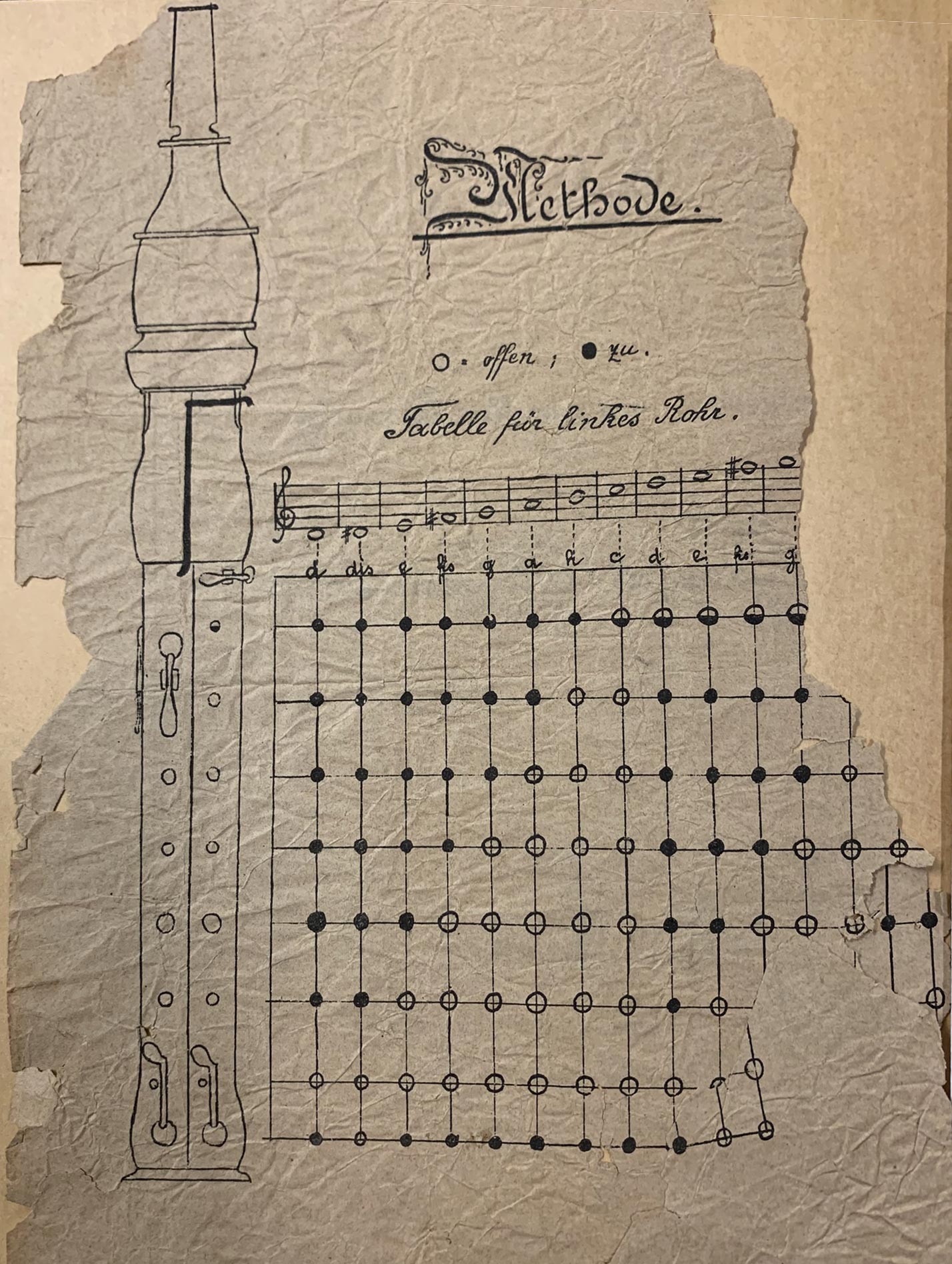
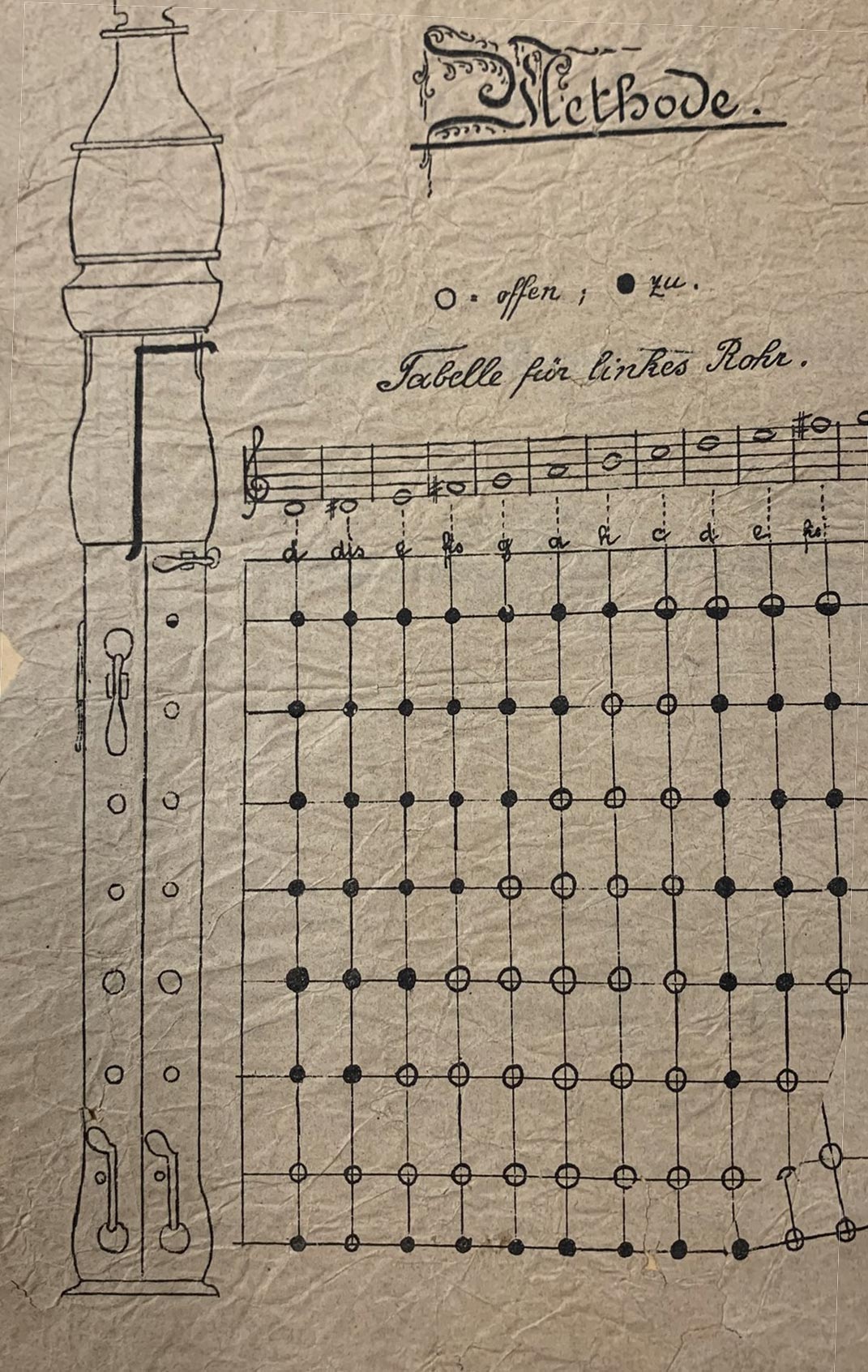
La méthode manuscrite conservée avec l’instrument de Vichy Enchères s’inscrit dans cette tradition. Rédigée en allemand, elle comprend une tablature consacrée au tuyau gauche, désigné par la mention Tabelle für linkes Rohr.
Un dessin représente le corps de l’instrument, ses trous et ses clefs.
[1] John Purkis, Scott & Purkis’s Delecta Harmonia or Patent Double-Flageolet, Londres, vers 1806
La légende “o = offen” ; “● = zu” indique qu’un cercle vide correspond à un trou ou à une clef ouverts, tandis qu’un disque noir signale un trou bouché ou une clef pressée.
Les doigtés sont associés aux notes inscrites sur une portée et à leur désignation alphabétique germanique.
Une telle tablature constitue une représentation condensée du fonctionnement acoustique de l’instrument. Elle permet d’établir la correspondance entre les sons recherchés, le tuyau employé et les clefs à actionner. Elle était d’autant plus nécessaire que les flageolets doubles ne furent jamais complètement uniformisés. L’accord des tuyaux, le nombre de clefs, la tessiture et la disposition des trous pouvaient varier selon les facteurs. Une table de doigtés n’était donc pas nécessairement adaptée à tous les modèles[1].
[1] William Waterhouse, “The flageolet double-Made in England”, The Galpin Society Journal, vol. 52, avril 1999
La situation de Mulhouse donne à cet ensemble un intérêt particulier. Inventé en Angleterre en 1805, le flageolet double connaît pendant près d’un demi-siècle un succès qui dépasse rapidement Londres et Dublin. William Bainbridge tenta de protéger son invention en France, mais celle-ci fut copiée sur le continent, principalement par des facteurs allemands[1]. Waterhouse relève plusieurs indices de cette diffusion germanique. Un dessin accompagné d’une table de doigtés, aujourd’hui conservé à Markneukirchen, aurait servi de modèle aux facteurs du Vogtland. Un flageolet double figure également dans le tarif illustré des marchands I. Kampffens Söhne, actifs à Neukirchen vers 1830.
[1] William Waterhouse, “The flageolet double-Made in England”, The Galpin Society Journal, vol. 52, avril 1999
À Göttingen, le facteur Georg Streitwolf conçut sa propre variante et publia une Tabelle nebst 14 Uebungsstücken für das Doppel-Flageolet.
Waterhouse recense enfin des instruments signés par Gerhard Hanniecke à Oldenburg, Jacob David Helwert et Carl August Schaufler à Stuttgart, Johann Andreas Mollenhauer à Fulda, et bien sûr, la méthode de Julius Streker aujourd’hui retrouvée à Vichy Enchères[1].
L’instrument de Streker appartient donc à une véritable tradition continentale, nourrie par les modèles anglais mais adaptée par les ateliers germaniques. Mulhouse occupait toutefois une position singulière, à la rencontre des espaces français, allemands et suisses. Cette situation se lit directement sur l’ensemble conservé, puisque Streker publie ses annonces en allemand sous la désignation de Musik-Instrumentenmacher à “Mülhausen im Elsass”, que sa méthode emploie l’allemand mais que l’instrument porte l’estampille française.
[1] William Waterhouse, “The flageolet double-Made in England”, The Galpin Society Journal, vol. 52, avril 1999
Ce flageolet double se révèle ainsi à nous comme un témoignage particulièrement rare de l’activité de Julius Streker. Les recherches menées dans la presse permettent désormais de mieux situer ce facteur, né certainement en 1838, établi à Mulhouse et mort en 1900, et dont l’activité semble avoir été prolongée par Jules Streker. Elles révèlent un atelier polyvalent, associé à la fabrication et à la réparation des instruments, à l’entretien des pianos et harmoniums, puis à la diffusion de partitions et au commerce musical. L’importance patrimoniale de l’ensemble tient surtout à la conservation conjointe de l’instrument et de sa méthode manuscrite. Son titre, son lieu d’origine et sa datation correspondent exactement à la méthode signalée par William Waterhouse en 1999. Bien que l’on ne puisse établir avec certitude son rapport avec la Grifftabelle mentionnée en 1993, aujourd’hui introuvable, ce document apporte une preuve matérielle essentielle de la production de Streker. Cet ensemble documente non seulement un facteur encore peu connu, mais aussi la circulation continentale d’un instrument inventé en Angleterre. À travers sa facture, son estampille française et sa méthode allemande, il reflète pleinement la situation culturelle de Mulhouse à la fin du XIXème siècle.
As is the case every year, our instrument auctions provide an opportunity to showcase lesser-known instruments or makers. On 7 November 2026, Vichy Enchères will present a double flageolet bearing the stamp “J. STREKER [lyre] MULHOUSE”. The instrument comes with its case, a manuscript method by Streker titled Schule zur gründlichen und schnellen Erlernung des Doppelflageolets, and an old fingering chart. Until now, very little documentation existed regarding Julius Streker. His name and his production of double flageolets were known primarily through an entry by William Waterhouse in The New Langwill Index in 1993, and a note by the same author in The Galpin Society Journal in 1999. While this note might seem anecdotal, it happens to mention the very method accompanying the instrument in the upcoming Vichy Enchères sale. This is of particular historical and cultural significance, as it had not been previously possible to find copy of it. Its discovery is therefore exceptional, providing a unique and tangible piece of evidence of Julius Streker’s work. The discovery of this set sparked further research into Streker, which allowed to shed light on his identity and activity, as well as his professional legacy, while placing his instruments within the history of the double flageolet’s spread across the continent.
The primary source of information regarding Julius Streker is William Waterhouse’s New Langwill Index of 1993[1] , which only provides summary information about him. In it, Waterhouse situates his activity in Mühlhausen, in the Vogtland region of Germany, around the mid-19th century. In a 1999 article dedicated to the English double flageolet, Waterhouse mentions Streker in a footnote, noting the existence of a double flageolet method written by the maker titled Schule zur gründlichen und schnellen Erlernung des Doppelflageoletts (a method for learning the double flageolet, including a fingering chart). He specifies that it was written around 1870 in “Mülhausen/Elsaß”[2], ], but does not provide its location. This note is particularly interesting because it includes the exact title of the method accompanying the instrument being sold at Vichy Enchères, even though there weren’t any extant copies of it known until now. It is also significant because, contrary to what Waterhouse had written in the Langwill, it places the writing of the method in “Mülhausen/Elsaß”, in other words in Mulhouse in the Alsace region, rather than Mühlhausen in the Vogtland region.
The discovery of the method at Vichy Enchères confirms this, as it bears the inscription “Jul. Streker / Musik Instrumentenmacher / Mulhausen/E” (in which E stands for Elsaß/Alsace).
Furthermore, the double flageolet accompanying the method bears a stamp in French reading “J. STREKER [lyre] MULHOUSE”. The use of the French form “Mulhouse” thus confirms that Streker was based in Mulhouse rather than in Mühlhausen in the Vogtland region.
To flesh out this information, we combed through the contemporary press of Mulhouse.
[1] William Waterhouse, The New Langwill Index, A Dictionary of Musical Wind-Instrument Makers and Inventors, Tony Bingham, London, 1993
[2] William Waterhouse, “The flageolet double-Made in England”, The Galpin Society Journal, vol. 52, avril 1999, p. 182
Two advertisements, published in the Neue Mülhauser Zeitung on 1 and 9 November 1884, made it possible to determine his address, as well as his first name and his profession as a “Musik-Instrumentenmacher”. These advertisements list the following address: “Seilergraben 8 u. Ecke Passage-Couvert, Mülhausen im Elsaß”, i.e. “8 Seilergraben and the corner of Passage-Couvert, Mulhouse in Alsace”. This location corresponds today to the intersection of rue des Cordiers and Passage du Théâtre in Mulhouse’s historic centre.
The advertisements present Streker as an instrument maker offering “fast and reasonably priced” manufacturing and repair services for “all musical instruments”. They also mention that upright pianos and harmoniums were tuned with care and for a moderate fee. He therefore handled a wide range of instruments.
Julius Streker carried out his activities within the commercial and cultural environment of Mulhouse. In the 19th century, the city was a major industrial hub, particularly in the textile and mechanical sectors. The growth of an urban middle class, educational institutions, musical societies, theatres and music-making in domestic settings provided a wealthy clientele for craftsmen.
Following the Franco-Prussian War and the annexation of Alsace-Lorraine by the German Empire in 1870, Mulhouse officially adopted the name of “Mülhausen” – hence the confusion with the German city of the same name. Mulhouse subsequently developed within a complex linguistic and cultural environment, at the confluence of France, Germany and Switzerland. The coexistence of Streker’s use of French, for the instrument’s stamps, and German, for advertisements, reflects this particular context.
In his article on the double flageolet published in The Galpin Society Journal, William Waterhouse correctly dates Streker’s flageolet method book to after 1870, i.e. after the annexation of Alsace-Lorraine.
The stamp on Streker’s double flageolet features the maker’s initial and surname, a small lyre, and the name of the city where he was based, i.e. “J. STREKER [lyre] MULHOUSE”. The lyre motif is noteworthy, as it also appears – sometimes rather in the form of a zither – in advertisements he published in 1884. The recurrence of this lyre on the instrument and in the press suggests it was the emblem, or distinctive brand mark, of his firm.
This feature is significant, as it could inform future attributions, regarding instruments with illegible stamps that nonetheless feature a lyre and craftsmanship similar to that of Julius Streker.
Further research into Julius Streker’s activities and training has led to new theories regarding his career path. We found two contemporary advertisements published in Mulhouse newspapers in 1888 that associate the name “Streker” with the manufacture of pipes, walking sticks, billiard accessories and snuffboxes[1].
As the first name is not mentioned, it is impossible to be certain that these advertisements refer indeed to Julius Streker. However, the matching name, location and period of activity strongly suggest that Julius Streker, or at least a member of his family, worked with turned objects..
This connection between wood turners and instrument makers is well established in the history of instrument making. Manufacturing pipes, much like making wind instruments, required mastery of wood turning, and precise and uniform boring. Consequently, several prominent makers began their careers as turners.
For instance, Johann Andreas Kinigsperger, a maker of flutes and bassoons in Roding, appears to have first learned the trade of wood turning.
Johann Heitz was also a turner and cabinetmaker before being appointed, in 1710, as « royal court and arts turner, as well as musical instrument maker ».
Finally, in the 19th century, Charles-Joseph Sax, Adolphe Sax’s father, also came from a background in wood turning. This connection was also in evidence, during Julius Streker’s time, in the instrument making cradle of La Couture-Boussey, where firms such as Lot, Godfroy, Noblet and Djalma Julliot upheld a tradition of instrument making rooted in boxwood turning.
[1] Centre de recherches sur l’histoire des familles du Haut-Rhin, base “Publicités anciennes”, notices “STREKER”, Mulhouse, 1888
Our research into historical archives also uncovered previously unknown information that fills gaps in Julius Streker’s biography, and sheds light on the legacy of his work in Mulhouse. While he was previously known to have been active around the mid-19th century, we managed to find the record of his death in Mulhouse on 23 November 1900. This is particularly interesting because the notice specifies that he was 62 years old at the time, placing his birth in 1838. The press described him as a musical instrument maker and the husband of Christine Friederika Kramer[1].
We also found a reference to “Jul. Streker” in the Musikalisch-literarischer Monatsbericht of 1911, as the Mulhouse-based publisher of Ivresse amoureuse, or Liebesrausch, a slow waltz for piano by Chr. Bennaner[2]. This entry could indicate either the continued use of the firm’s trade name, or the takeover of the business by a successor. In any case, it demonstrates that the firm of Streker was also involved in the distribution of printed music, an extension of the double flageolet method mentioned by William Waterhouse[3] and recently rediscovered at Vichy Enchères.
Finally, our research into the Mulhouse press revealed a certain Jules Streker, likely a son of Julius, though this lineage remains to be confirmed. The reference to “Jul. Streker” as the publisher of a piano waltz in 1911 might therefore correspond to this successor, especially given that we also found an advertisement from 1913 in which Jules Streker offered a piano for sale[4].
[1] Express, journal politique paraissant à Mulhouse, 9 décembre 1900, rubrique “Todesfälle”, p. 3-4
[2] Musikalisch-literarischer Monatsbericht über neue Musikalien, musikalische Schriften und Abbildungen, Leipzig, Friedrich Hofmeister, 1911, p. 140-141
[3] William Waterhouse, “The flageolet double-Made in England”, The Galpin Society Journal, vol. 52, avril 1999, p. 182
[4] Neue Mülhauser Zeitung, Mulhausen, 8 novembre 1913
In 1929, he ran a shop at “Passage Couvert, 26” selling instruments, sheet music, strings, gramophones and records, while also providing repair services[2]. The address appears to be the same as, or very close to, that of Julius Streker in the Passage Couvert (almost certainly that of the Théâtre). These documents therefore paint the picture of a professional closely linked to the piano and the distribution of printed music. His activities seemed to have continued and expanded upon those of Julius – likely his father – who, as early as 1884, offered instrument repairs as well as the maintenance and tuning of pianos and harmoniums.
[2] Der Republikaner, Mülhauser Volkszeitung, Sozialistisches Organ für den Ober-Rhein, 31 juillet 1929
The double flageolet presented by Vichy Enchères is made of boxwood. Its two parallel bodies are connected to a common head designed to distribute the player’s breath. The maker had to balance the two conduits so that the pipes could sound simultaneously without one consistently overpowering the other. The uniformity of the channels and the set-up of the head were therefore crucial to the instrument’s response[1].
Six brass keys are mounted on applied wooden blocks.
[1] William Waterhouse, “The flageolet double-Made in England”, The Galpin Society Journal, vol. 52, avril 1999
They allowed to play accidentals, extended the range, and corrected the intonation of certain notes. The quality of the materials used and the instrument’s craftsmanship indicate that it was intended for a wealthy clientele.
Almost all of Julius Streker’s instruments are now lost. With the exception of another example mentioned on the website Music Treasures, there are no surviving examples that would allow for a detailed study of his output. The double flageolet presented by Vichy Enchères is therefore of major cultural significance, especially as it retains its original manuscript method book.
In 1993, in the Langwill, William Waterhouse noted the existence of a Grifftabelle, i.e. fingering chart, designed for Julius Streker’s double flageolets, supposedly held at the Bayerische Staatsbibliothek in Munich. However, this location could not be confirmed. At our request, the library’s information specialists searched their archives but did not find either the document or any reference to it. Leads involving the Deutsches Museum in Munich and the William Waterhouse archives, held at the Royal Northern College of Music, also proved fruitless. Furthermore, given that the Bayerische Staatsbibliothek indicated that it permanently retains its collections, the theory that the document was sold or discarded could be safely ruled out[1].
[1] Nous remercions Uta Schaumberg de la Bayerische Staatsbibliothek de Munich et Heather Roberts du Royal Northern College of Music pour leurs recherches dans leurs collections
The location indicated by Waterhouse in 1993 therefore seems to result from some confusion, or information that cannot be ascertained. As previously noted, in 1999 Waterhouse mentioned this method by Streker, titled “Schule zur gründlichen und schnellen Erlernung des Doppelflageolets”, dating it to after 1870 and placing its origin in « Mülhausen/Elsaß », without making reference again to its supposed location in Munich. The title, location and date correspond precisely to the indications found on the method kept with the double flageolet offered by Vichy Enchères. It is therefore possible that the Grifftabelle cited in 1993 and the method mentioned in 1999 refer to the same document, and that Waterhouse implicitly corrected his initial entry of 1993 in the one he made in 1999.
From its advent, the double flageolet was accompanied by educational publications. John Purkis’s method helped popularize the model patented by Scott, while John Bainbridge published instructions tailored to his own instruments.
These works addressed a practical challenge, as the fingerings for a double instrument could not simply be deduced from those of the standard flageolet[1].
The manuscript method preserved alongside the instrument at Vichy Enchères belongs to this tradition. Written in German, it includes a fingering chart for the left pipe, titled Tabelle für linkes Rohr.
A drawing depicts the instrument’s body, its holes and its keys.
[1] John Purkis, Scott & Purkis’s Delecta Harmonia or Patent Double-Flageolet, Londres, vers 1806
The legend “o = offen” and “● = zu” indicates that an open circle corresponds to an open hole or key, while a solid black circle signifies a closed hole or a depressed key.
The fingerings are associated with the corresponding notes written on a musical staff and to their German alphabetical designations.
Such a chart serves as a condensed representation of the instrument’s acoustic operation. It establishes the relationship between the desired notes, the specific pipe used, and the keys to be operated. This was all the more necessary since double flageolets were never fully standardized. The tuning of the pipes, number of keys, note range and placement of holes could vary from one maker to another. Consequently, a given fingering chart was not necessarily suitable for every model[1].
[1] William Waterhouse, “The flageolet double-Made in England”, The Galpin Society Journal, vol. 52, avril 1999
The location of Mulhouse lends this set a particular interest. Invented in England in 1805, the double flageolet enjoyed success for nearly half a century, and this success quickly spread beyond London and Dublin. William Bainbridge attempted to patent his invention in France, but it was copied on the continent, primarily by German makers[1]. Waterhouse noted several signs of this spread in Germany. A drawing accompanied by a fingering chart, now held in Markneukirchen, is believed to have served as a model for makers in the Vogtland region. A double flageolet also appears in the illustrated catalogue of the merchants I. Kampffens Söhne, who were active in Neukirchen around 1830.
[1] William Waterhouse, “The flageolet double-Made in England”, The Galpin Society Journal, vol. 52, avril 1999
In Göttingen, the maker Georg Streitwolf designed his own variant and published a Tabelle nebst 14 Uebungsstücken für das Doppel-Flageolet.
Finally, Waterhouse lists instruments signed by Gerhard Hanniecke in Oldenburg, Jacob David Helwert and Carl August Schaufler in Stuttgart, and Johann Andreas Mollenhauer in Fulda, as well as, of course, the method book by Julius Streker that recently resurfaced at Vichy Enchères[1].
The instrument by Streker thus belongs to a genuine continental tradition, inspired by English models which were adapted by German workshops. Mulhouse, however, occupied a unique position at the confluence of France, Germany and Switzerland. This position is clearly in evidence in the surviving material, as Streker published advertisements in German, identifying himself as a Musik-Instrumentenmacher in « Mülhausen im Elsass », and also wrote his method book in German, but the instrument bears a maker’s stamp in French.
[1] William Waterhouse, “The flageolet double-Made in England”, The Galpin Society Journal, vol. 52, avril 1999
This double flageolet thus stands as a particularly rare testament to the work of Julius Streker. Research conducted into press archives has shed new light on this instrument maker – likely born in 1838, based in Mulhouse and deceased in 1900 – whose business appears to have been continued by Jules Streker. It reveals a multifaceted workshop involved in instrument manufacturing and repair, the maintenance of pianos and harmoniums, and then the distribution of sheet music and the music trade. The collection’s significance as cultural heritage lies primarily in the joint preservation of the instrument and its accompanying manuscript method book. Its title, place of origin and date correspond exactly to the method mentioned by William Waterhouse in 1999. Although its connection to the – now lost – Grifftabelle noted in 1993 cannot be established with certainty, this document provides vital tangible evidence of Streker’s output. This collection documents not only a little-known maker but also the spread across the continent of an instrument invented in England. Through its construction, maker’s mark in French and method book in German, it perfectly embodies the cultural position of Mulhouse in the late 19th century.